HEPLANET Weekly Heavy Equipment Market Report: Fuel, Auctions, Used Equipment & Fleet Strategy

Week of May 26–June 1, 2026
Fuel volatility, used-equipment pricing, auction movement, equipment finance, rental strategy, parts support, mining demand, infrastructure work, and future technology all moved through the heavy equipment market at the same time this week.
For contractors, fleet owners, rental companies, dealers, exporters, repair shops, parts suppliers, and equipment buyers, the message is clear: equipment decisions are no longer being shaped by purchase price alone.
The real market is being shaped by operating cost, fuel exposure, resale value, machine supportability, parts availability, financing conditions, regional demand, auction results, technician capacity, and the ability to keep machines working when jobsites get more expensive and more complicated.
This weekly HEPLANET report connects the market signals behind heavy equipment ownership, used equipment values, construction demand, mining activity, rental strategy, technology, and fleet economics.
1. Fuel, Oil, Diesel, and Geopolitical Risk
Fuel was the most immediate fleet-cost signal this week.
Oil and diesel prices are not abstract market numbers for contractors. They affect bids, hauling costs, paving margins, quarry production, mining operations, trucking, equipment utilization, rental decisions, and whether a fleet owner repairs a machine, rents a replacement, or delays work.
Oil markets remained volatile as traders watched Middle East supply risk, U.S.-Iran tension, shipping concerns, and global crude movement. U.S. crude exports also surged as global buyers looked for alternate supply during disruption in energy markets.
For heavy equipment owners, that kind of oil-market instability can quickly move into diesel costs, freight rates, parts shipping, asphalt costs, aggregate hauling, and project pricing.
A recent contractor survey also showed that many construction companies have already made operating or pricing changes because of diesel costs, including raising bid prices, changing hourly rates, or adding fuel surcharges.
That matters because fuel is not only a cost line. It changes behavior.
A contractor facing higher diesel prices may tighten dispatch, reduce idle time, consolidate trucking, increase fuel surcharges, raise bids, delay low-margin work, or rent instead of buying additional machines. A quarry may watch cost per ton more closely. A paving contractor may reprice jobs faster. A hauler may become more selective about routes. A rental company may see more demand from contractors who need machines but do not want to commit capital in an uncertain cost environment.
Fuel volatility also affects machine-category decisions. Large dozers, wheel loaders, haul trucks, articulated trucks, excavators, paving machines, crushers, screens, service trucks, and support equipment all face different fuel exposure. Even compact machines matter when they affect jobsite timing, truck waiting time, trenching productivity, or crew efficiency.
This is why fuel belongs inside fleet strategy, not just inside an energy-market headline.
Reader takeaway: when diesel moves, equipment economics move. Contractors should review bid assumptions, idle-time discipline, hauling exposure, fuel surcharge language, rental options, and repair-versus-replace decisions before fuel volatility turns into margin loss.
2. Used Equipment, Auctions, Resale Values, and Equipment-Market Channels
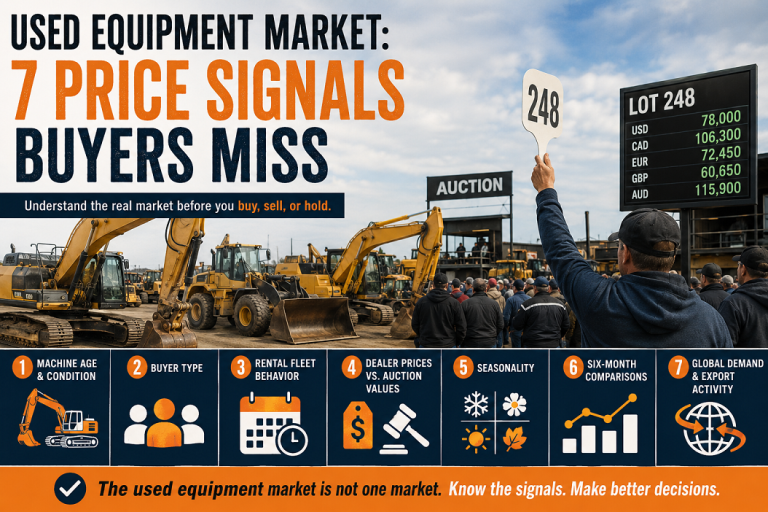
Used equipment should not be treated as one single market.
Buyers looking at auction machines should also review our Used Excavator Inspection Guide and Buying Used Heavy Equipment at Auction coverage before bidding.
A 10-year-old Komatsu PC200 with 10,000 hours can bring one value at auction, another value in a private contractor sale, another value through an independent reseller, and another value through a dealer. The machine may be the same model, but the sales environment changes the price.
At auction, value is shaped by timing, condition, inspection limits, bidder interest, auction momentum, and who happens to be participating that day. A clean machine with the right bidders in the room can exceed expectations. A good machine offered at the wrong time, in the wrong region, or with limited buyer attention may sell below what it could have brought elsewhere.
In a private contractor sale, the value depends more heavily on the seller’s situation. Is the contractor trying to raise cash quickly? Is the machine still working every day? Is the seller willing to wait for the right buyer? How many serious buyers will even see the listing? Private-sale pricing can be attractive for buyers, but the reach, financing options, inspection quality, and buyer confidence are usually limited.
Independent resellers sit in the middle. They often buy machines through auctions, contractors, trade packages, or dealer channels, then clean them up, market them better, and resell them at a higher price. That does not automatically mean they are doing anything wrong. Presentation matters in used equipment. But a reseller usually does not bring the same financing programs, warranty support, technician depth, parts infrastructure, or manufacturer-backed reputation that a dealer can bring.
Dealer-used equipment normally commands the highest price because the buyer is not only buying the machine. The buyer is also buying confidence. That confidence may include the dealer’s inspection process, service department, trained technicians, parts access, financing options, certified-used programs, warranty possibilities, manufacturer relationship, and reputation. A contractor may knowingly pay more for a dealer machine because if that machine goes to a jobsite and fails, the dealer relationship gives the buyer a level of recourse that usually does not exist after an auction, private sale, or lower-support reseller transaction.
Brand demand also affects used-equipment pricing, but it should be understood carefully. A higher resale price does not automatically mean one machine is mechanically better than another. In many cases, resale strength reflects buyer familiarity, global demand, dealer network depth, parts availability, technician support, financing confidence, and the number of buyers willing to compete for that brand or model.
That matters at auction because auctions are demand environments. If a machine attracts a larger buyer pool — including contractors, dealers, exporters, rental companies, and international buyers — it may bring a stronger price even if another comparable machine could perform the same work very well. A production-focused contractor may care most about whether the machine is reliable, properly priced, and ready to work. A larger contractor with a longer ownership strategy may place more value on dealer support, parts availability, technician access, uptime confidence, warranty or certified-used options, and future resale liquidity.
This is why used-equipment value should not be read as a simple ranking of machine quality. It is a combination of machine condition, application, brand demand, buyer confidence, support infrastructure, sales channel, and timing.
The same logic applies across equipment sectors. Industrial equipment, aerial equipment, compact utility equipment, earthmoving equipment, mining equipment, roadbuilding equipment, agricultural equipment, and material-handling equipment do not always move together because they serve different applications and respond to different economic forces.
Aerial equipment often follows a different construction cycle than earthmoving equipment. Excavators, dozers, wheel loaders, compactors, and articulated trucks are tied to early-stage site development, excavation, grading, roadwork, utilities, quarrying, mining, and heavy civil work. Aerial lifts, scissor lifts, and boom lifts are often used later in the project cycle for building construction, glass installation, electrical work, mechanical work, warehouse work, maintenance, and finishing trades.
That timing matters right now. With more attention on bringing manufacturing capacity back to the United States, large factory and industrial projects can first create demand for site development, grading, excavation, utilities, concrete preparation, and heavy civil work. Earthmoving equipment may benefit earlier in that cycle. Aerial and access equipment can follow later, once structures are up and contractors move into electrical, mechanical, glass, interior, safety, maintenance, and finishing work. Weakness in aerial equipment does not always mean the broader construction equipment market is weak. It may reflect where certain projects are in the construction cycle.
Compact equipment also deserves its own lane. In many parts of the industry, compact machines are really utility equipment. Compact excavators, skid steers, compact track loaders, mini loaders, and small trenching machines go where larger earthmoving machines cannot. They support utility installation, fiber and electrical work, landscaping, municipal jobs, farm support, rental fleets, and small contractors. Their unit volume can be high even when their dollar value per machine is lower than larger earthmoving machines.
Industrial equipment is another separate market. Forklifts, warehouse equipment, some aerial equipment, and material-handling machines are tied more closely to warehousing, manufacturing, retail distribution, ports, logistics, and the broader economy. That sector may also face a different type of technology disruption as robotics, warehouse automation, autonomous forklifts, and automated fulfillment systems continue changing how warehouses and distribution centers operate.
Heavy earthmoving equipment remains more diesel-driven, more global, more cyclical, and more connected to construction, mining, infrastructure, energy, roadbuilding, aggregates, and export demand. Used excavators, dozers, wheel loaders, motor graders, articulated trucks, and similar machines can be influenced by oilfield activity, mining investment, infrastructure funding, currency movement, freight cost, auction timing, dealer inventory, and export demand.
The better question is not, “What did used equipment do this week?”
The better questions are:
Which machine categories are moving?
Which sales channels are setting the price?
Are dealers short on clean trade-ins?
Are auctions showing stronger or weaker bidder demand?
Are contractors selling because they are replacing machines, raising cash, or reducing fleet size?
Are exporters active?
Are rental companies rotating fleets?
Are industrial and warehouse equipment values moving differently from diesel-driven earthmoving equipment?
Are compact utility machines gaining strength because utilities, landscapers, municipalities, and rental yards need smaller machines?
Those questions create better market intelligence than simply saying used equipment prices are up or down.
Reader takeaway: auction results matter, but they are only one part of the used-equipment market. Real machine value depends on condition, application, buyer demand, support infrastructure, sales channel, timing, parts availability, and the confidence buyers have after the sale.
3. Auction Results, Auction Chatter, and What to Watch
Auction activity is useful because it shows real buyer behavior.
For more on auction risk, inspection limits, and how buyers can avoid confusing low price with good value, see HEPLANET’s used-equipment and auction coverage in Auctions & Used Equipment.
Published market commentary from a major equipment auction group showed mixed Q1 2026 pricing across construction and transportation equipment. Aerial equipment, telehandlers, and forklifts were under price pressure partly because of higher volume, while several earthmoving categories showed stronger pricing behavior.
That is a useful signal because it supports a practical point: used equipment does not move as one market.
Aerial and industrial equipment can soften if supply rises, warehouse demand cools, rental fleets rotate equipment, or buyers become more selective. Earthmoving equipment can remain firmer if infrastructure, sitework, mining, roadbuilding, oilfield, or export demand supports buyer competition.
Auction results also need to be read with caution. A strong sale does not always mean the entire market is rising. A weak sale does not always mean the market is falling. Results can be shaped by the condition of the machines, the reputation of the seller, the number of bidders, the auction location, export demand, freight economics, seasonal timing, and whether the right buyers were active that day.
Important auction questions include:
Were bidders active or selective?
Did the sale show strong online participation or international buyer interest?
Which categories drew the most attention?
Were late-model machines scarce?
Were high-hour machines still bringing strong money?
Were rental fleets, contractors, municipalities, oilfield companies, forestry fleets, or dealers prominent sellers?
Did prices look strong because of true demand, low supply, seasonal timing, export pull, or one unusual machine?
Were results concentrated in earthmoving, trucks, industrial equipment, compact equipment, aerial, forestry, mining, or roadbuilding?
Those questions help turn auction activity into market intelligence instead of just sales results.
Auctions and Equipment Events This Week
| Date | Auction / Event | Location | Market Signal |
|---|---|---|---|
| June 2–3, 2026 | Grande Prairie Heavy Equipment Auction | Grande Prairie, Alberta | Western Canada oilfield, forestry, roadbuilding, trucks, dozers, excavators, and support equipment. |
| June 3–6, 2026 | Leeds Heavy Equipment Auction | Leeds, United Kingdom | European used-equipment flow, asphalt equipment, excavators, roadbuilding machinery, and export demand. |
| June 4–5, 2026 | Elko Mining Expo | Elko, Nevada | Mining equipment, suppliers, parts support, and Western U.S. mining activity. |
| June 8–11, 2026 | EXPONOR 2026 | Antofagasta, Chile | Latin America mining, copper, energy, equipment support, and global mining demand. |
| June 9, 2026 | National Forklift Safety Day | Washington, D.C. | Material handling, forklift safety, training, warehouse fleets, and industrial equipment support. |
| June 23–25, 2026 | Hillhead 2026 | Buxton, United Kingdom | Quarrying, aggregates, crushing, screening, recycling, and materials production. |
| June 25–26, 2026 | Houston Heavy Equipment Auction | Houston, Texas | Gulf Coast construction, energy, LNG, refinery, trucks, and export-related equipment flow. |
Reader takeaway: auction activity should be read both backward and forward. Recent results help explain market strength or weakness, while upcoming auctions show where contractors, exporters, dealers, rental companies, and fleet buyers may be active next.
4. Equipment Stocks, Rental, and Finance Signals
Public equipment stocks are not the whole heavy equipment market, but they can be useful signals when read carefully.
Caterpillar, Deere, United Rentals, and RB Global each represent a different part of the equipment ecosystem. Caterpillar is a broad construction, mining, energy, engine, and dealer-network signal. Deere connects construction equipment, agriculture, precision technology, and fleet support. United Rentals is one of the strongest rental-market signals. RB Global is a key used-equipment, auction, and asset-disposition signal.
This week’s public-market snapshot was mixed. That is not enough by itself to build a standalone article, but it is worth tracking weekly because equipment stocks can reflect expectations around construction activity, mining demand, rental utilization, used-equipment values, fleet replacement, financing appetite, and broader industrial confidence.
Equipment finance also deserves attention. A recent equipment finance securitization totaling $747.9 million showed that capital markets are still supporting commercial equipment finance paper. That does not mean every contractor has easy access to credit, but it does show that financing remains an important part of the equipment cycle.
For the equipment market, finance conditions matter because they influence whether contractors buy new, buy used, rent, lease, repair longer, or delay replacement. If credit tightens, older machines may stay in service longer. If financing remains available, dealers and rental companies may refresh fleets and push more used equipment into the market.
Rental remains one of the most important practical signals. As equipment gets more expensive and technology risk grows, rental becomes a way for contractors to manage uncertainty. A contractor may rent to cover a short-term project, test a new machine category, avoid ownership risk, handle seasonal work, or avoid committing capital while fuel and financing conditions remain uncertain.
European rental and access-equipment events this week also matter. They are not just event-calendar items. They are signals that rental, access equipment, fleet technology, safety, battery systems, portable power, and fleet utilization are becoming more central to equipment strategy.
Reader takeaway: equipment finance, rental demand, public-company movement, and used-equipment pricing should be read together. They all help explain whether fleets are buying, renting, repairing, or waiting.
5. Machine Categories That Mattered This Week
Several equipment categories stood out this week: excavators, roadbuilding equipment, compact equipment, wheel loaders, cranes, agricultural equipment, forklifts, and material-handling equipment.
Excavators remain one of the most important categories in the used-equipment market because they are widely used, heavily traded, and critical to construction, demolition, utility, site-prep, roadbuilding, mining support, and rental fleets. That is why HEPLANET’s used excavator inspection coverage is a foundational article, not a one-off post.
Roadbuilding equipment also deserves strong early coverage. HEPLANET’s Roadbuilding Equipment: The Machines Behind Modern Infrastructure article helped define roadbuilding as a system of machines rather than a single category. Excavators, dozers, graders, wheel loaders, compactors, asphalt pavers, milling machines, haul trucks, compact equipment, and support vehicles all play different roles in road construction and maintenance.
New 3-ton-class mini excavator activity also reinforced the importance of compact equipment. Compact machines may not dominate total market dollars the same way larger equipment does, but they matter heavily by unit volume. Landscapers, utility crews, municipalities, rental yards, small contractors, farm operations, and site-development crews all depend on compact excavators, loaders, attachments, and support equipment.
Large wheel-loader developments also stood out because they support a practical technology thesis: electrified drivetrains may scale faster in some production applications than fully battery-electric machines. Quarries, yards, ports, and material-handling operations need productivity, fuel efficiency, tire savings, diagnostics, and uptime without always rebuilding the entire jobsite around charging infrastructure.
New telescopic crawler crane activity points toward another demand theme: data centers, bridges, industrial projects, refineries, power work, and infrastructure sites need lifting equipment that can operate in complex and constrained conditions.
Forklifts and material-handling equipment also belong in the broader equipment universe, even though they are not the same market as heavy earthmoving. National Forklift Safety Day is scheduled for June 9, and the broader material-handling sector is tied to warehouses, logistics, manufacturing, retail distribution, training, safety, insurance, automation, and maintenance discipline.
HEPLANET also expanded agricultural equipment coverage with Agricultural Equipment Trends: Farm Machinery, Technology & Equipment Ownership. Agriculture may not be the main launch focus, but farm machinery overlaps with compact equipment, loaders, attachments, parts support, financing, precision technology, dealer networks, and rural equipment ownership.
Reader takeaway: machine categories should be studied by application, ownership cost, support network, resale value, parts availability, technology exposure, and jobsite role — not only by horsepower, size, or model year.
6. Parts, Repair, Uptime, and Supportability
Uptime is the common thread across almost every major equipment-market signal.
Fuel affects uptime because contractors may reduce idle time, consolidate work, or delay low-margin projects. Used-equipment buyers care about uptime because a cheap machine can become expensive if it breaks early. Electrified and connected machines depend on trained support. Mining automation depends on sensors, diagnostics, service planning, and software reliability. Roadbuilding fleets depend on multiple machines working together. Rental companies depend on utilization and fast turnaround. Dealers and independent shops depend on technician capacity, parts availability, and repair discipline.
That is why HEPLANET’s Heavy Equipment Repair in the Age of AI and Robotics article matters. AI diagnostics, robotics, remote support, predictive maintenance, and software-heavy equipment may change the repair industry over time, but physical uptime will still depend on people, parts, tools, diagnostics, procedures, and accountability.
Mining support networks also remain important. Dealer-support expansion, service centers, training investments, and condition-monitoring programs show that mining and aggregates competition is increasingly about lifecycle support, not just equipment sales. Screens, crushers, drills, loaders, haulage fleets, and processing plants all need parts, training, monitoring, repair capability, and local support.
For contractors, the practical questions are straightforward:
Can the machine be diagnosed quickly?
Are parts available?
Is there a trained technician or service provider nearby?
Can the machine be repaired in the field?
Are aftermarket, OEM, reman, or used-parts options available?
Will the machine become stranded if one component fails?
Does the support network match the machine’s role in production?
These questions apply to new machines, used machines, auction purchases, rental fleets, compact equipment, mining equipment, agricultural machines, and roadbuilding fleets.
Reader takeaway: supportability is part of machine value. A machine with weak parts access, limited technician knowledge, or poor repair options may carry more ownership risk than the purchase price suggests.
7. Infrastructure, Mining, Energy, and Construction Demand
Energy and infrastructure were major demand signals this week.
Global power infrastructure is becoming a heavy equipment story because grid work requires access roads, trenching, foundations, substations, cranes, compact equipment, utility fleets, transport, and rental support.
LNG and natural gas infrastructure also remain important equipment-demand drivers. Large LNG, pipeline, refinery, petrochemical, power-corridor, and utility projects all pull demand for excavators, dozers, cranes, loaders, trenching equipment, pipe-handling equipment, trucks, welding support, generators, compact machines, and rental fleets.
Mining remains another core equipment-demand signal. Autonomous drilling, remote operations, copper demand, quarry production, aggregates, and mining support infrastructure all point toward a market where equipment uptime, dealer support, parts availability, and technician skill matter as much as machine capacity.
Latin America also deserves watchlist status. Chile’s Antofagasta mining region is an important copper and mining equipment signal. EXPONOR 2026 in Antofagasta is another reminder that mining, energy, copper demand, dealer support, and parts availability are global equipment-market issues.
Reader takeaway: infrastructure and mining demand do not only affect large contractors. They affect equipment values, rental demand, parts demand, used-equipment movement, export flow, dealer support, and aftermarket opportunity.
8. Technology Watch: AI, Autonomy, Electrification, and Future Repair
Technology remains important, but it should be read through an ownership lens.
AI, electrification, autonomy, robotics, connected equipment, predictive maintenance, and remote diagnostics are not separate from the equipment market. They affect cost, repair complexity, training, parts, resale value, dealer support, downtime, and who can realistically own and maintain a machine over its life.
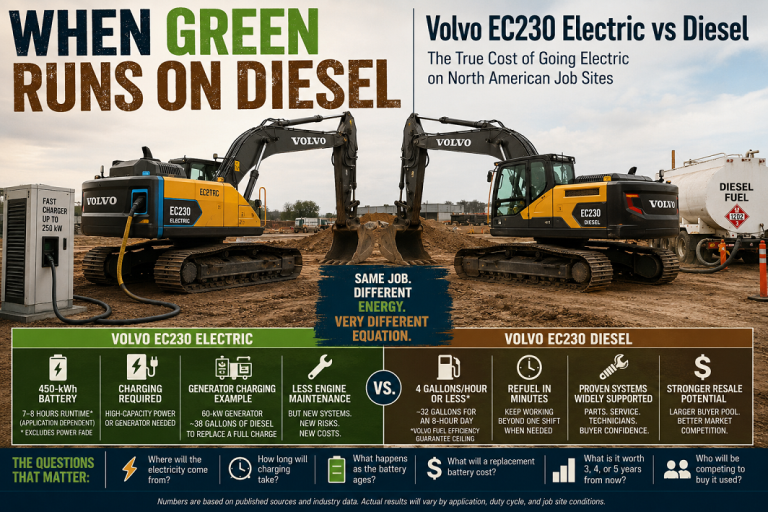
Zero-emission construction-site planning shows that electrification is about more than machines. Contractors need power systems, charging infrastructure, site planning, support models, and rental strategy.
Electrified drivetrains may also become a practical bridge technology for some production fleets before full battery-electric adoption becomes widespread.
Autonomous drilling and remote mining operations show that mining automation is moving further into production environments. That creates productivity and safety opportunities, but it also increases reliance on software, sensors, diagnostics, communications, and service planning.
AI infrastructure is also becoming a demand engine. Data centers require power, cooling, copper, construction, earthmoving, cranes, aggregates, utility equipment, backup generation, and long-term maintenance.
The key point is simple: future technology matters most when it changes ownership cost, uptime, repair access, workforce needs, resale value, or project productivity.
Reader takeaway: technology should not be judged only by how advanced it sounds. It should be judged by what it does to machine ownership, jobsite productivity, repair access, and long-term fleet cost.
9. Industry Conversation This Week
The broader industry conversation this week centered on diesel-cost behavior, equipment launches, rental equipment, aerial platforms, compact equipment, electrification, mining automation, and market forecasts.
That mix says something important. Contractors are being pulled in two directions at once: immediate operating-cost pressure and long-term technology change.
On one side, fuel, financing, used-equipment values, and rental decisions are affecting day-to-day business. On the other side, electrification, AI diagnostics, autonomous equipment, robotics, and connected machines are changing how fleets may be owned and repaired in the future.
Market-size forecasts continue to point toward long-term demand for construction equipment, electric machines, compact equipment, mining support, and infrastructure work. Those reports are useful background signals, but the practical question is more important:
Which machines are being used?
Who is buying them?
How are they financed?
Where are they supported?
What happens to ownership cost after the sale?
That is where market coverage becomes useful for contractors, dealers, rental companies, fleet owners, used-equipment buyers, parts suppliers, and repair operations.
10. HEPLANET Articles Published This Week
This week’s HEPLANET coverage strengthened several core content clusters.
Used Equipment and Auctions
HEPLANET continued building its used-equipment and inspection authority with the Used Excavator Inspection Guide. This article supports buyers who need to evaluate excavators beyond hours and appearance, including undercarriage condition, hydraulic performance, final drives, swing systems, leaks, attachments, oil history, and parts support.
This connects directly to broader auction buyer-beware coverage and future auction-market tracking.
Roadbuilding Equipment
The Roadbuilding Equipment article helped establish HEPLANET’s roadbuilding equipment category. It explains how excavators, bulldozers, motor graders, wheel loaders, compactors, asphalt equipment, trucks, and support machines work together in infrastructure development and maintenance.
Agricultural Equipment
The Agricultural Equipment Trends article gave HEPLANET a useful starting point for farm machinery, rural equipment ownership, compact machines, precision technology, dealer support, and financing.
Heavy Equipment Repair and AI
The Heavy Equipment Repair in the Age of AI and Robotics article opened an important future-facing repair conversation. AI diagnostics, robotics, autonomous service tools, technician shortages, and software-heavy equipment may reshape service departments and independent repair over time.
Daily Market Signals
HEPLANET also published daily market signal reports, including:
HEPLANET Daily Heavy Equipment Market Signals: May 26, 2026
Heavy Equipment Industry Briefing: May 27, 2026
[INTERNAL LINK: May 28, 2026 Heavy Equipment Industry Briefing]
These daily reports helped connect AI infrastructure, power demand, mining, grid modernization, auction movement, used equipment, electrification, rental strategy, diagnostics, and aftermarket support.
11. What to Watch Next Week
Several practical market signals deserve attention next week.
First, oil and diesel prices remain critical. Any new movement in Middle East conflict risk, U.S.-Iran tension, Strait of Hormuz shipping risk, crude exports, diesel futures, or refinery supply can affect contractors quickly.
Second, auction activity should be watched by both machine category and sales channel. Grande Prairie, Leeds, Houston, IronPlanet, Alex Lyon, AuctionTime-related events, Yoder & Frey, Euro Auctions, and regional fleet-retirement auctions may offer useful signals about buyer demand, export flow, fleet rotation, and used-equipment pricing.
Third, rental and finance signals should be watched closely. Rental utilization, fleet replacement, interest-rate pressure, and equipment finance activity all affect whether contractors buy, rent, lease, repair, or wait.
Fourth, used-equipment values should be watched by machine category and sales channel. Excavators, dozers, wheel loaders, compact machines, motor graders, articulated trucks, cranes, forklifts, aerial equipment, and roadbuilding equipment will not all move the same way.
Fifth, parts and repair support should stay central. Used-equipment inspection, dealer-certified used machines, aftermarket support, reman, hydraulic repairs, undercarriage inspection, and auction risk all belong in the same ownership conversation.
Finally, technology should remain in the report, but after the practical market signals. AI, electrification, autonomy, and robotics matter because they affect the future of machine ownership, not because they are buzzwords.
Weekly Bottom Line
The heavy equipment market is being pulled by several forces at once.
Fuel volatility is changing contractor behavior. Oil and geopolitical risk are affecting operating costs. Auctions are revealing regional demand and used-equipment flow. Equipment finance and rental strategy are shaping fleet decisions. Excavators, roadbuilding equipment, compact machines, loaders, cranes, forklifts, and agricultural machines are all showing different demand patterns. Parts, repair, and uptime remain the backbone of real machine value. Infrastructure, mining, LNG, power corridors, and data centers are creating long-term demand. AI, electrification, and autonomy are becoming important, but only when tied to ownership cost and supportability.
For equipment owners, the key question is not simply, “What machine should I buy?”
The better question is:
Which machine can I keep working, support affordably, repair quickly, finance responsibly, use productively, and resell confidently in the market ahead?
That is the equipment market HEPLANET will continue to track.