HEPLANET Daily Heavy Equipment Industry Briefing — May 28, 2026
The heavy equipment industry continues to show a clear pattern: demand is being shaped by more than traditional roadbuilding and commercial construction.
Power infrastructure, AI data centers, copper demand, grid modernization, quarry automation, electric hauling, rental strategy, diagnostics, and aftermarket support are all beginning to influence how contractors, mining companies, rental fleets, dealers, and equipment owners plan for the next cycle.
The strongest signal in today’s briefing is that the heavy equipment market is increasingly connected to power, technology, infrastructure, and lifecycle ownership. Contractors are not only asking what machine to buy. They are asking how that machine will be powered, serviced, diagnosed, financed, rented, repaired, and supported over its full working life.
Copper, Grid Expansion, and AI Infrastructure Are Supporting Long-Cycle Equipment Demand
Copper demand remains one of the clearest long-term signals for mining and heavy equipment utilization.
The growth of AI data centers, utility expansion, electrification, transmission upgrades, renewable energy, and industrial power demand all depend heavily on copper and grid infrastructure. Reuters reported that Rio Tinto agreed to supply copper to Amazon for AI data-center-related use, highlighting how artificial intelligence is becoming another demand driver for critical minerals.
For the heavy equipment industry, this matters because copper demand is not only a mining story. It also affects quarrying, aggregates, civil construction, utility work, haul roads, trenching, cranes, drills, excavators, haul trucks, and support fleets.
The equipment cycle is increasingly tied to the power economy. If AI infrastructure, data centers, electrical transmission, and grid modernization continue expanding, the downstream demand reaches far beyond the mine site.
Autonomous Hauling Is Moving From Mining Toward Quarry Operations
Autonomous hauling continues to move beyond ultra-class mining and into quarry and aggregates environments.
Komatsu’s Smart Quarry Autonomous, powered by Pronto, was named a finalist for the CONEXPO-CON/AGG Next Level Awards. Komatsu describes the system as a quarry-specific autonomous haulage solution designed to apply automation and digital capability to real jobsite challenges.
That is important because quarry operations may become the bridge between mining autonomy and broader construction technology. Quarries are controlled environments, but they still require real production discipline, haul-road management, machine uptime, safety, dispatching, maintenance planning, and fleet coordination.
The impact of autonomy should not be viewed only through labor savings. Autonomous hauling can also change maintenance strategy, tire management, site planning, production consistency, fuel use, telematics, and repair timing.
For aggregates producers and quarry fleets, autonomy may become less of a futuristic concept and more of a practical production tool.
Electric Articulated Haulers Move Electrification Into Heavier Work
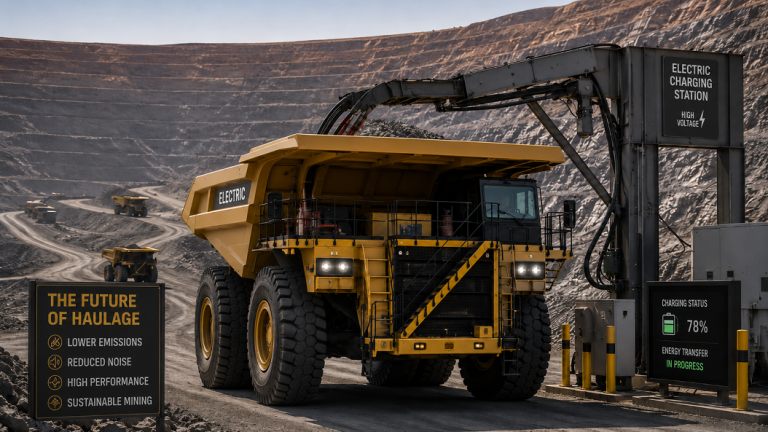
Volvo Construction Equipment’s A30 Electric and A40 Electric articulated haulers remain one of the strongest real-world electrification signals in the heavy equipment market.
Volvo CE announced serial production of the A30 Electric and A40 Electric articulated haulers in April 2026, with payloads of 29 tonnes and 39 tonnes respectively. Volvo CE says the machines can offer up to six hours of operation on a single charge depending on the application.
This matters because articulated haulers are not light-duty machines. They work in quarrying, mining support, earthmoving, and material movement. Electrifying this class of equipment tests battery capacity, charging infrastructure, site planning, payload requirements, duty cycles, and maintenance support in a much more serious way than compact equipment alone.
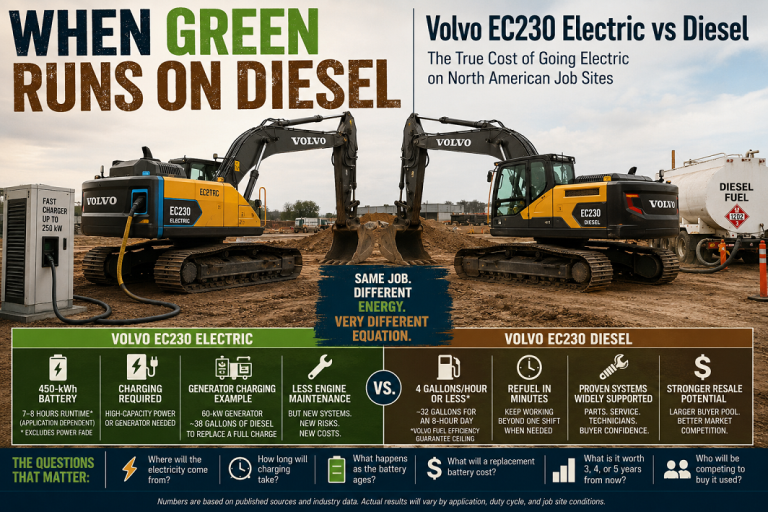
The likely near-term future is not a universal shift to electric machines. It is more likely to be application-specific. Controlled sites, shorter haul cycles, urban work, emissions-sensitive projects, and operations with predictable charging windows may adopt electric equipment faster than remote, high-hour, heavy-production applications.
Mixed-Energy Fleets Are Becoming the Practical Reality
The energy transition in heavy equipment is not moving in only one direction.
Diesel, electric, hydrogen, hybrid systems, renewable fuels, and emissions-compliant engine platforms are all part of the current discussion. Even where full electrification is not practical, fleet owners are beginning to evaluate fuel flexibility, charging access, emissions exposure, operating cost volatility, service requirements, and future regulatory risk.
The practical result is likely to be mixed-energy fleets.
A contractor may continue using diesel equipment for remote production work, electric machines for controlled sites, rental equipment for specialized applications, and older machines where replacement costs are too high to justify immediate turnover.
For fleet owners, the question is not simply whether electric machines will replace diesel. The better question is which energy source fits the work, the site, the support network, and the ownership cost.
Rental Strategy Is Becoming a Technology and Risk Decision
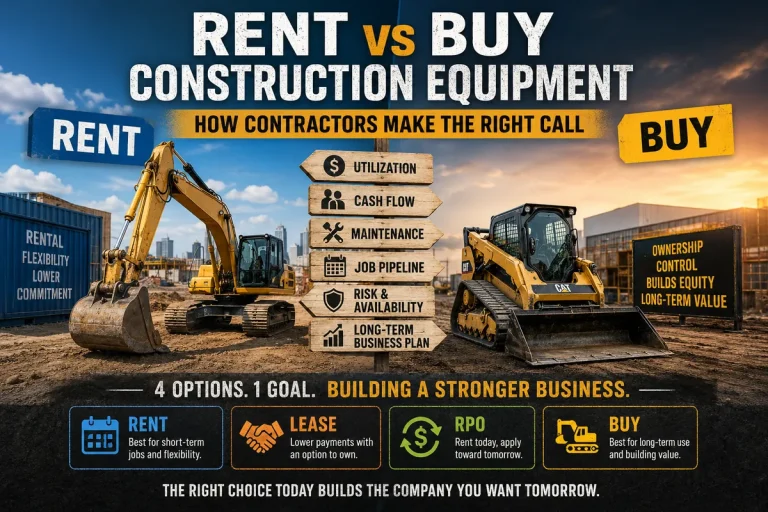
Rental continues to gain importance as contractors manage high machine prices, financing costs, uncertain project timing, and rapid technology change.
EquipmentShare priced its initial public offering in January 2026, describing itself as a connected jobsite technology company and one of the largest equipment rental providers in the United States. Reuters also reported that EquipmentShare’s IPO targeted a valuation of more than $6 billion, with the company operating hundreds of locations and using its T3 platform across rental, resale, servicing, and jobsite technology.
The larger signal is that equipment rental is no longer only about avoiding the upfront cost of buying a machine. Rental is becoming a way to manage uncertainty.
Contractors are balancing ownership risk, utilization, financing costs, technology obsolescence, maintenance exposure, and project timing. As equipment becomes more software-driven, more expensive, and more specialized, rental can give contractors access to machines without carrying the full ownership burden.
The modern fleet may increasingly divide into three categories: core owned equipment, rented specialty machines, and older machines kept in service because replacement cost remains high.
Diagnostics and Predictive Maintenance Are Becoming More Important to Ownership Strategy
Diagnostics and predictive maintenance have always been part of uptime management. Experienced mechanics have always watched for leaks, noises, heat, vibration, filter debris, oil condition, and changing machine behavior.
What is changing is how much of that information is now collected and organized by the machine itself.
As fleets become more autonomous, electric, software-driven, and telematics-connected, the value of machine-health data increases. Predictive maintenance, fault codes, remote diagnostics, sensor feedback, and software alerts can help fleet owners identify small problems before they become machine-down failures.
The important ownership question is who can access and use that information.
If machine data is available to the owner, the dealer, and qualified repair providers, it can improve uptime and reduce cost. If diagnostic information becomes too restricted, equipment owners may become more dependent on OEM and dealer support.
That does not make technology bad. It means diagnostics are becoming part of the ownership equation.
The technician of the future may need to be both a mechanic and a systems diagnostician.
Aftermarket Support Continues Gaining Strategic Importance
As equipment replacement costs rise and fleets stay in service longer, the aftermarket ecosystem becomes more important.
That includes rebuilds, reman components, hydraulic repair, undercarriage management, used parts, field service, seal kits, component repair, and independent support networks.
The real issue is not simply OEM versus aftermarket. The stronger ownership question is whether the machine has reliable support paths.
Fleet owners need parts availability, installation discipline, supplier knowledge, warranty clarity, technician capability, and response time. A lower-cost part does not help if the supplier cannot support the application. An OEM part does not solve the full problem if the machine is down for too long, the repair is not done correctly, or the owner has no backup plan.
This matters even more for used equipment buyers. A used machine may look attractive at purchase, but if parts are difficult to source, dealer support is weak, or aftermarket coverage is limited, the machine can become expensive quickly.
Infrastructure Demand Reaches Beyond the Jobsite
Infrastructure activity creates more than direct equipment demand.
Roadbuilding, bridge work, utility expansion, power infrastructure, industrial construction, and data-center development all create secondary demand for aggregates, hauling, paving, concrete, steel processing, material handling, rental equipment, field service, and parts support.
This is why infrastructure should be viewed as an equipment ecosystem.
A major infrastructure project may directly use excavators, dozers, graders, loaders, rollers, pavers, cranes, trucks, and compactors. But it also supports quarry production, maintenance shops, transport fleets, parts suppliers, rental companies, and support-service businesses.
For the heavy equipment industry, the strongest infrastructure cycles are not limited to the machines visible on the jobsite. They move through the entire support chain.
Chinese OEM Competition Remains a Global Market Theme
Chinese construction equipment manufacturers remain an important global competitive force.
International Rental News has reported that companies such as SANY, XCMG, Zoomlion, and Lovol are pursuing ambitious overseas growth strategies as domestic conditions and trade pressures push Chinese OEMs toward international markets.
The competitive issue should not be reduced to “premium equipment versus low-cost equipment.”
The real question is lifecycle support.
Buyers are evaluating acquisition cost, dealer infrastructure, parts availability, warranty response, technician training, resale value, service capability, and aftermarket coverage. A lower purchase price can be attractive, especially in price-sensitive markets, but the ownership test comes after the machine is working.
Can it be serviced quickly?
Are parts available?
Is the dealer network strong enough?
Can independent technicians support it?
Will resale value hold?
Does the machine fit the market, or only the purchase budget?
As Chinese OEMs continue expanding globally, the competitive battle will increasingly be fought through support ecosystems, not price alone.
HEPLANET Takeaway
The heavy equipment industry is entering a cycle shaped by power infrastructure, mining demand, quarry automation, electric hauling, mixed-energy fleets, rental strategy, diagnostics, aftermarket support, and global OEM competition.
The most important decisions are no longer only about machine size, brand, horsepower, or purchase price.
Equipment owners now have to evaluate:
Application.
Utilization.
Power source.
Dealer support.
Parts availability.
Diagnostic access.
Rental alternatives.
Aftermarket coverage.
Technician capability.
Resale risk.
Lifecycle ownership cost.
The machine still matters. But the support system around the machine may matter even more.
For contractors, rental companies, mining operators, quarry fleets, dealers, and used equipment buyers, the next equipment cycle will reward those who look beyond the machine and understand the entire ownership ecosystem.