
When Green Runs on Diesel: Volvo EC230 Electric vs Diesel
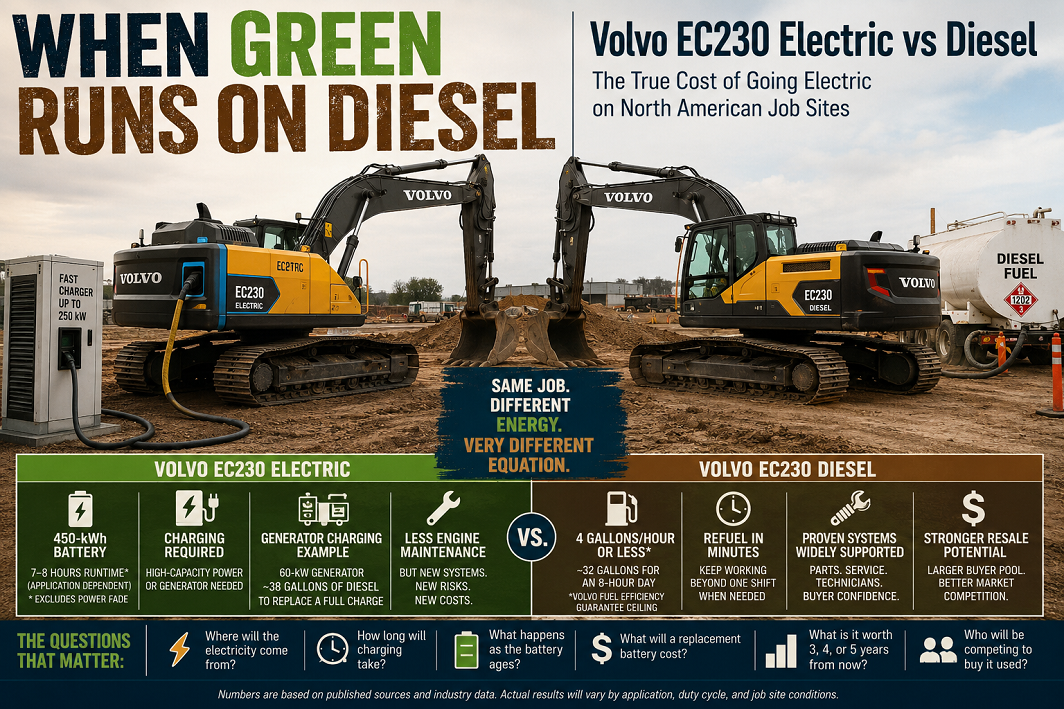
The Volvo EC230 Electric promises lower energy costs, less maintenance, and a full working day. But on a North American job site without high-capacity grid power, the numbers become much harder to explain.
The Volvo EC230 Electric vs diesel EC230 comparison begins with a surprise: the electric excavator appears fully capable of doing the work.
Its published digging forces, hydraulic flow, bucket capacity, travel speed, swing performance, and operating weight closely match the conventional EC230. Volvo says the electric model can operate for seven to eight hours, reduce energy running costs by 60% to 70%, require less maintenance, and produce no exhaust at the machine.
But one calculation changes the discussion.
The EC230 Electric carries a 450-kWh battery. If a contractor must replace a full battery charge using a diesel generator on a job site without sufficient electrical service, a 60-kW-class generator could burn approximately 38 gallons of diesel during the charging process.
Volvo lists the standard diesel EC230 at four gallons per hour or less under its Fuel Efficiency Guarantee. Over an eight-hour shift, that equals approximately 32 gallons.
Under that full-recharge scenario, more diesel could be burned charging the electric excavator than operating the diesel excavator.
And while the generator is running, the electric machine is not digging.
This does not prove that the EC230 Electric is a bad machine. It exposes the assumption behind many electric-equipment comparisons: that inexpensive, high-capacity electricity is already available beside the excavator.
On many North American job sites, it is not.
A 50,000-pound excavator may remain on a subdivision, highway project, pipeline, drainage job, land-clearing site, or commercial development for weeks or months. Bringing it back to a powered facility every night is impractical. The contractor must bring the electricity to the excavator.
That may require:
- Commercial three-phase electrical service
- A high-output external charger
- A large diesel generator
- A mobile battery weighing more than 16,000 pounds
- Additional transportation, servicing, security, and planning
The EC230 Electric eliminates the fuel tank. It does not eliminate the need to deliver energy.
It replaces a familiar refueling process with a charging system that may be nearly as complicated as the excavator itself.
Can the EC230 Electric perform like the diesel EC230?
On paper, the answer appears to be yes—while both machines are operating.
Volvo engineered the electric model to compete directly with the conventional EC230. According to Volvo’s published specifications, the machines have comparable:
- Operating weights
- Bucket capacities
- Hydraulic pump flow
- Digging forces
- Travel speeds
- Swing speeds
- Drawbar pull
- Working dimensions
The electric model is not merely a limited-capacity demonstration machine carrying an EC230 badge. It appears to be a legitimate production excavator.
Volvo also promotes immediate electric response and responsive hydraulics. An electric motor can produce torque without waiting for a diesel engine to increase speed.
But the EC230 Electric remains a hydraulic excavator.
Its electric motor drives hydraulic pumps. Oil still moves through the main control valve, hoses, cylinders, travel motors, swing motor, and final drives. The boom and bucket are not driven directly by electric motors in the way an electric automobile’s wheels are.
The machine may feel smooth and responsive, but Volvo has not publicly demonstrated a major advantage in cycle time, truck loading, or material moved per hour.
The real question is no longer whether the machine can dig.
It is how long, how often, and how flexibly it can continue digging.
What does “a full working day” mean?
Volvo says the EC230 Electric’s 450-kWh battery can provide seven to eight hours of operation, depending on the application.
That qualification matters.
Excavators do not follow one standard duty cycle.
A machine installing utilities may spend substantial time waiting for workers in a trench, checking grade, repositioning, or coordinating with another crew. During those pauses, an electric excavator consumes little traction energy.
A machine loading trucks continuously, digging hard material, climbing grades, traveling frequently, or operating a demanding attachment places a much heavier load on the battery.
The seven-to-eight-hour claim should not be interpreted as eight hours of uninterrupted, full-capacity excavation under every condition.
Runtime could fall below seven hours during:
- Continuous truck loading
- Hard or rocky excavation
- Frequent machine travel
- Steep-grade operation
- Heavy hydraulic demand
- High-flow attachment use
- Extreme heat or cold
- Extended cab heating or air-conditioning use
Volvo does not publicly identify the exact duty cycle behind the advertised runtime.
Contractors are not told:
- What material was excavated
- Which bucket was used
- How much of the test involved active hydraulic work
- How much time the machine spent waiting
- How far it traveled
- Which work mode was selected
- Whether cab heating or cooling was operating
- How much charge remained at the end
- How much material was moved per charge
Eight hours on a job site is not necessarily eight productive hours.
The more useful measurement would be output per charge: cubic yards moved, tons loaded, trench completed, or productive hydraulic hours.
Those figures are not prominently disclosed.
Low-charge power fade
Runtime is only part of the battery equation.
The second question is whether the machine maintains full performance as its charge approaches empty.
We call this low-charge power fade. The technical term is generally power derating.
Low-charge power fade is a potential reduction in available machine performance when the battery reaches a low state of charge, becomes too hot or cold, or approaches another protection limit.
Volvo does not publish an EC230 Electric performance curve showing:
- Hydraulic output at different charge levels
- Digging performance at 80%, 50%, 20%, or 10%
- The charge level where power restrictions begin
- Whether travel, swing, or digging power is reduced first
- Whether sustained heavy work causes thermal power reduction
- Whether fast charging affects performance later that day
The absence of this information does not prove that the EC230 Electric gradually weakens throughout the shift. Modern battery systems are normally designed to maintain consistent output across most of their usable range.
But contractors should know whether seven to eight hours means equal production throughout—or several hours of full output followed by a protected, reduced-performance period.
The machine is purchased to move material, not merely to keep its hour meter running.
The diesel EC230 can keep working
Volvo lists the diesel EC230 at four gallons per hour or less under its Fuel Efficiency Guarantee.
That is a program ceiling, not a claim that every EC230 burns exactly four gallons each hour. Actual consumption changes with the material, operator, work mode, idle time, and hydraulic load.
Using Volvo’s published ceiling:
4 gallons per hour × 8 hours = 32 gallons
The diesel EC230 carries approximately 83 gallons of fuel.
At four gallons per hour, a full tank could theoretically support approximately 20.75 operating hours.
A contractor would refuel before the tank was completely empty, but the practical difference is clear. The diesel machine can potentially work more than two normal shifts before exhausting its fuel supply.
Refueling takes minutes.
The diesel EC230 can work:
- A normal eight-hour day
- A ten-hour production shift
- Overtime after weather delays
- A second shift
- Emergency schedule-recovery hours
- Continuous production when necessary
The EC230 Electric can operate for approximately seven to eight hours under Volvo’s application-dependent conditions before requiring another substantial supply of electricity.
That window may be shorter under continuous high-load work. It also does not tell us whether low-charge power fade begins before the battery reaches its minimum operating level.
Volvo can reasonably claim similar digging capability.
That does not mean the electric and diesel machines provide equal operating flexibility.
The EC230 Electric may match the diesel EC230 during its charged operating window. It does not automatically match how long or how flexibly the diesel excavator can work.
That distinction matters because, as HEPLANET previously examined in Equipment Uptime Is the New Buying Equation, the value of a machine depends on how reliably it supports production—not merely on its published specifications.
The onboard charger does not create electricity
Volvo’s charging terminology can be confusing.
The onboard charger is not a generator. It does not create electricity or recharge the excavator while it works.
It converts electricity supplied from outside the machine into the DC power needed by the battery.
That external electricity must come from:
- A utility connection
- Temporary commercial site power
- A diesel generator
- A mobile battery-storage unit
- Another compatible source
Volvo also promotes fast-charging options capable of supplying up to 250 kW.
A fast charger can reduce charging time, but it does not solve the original energy problem.
A 250-kW charger must receive that power from somewhere.
It requires commercial-scale electrical infrastructure, a large generator, or stored energy from a mobile power unit.
The charger transfers electricity.
It does not generate it.
Grid power creates the strongest electric case
Volvo says the EC230 Electric can achieve a 60% to 70% reduction in energy running costs compared with its diesel predecessor.
The wording is important.
Volvo says energy running costs, not total ownership costs.
The claim may be credible where the excavator connects directly to affordable commercial or industrial grid electricity. Under those conditions, the contractor is comparing the cost of diesel fuel with the cost of electricity.
The electric machine also consumes little traction energy while waiting, and an electric motor can convert supplied energy efficiently.
But the 60% to 70% claim does not automatically include:
- The excavator’s higher purchase price
- Charger purchase or rental
- Utility upgrades
- Transformers and switchgear
- Temporary electrical installation
- Demand charges
- Generator ownership or rental
- Mobile battery costs
- Transportation
- Financing
- Charging interruptions
- Resale-value risk
The claim begins with one major assumption:
Suitable, economical electricity is available where the excavator works.
That may be true at a fixed industrial facility, recycling operation, tunnel, or long-duration project with engineered electrical service.
It is often untrue on undeveloped North American job sites.
The price of grid electricity is only part of the equation.
Access to enough electricity is the harder problem.
When the electric excavator runs on diesel
Without suitable grid power, a contractor could use a diesel generator to supply the charger.
The EC230 Electric would then still be operating indirectly on diesel.
The energy path becomes:
Diesel fuel → generator → electricity → charger → battery → electric motor → hydraulic pumps
Every conversion introduces losses.
A Cummins 60-kW-class generator provides approximately 54 to 55 kW of continuous prime output. Cummins lists fuel consumption at approximately 4.6 gallons per hour at full prime load.
Replacing a theoretical 450 kWh at 55 kW requires:
450 kWh ÷ 55 kW = approximately 8.2 hours
At 4.6 gallons per hour:
8.2 hours × 4.6 gallons = approximately 37.7 gallons
This is a stress-test calculation, not a prediction that every EC230 Electric will require exactly 37.7 gallons after every shift.
The result depends on:
- The usable portion of the 450-kWh battery
- The charge remaining after the shift
- Charger efficiency
- Generator efficiency
- Cable and conversion losses
- Battery temperature
- Charging taper
- Whether the machine actually consumed a full charge
But the direction is difficult to ignore.
Using Volvo’s diesel ceiling:
- Diesel EC230 working eight hours: up to approximately 32 gallons
- Generator replacing a theoretical full 450-kWh charge: approximately 38 gallons
In that scenario, the generator burns more diesel charging the electric machine than the diesel excavator burns producing the work.
The generator also adds:
- Purchase or rental costs
- Transportation
- Maintenance
- DEF
- Fuel delivery
- Charger equipment
- Cables and electrical setup
- Security and theft exposure
A larger generator and faster charger reduce charging time, but they do not reduce the amount of energy the battery requires.
Generator charging may move the exhaust away from the excavation area. That could have value in a tunnel or controlled environment.
It is not an obvious fuel-saving strategy.
It may simply move the diesel engine from the excavator to the charging system.
Zero tailpipe emissions—not zero emissions
The EC230 Electric produces zero tailpipe emissions at the machine.
That is true.
There is no diesel exhaust coming directly from the excavator.
It does not mean:
- The electricity was produced without emissions
- The entire job site is emission-free
- A diesel generator produces no exhaust
- Charging equipment arrived without fuel consumption
- Battery manufacturing created no emissions
- The machine has zero lifecycle emissions
When electricity comes from nuclear, hydroelectric, wind, solar, or another low-operational-emission source, the environmental case becomes stronger.
When grid electricity comes partly from natural gas or coal, some emissions move from the excavator to the power plant.
When a diesel generator charges the machine, the exhaust moves from the excavator to the generator—and the generator may burn as much or more fuel.
The accurate phrase is:
Zero tailpipe emissions at the excavator.
Anything broader depends on where the electricity came from.
Where electric operation could make sense
There are applications where zero tailpipe emissions and lower engine noise could create real value:
- Tunnels and underground civil projects
- Fixed industrial sites with high-capacity power
- Large recycling and material-processing operations
- Long-duration projects with engineered charging
- Contracts requiring zero tailpipe emissions
- Sites where reduced engine noise has measurable value
- Predictable one-shift operations
- Projects that pay a premium for electric equipment
Even those applications involve tradeoffs.
Recycling facilities, mills, scrap operations, and industrial plants may have suitable power, but many also operate ten, twelve, sixteen, or twenty-four hours per day.
A cleaner excavator may still become a production bottleneck if it cannot complete the required schedule without substantial fast charging.
The strongest use case may be a site designed around electrification—not a conventional operation attempting to add one electric excavator.
Less maintenance does not guarantee more uptime
The electric machine eliminates many diesel-related service items:
- Engine oil and filters
- Fuel filters
- DEF
- Exhaust aftertreatment
- Turbocharger service
- Fuel-injection repairs
- Certain belts and engine accessories
That should reduce scheduled maintenance and remove some failure points.
But the EC230 Electric still contains:
- Hydraulic pumps and valves
- Cylinders and hoses
- Hydraulic oil and filters
- Final drives
- Swing components
- Undercarriage
- Pins and bushings
- Cooling systems
- Structural components
It also introduces:
- A 450-kWh high-voltage battery
- Inverters and power electronics
- Battery-management systems
- High-voltage cooling
- Charging equipment
- Specialized diagnostics and safety procedures
Volvo can reasonably claim lower engine-related maintenance.
That does not automatically create more productive uptime.
Preventive maintenance on diesel equipment is commonly performed after the shift, during weekends, or during planned downtime. The electric machine also sits outside its work shift, but much of that time may be committed to charging.
If both machines work eight hours and sit overnight, neither necessarily loses scheduled production because of routine servicing or charging.
The difference appears when the project needs extended production.
The diesel machine can be refueled in minutes.
The electric machine requires another charging event.
The financial effect of that lost availability could extend beyond the excavator itself. As explained in Heavy Equipment Downtime Costs, an unavailable machine can also leave operators, trucks, labor, and downstream work waiting.
Lower maintenance costs and greater operating flexibility are separate issues.
The mobile battery problem
Volvo offers mobile battery systems such as the PU500 for locations with weak or unavailable grid power.
The PU500 stores approximately 540 kWh, includes a high-output DC charger, and weighs about 16,755 pounds.
The EC230 Electric carries a 450-kWh battery.
At impossible 100% transfer efficiency:
540 kWh ÷ 450 kWh = 1.2 full charges
After accounting for operating reserves, cooling, conversion losses, and battery-protection limits, the PU500 should be viewed as approximately one full EC230 recharge.
It is not a week of stored energy.
After supporting one heavily used shift, the PU500 must be:
- Recharged at the site
- Transported to a powered facility
- Exchanged for another charged unit
- Connected to a generator
At more than 16,000 pounds, it is not something moved behind a pickup.
It requires commercial transportation, securement, loading equipment, planning, and a high-capacity location where it can be recharged.
A contractor could rotate two units between the project and a charging depot. That effectively creates a battery-delivery operation in which the energy container weighs more than eight tons and stores about one excavator charge.
If a diesel generator recharges the PU500, another conversion stage is added:
Diesel → generator → PU500 → EC230 battery → electric motor → hydraulics
The PU500 makes more sense where some grid power already exists but cannot provide the short, high-output charge required by the excavator.
It stores and transports electricity.
It does not create it.
Charging equipment becomes mission-critical
With a diesel excavator, the machine’s energy system is largely self-contained. A fuel truck can refill the tank, but the excavator does not permanently depend on a separate charger remaining onsite.
The EC230 Electric does.
If the charger, generator, mobile battery, or charging cable is stolen, damaged, or unavailable, the excavator stops when its battery is depleted.
Construction generators and portable equipment are already common theft targets.
Electric charging infrastructure adds:
- Theft and vandalism exposure
- Cable theft
- Security costs
- Insurance requirements
- Replacement lead times
- Potential shutdown of the excavation operation
The cost is not limited to replacing the charger.
It may leave a 50,000-pound excavator, its operator, haul trucks, and supporting crew unable to work.
Battery degradation changes the equation
The EC230 Electric may begin its life with enough usable battery capacity to support Volvo’s advertised runtime.
That capacity will not remain unchanged forever.
Lithium-ion batteries gradually lose storage capacity through age, charging cycles, temperature exposure, work intensity, and charging practices.
This is battery degradation.
A battery retaining 80% of its original capacity may still operate the machine normally, but it cannot store the same amount of energy.
An application that originally supported eight hours may eventually support materially less.
Volvo does not publicly provide enough EC230-specific information to answer:
- Guaranteed battery-capacity retention
- Expected charging-cycle life
- Effects of frequent fast charging
- Module-level repair options
- Complete battery replacement cost
- Replacement labor
- Battery availability
- Whether normal degradation is covered
- Whether warranty coverage transfers to the next owner
These are not distant technical concerns.
They affect production, ownership costs, financing, trade-in value, and resale.
Resale value may decide the ownership cost
The resale question may eventually matter more than the daily energy calculation.
A diesel EC230 enters a broad and established secondary market.
Potential buyers include contractors, dealers, rental fleets, brokers, exporters, industrial users, owner-operators, and rebuilders.
At auction, ten buyers may value the diesel machine differently, but they understand what they are buying.
They understand:
- Diesel engines
- Hydraulic systems
- Expected repairs
- Parts availability
- Service options
- Financing
- Export demand
- Future resale
A used EC230 Electric may attract a much smaller buyer pool.
A buyer may need:
- A suitable fixed application
- Adequate charging infrastructure
- Volvo high-voltage support
- Confidence in the battery
- Specialized financing
- A battery-replacement plan
- Confidence in long-term parts availability
Instead of ten buyers competing, there may be one or two whose operations fit the machine.
Those buyers will ask:
- How much battery capacity remains?
- How many charging cycles has it completed?
- How often was it fast-charged?
- Was it exposed to extreme heat?
- Can individual modules be replaced?
- What does a complete battery cost?
- How quickly can Volvo supply one?
- Can anyone besides Volvo diagnose it?
- Does the warranty transfer?
- Will a lender finance it?
- What will it be worth during the next ownership cycle?
A diesel engine can normally be inspected, oil-sampled, repaired, rebuilt, or replaced. Multiple service providers may support it, and remanufactured or used components may be available.
The EC230 Electric does not yet have that North American history.
The updated 450-kWh model entered the North American market in 2025. It has no established four-, five-, or eight-year auction record in this market.
That does not prove its resale value will be poor.
It means the first owner accepts substantial residual-value risk.
Even if Volvo’s energy and maintenance claims prove accurate, a large resale disadvantage could erase years of savings.
A machine that saves $15,000 annually but sells for $100,000 less at trade-in has not produced the expected ownership advantage.
As HEPLANET examined in How Parts Availability Affects Heavy Equipment Resale Value, buyers pay more when they believe a machine can be supported, repaired, and resold with confidence. Uncertainty reduces competition and changes what buyers are willing to risk.
Battery warranty, replacement cost, trade-in support, and the future buyer pool are therefore part of the original purchase decision.
North American conditions matter
The EC230 Electric must be judged in the market where it will work.
North American projects can be geographically dispersed, undeveloped, remote, and temporary. Excavators may work long days and remain onsite for months without commercial electrical infrastructure.
Transport distances are greater. Schedules may change. Contractors may need overtime after weather delays or move the machine among several applications during its ownership life.
Equipment that performs well in Europe or another market can encounter different challenges in North America because of:
- Work cycles
- Ground conditions
- Project duration
- Transportation
- Climate
- Operator practices
- Infrastructure
- Service support
- Secondary-market demand
European electricity and diesel comparisons cannot automatically be transferred to North American contracting.
Where the business case becomes difficult
The Volvo EC230 Electric becomes harder to justify when:
- High-capacity grid power is unavailable
- Electricity must be generated with diesel
- The excavator regularly works more than eight hours
- Heavy production shortens battery runtime
- A second shift may be required
- Charging equipment must move between projects
- A mobile battery requires daily rotation
- Long charging interruptions cannot be tolerated
- Independent repairs matter
- Resale value is central to ownership cost
- The contractor cannot earn a premium for electric operation
In these applications, the diesel EC230’s greatest advantage may not be its fuel consumption.
It may be flexibility.
The contractor can refuel it almost anywhere, work beyond one shift, support it through an established service network, and sell it into a broad global market.
Managing that complete ownership cycle is just as important as selecting the machine. The same principle applies in Used Equipment Management Is a Poker Game: the purchase is not a win until maintenance, downtime, financing, market fit, and final resale are all counted.
Questions Volvo should answer
Before a contractor can complete a credible Volvo EC230 Electric vs diesel ownership comparison, Volvo or its dealer should provide:
- The actual purchase-price difference.
- The cost of each charging option.
- Utility and installation requirements.
- Actual kWh consumption under several duty cycles.
- Production per charge.
- Runtime during continuous heavy work.
- Whether low-charge power fade occurs.
- Usable versus nominal battery capacity.
- Battery warranty and hour limits.
- Guaranteed capacity retention.
- Fast-charging effects on battery life.
- Module and full-pack replacement costs.
- Replacement labor and expected downtime.
- Independent service availability.
- Warranty transferability.
- Battery-health documentation for resale.
- Trade-in or residual-value support.
- The assumptions behind the 60% to 70% energy-cost claim.
These questions do not prove that the EC230 Electric is a failed concept.
They show that its ownership proposition is more complicated than the machine specifications alone suggest.
The excavator may be ready before the market is
The Volvo EC230 Electric appears technically capable.
It may match the diesel EC230’s fundamental digging performance during its charged operating window. It also offers real advantages in zero tailpipe emissions at the machine, lower engine-related maintenance, reduced vibration, and certain fixed or controlled applications.
But a contractor owns the machine during more than the hours when the bucket is moving.
The owner must also account for:
- Where the electricity comes from
- How it reaches the excavator
- How long charging takes
- What happens after the battery window ends
- Whether low-charge power fade affects production
- How battery degradation changes runtime
- What the charging system costs
- Who can repair the machine
- What a replacement battery costs
- Who will buy the machine later
The EC230 Electric may make sense where economical grid power, predictable schedules, engineered charging infrastructure, and a specific environmental or contractual need already exist.
For contractors working on temporary, undeveloped, and constantly changing North American job sites, the diesel EC230 still offers something difficult to express in a promotional percentage but easy to understand in the field:
It can keep working.
That may be the most important specification of all.