Heavy Equipment Market Trends: Dealer Data, Reman, and Used Equipment Demand
Today’s heavy equipment market trends point toward a market where OEMs, dealers, auction platforms, and aftermarket suppliers are competing for more than the initial machine sale.
The larger trend is lifecycle control.
Dealer data, reman programs, used-equipment demand, auction results, parts availability, and aftermarket repair options are all becoming more important as fleet owners look for uptime, lower repair costs, and smarter buying decisions.
OEM & Dealer Intelligence
Hitachi Construction Machinery’s LANDCROS Sales Navigator announcement is more than a dealer software update.
The system is designed to centralize dealer customer data, business discussions, project status, and sales activity, with possible future use of AI-based automated entry and analytics. The rollout begins in Japan and Southeast Asia, with global expansion planned in stages.
The bigger signal is that dealer data is becoming a competitive tool.
OEMs and dealers are increasingly trying to understand customer activity, machine history, service opportunities, lead timing, and future demand before the customer makes the next move. For equipment owners, that means the dealer relationship may become more digital, more predictive, and more closely tied to lifecycle support.
For independent buyers, rental companies, exporters, and aftermarket suppliers, the same trend raises an important question:
Who controls the machine history, parts intelligence, repair planning, and customer relationship after the sale?
Parts, Reman & Repair Economics
Cat Reman continues to show that remanufactured components are no longer a side business.
According to the report, Caterpillar has added more than 1,300 construction reman part numbers since 2021, and the full Cat Reman portfolio now includes more than 8,000 part numbers. The listed construction categories include engines, hydraulics, drivetrain, electronics, alternators, displays, ECMs, joysticks, sensors, starters, pumps, motors, transmissions, torque converters, final drives, steering and brake groups, and more.
That matters because reman is being positioned as an answer to cost, downtime, availability, and sustainability.
For fleet owners, the practical question is not simply whether to buy new or used. It is whether a machine can be repaired, rebuilt, or kept productive at a cost that still makes sense.
Reman, rebuilds, aftermarket replacement parts, and component-level repair strategies are becoming a larger part of the ownership conversation.
Auction Results & Used Equipment Signals
The used-equipment market continues to show demand for quality machines, but auction results need context.
Ritchie Bros. reported that its April 13–16 Grande Prairie auction in Canada generated more than CA$93.5 million in gross transaction value, more than doubling year over year. The auction included nearly 10,000 registered bidders, more than 1,100 active buyers, and more than 2,600 lots sold. Notable results included a 2019 Cat D9T dozer at CA$1.525 million and multiple 2022 Deere 470G LC VG excavators at CA$305,000 each.
Those results suggest buyers are still competing for good iron, especially late-model or low-hour production machines that can go to work quickly.
The specific machines matter. A Cat D9T is a large production dozer, and a Deere 470G LC is a large excavator. These are not small utility machines. They are high-value production assets, and moving them is not simple or cheap. In a regional market like Grande Prairie, transportation, timing, and immediate availability can all influence what buyers are willing to pay.
The D9T result is a good example of why auction prices need more than a headline reading. While the machine was nearly seven years old, it reportedly had about 4,800 hours. For a dozer in that size class, that can represent only about two to two-and-a-half years of real production use, depending on the application. A low-hour, well-presented, fully equipped machine is not the same as an average seven-year-old dozer.
That matters because buyers are not only pricing the model year. They are pricing remaining useful life, condition, configuration, replacement cost, and availability. If a comparable new machine is expensive, delayed, or difficult to secure, a clean low-hour used machine can become highly desirable, even at a strong auction price.
Seasonality also matters. Grande Prairie is in Canada, and April timing can be important because northern contractors often face a shorter working season. When spring arrives, production machines that can go straight to work may draw stronger bidding.
Auction averages can also be influenced by major benchmark events earlier in the year. Ritchie Bros.’ Orlando auction each February is one of the industry’s largest destination sales. Its 2026 Orlando sale generated more than US$265 million in gross transaction value, with more than 14,500 equipment items, trucks, and vehicles sold and more than 19,500 participants from over 80 countries. Ritchie Bros. described Orlando as a premier global auction and an early indicator of equipment demand and pricing trends.
That matters because Orlando is not a normal local auction. It attracts contractors, dealers, exporters, rental companies, and international buyers. Strong prices at a major event like Orlando can affect seller expectations and buyer behavior at later auctions in the first half of the year.
That is why one strong auction result should not be read as the whole market. It may reflect machine quality, low hours, buyer urgency, regional seasonality, transportation realities, replacement cost, limited new supply, export demand, currency conditions, and the influence of earlier benchmark auctions.
For contractors and fleet managers, the lesson is simple: auction pricing should be read carefully. Strong results may show demand, but they also raise the stakes for inspection discipline, maintenance documentation, undercarriage evaluation, hydraulic performance, parts availability, and understanding why buyers are paying up for certain machines.
Used Equipment Market Pulse and Heavy Equipment Market Trends
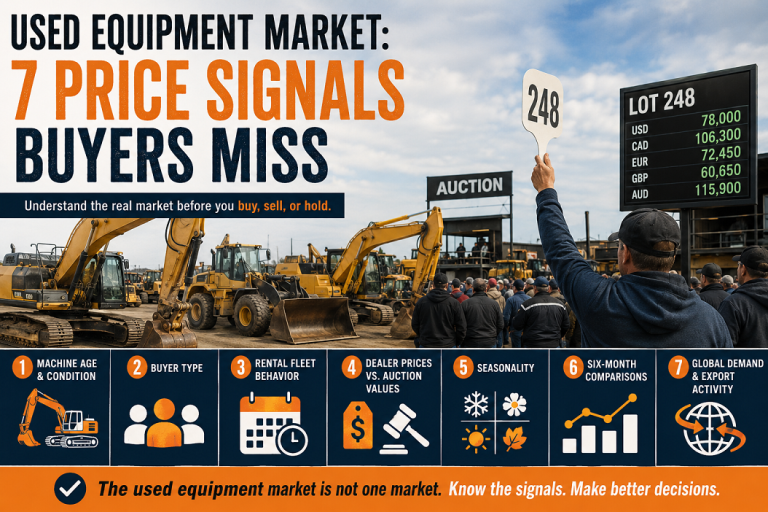
The broader used-equipment market does not behave exactly like the new equipment market.
New equipment demand can move through sharper peaks and valleys. Contractor confidence, financing conditions, interest rates, infrastructure spending, commodity markets, dealer inventory, and the broader economy can all push new-machine demand up or down quickly.
Used equipment is usually steadier because it is supported by several layers of buyers.
At the top are buyers who prefer new machines and trade them before they become too old or too expensive to maintain. Below them are secondary buyers looking for two- or three-year-old machines that still have useful life, good appearance, lower hours, and some remaining confidence. Below that are smaller contractors, farmers, landowners, and startup operators who may not have the funds or financing strength to buy newer machines but still need equipment to work.
Then there is the export market.
Older and higher-hour machines may lose some appeal in the United States because repeated repairs become expensive when labor rates are high. But in lower-labor-cost markets, those same machines may still have years of useful life. Buyers in export markets may be more willing to repair components locally, rebuild assemblies, or keep machines working with a different cost structure than a U.S. contractor faces.
That is one reason used equipment rarely fits a simple boom-or-bust story.
A clean late-model machine may attract contractors, rental fleets, or dealers. A mid-life machine may appeal to secondary buyers. An older but repairable machine may work for a smaller contractor or farmer. A high-hour machine may still have export value if parts are available and the machine can be repaired economically.
Used equipment also moves differently than new equipment. New heavy equipment dealers typically operate within defined territories, but used equipment can move more freely between regions and countries. That means used-machine demand can come from local contractors, out-of-state buyers, dealers, exporters, and international projects all at once.
Currency conditions can add another layer. When the U.S. dollar is favorable to foreign buyers, North American used equipment may become more attractive to buyers from Europe, Latin America, the Middle East, and other regions. Large infrastructure, mining, energy, and construction projects overseas can pull demand toward major U.S. and Canadian auctions, especially when buyers need multiple machines.
For HEPLANET readers, the important takeaway is that machine value is layered.
Make, model, hours, age, location, condition, dealer support, parts availability, labor cost, export demand, transportation cost, currency conditions, and buyer type all matter. A used machine’s value is not just what it is worth in one market. It is what it is worth to the right buyer, in the right region, at the right time.
Construction and Agriculture Demand Signals
Deere’s Q1 FY2026 language is useful because it points to uneven demand across sectors.
According to the report, Deere said net sales and revenues increased 13% year over year, while CEO John May described recovery in construction and small agriculture, with large agriculture still challenged. Deere also projected FY2026 net income of $4.5 billion to $5.0 billion.
For the heavy equipment market, that supports a careful but constructive view.
Construction demand is not dead. Recovery may be uneven, but contractors, dealers, rental fleets, and parts suppliers should watch where activity is returning first.
For HEPLANET, this favors continued coverage of construction equipment, compact and mid-size machines, forestry and earthmoving support, used-machine demand, and parts strategies that help owners keep fleets working.
Aftermarket & Fleet Strategy
Aftermarket parts trends continue to support the direction of the HEPLANET, WQC Parts, and 19PARTS strategy.
The report highlights aftermarket themes including predictive maintenance, digital aftermarket platforms, high-performance hydraulic and electrical components, online aftermarket procurement, durable replacement parts, aging fleets, earthmoving and roadbuilding support, and more OEM-compatible third-party parts.
That aligns closely with what equipment owners are likely to need as machines age.
The most important content and parts categories to watch include:
Komatsu hydraulic parts
Komatsu engine parts
Cylinder seal kits
Pins and bushings
Final drive and drivetrain parts
Cooling system parts
Electrical sensors and switches
Undercarriage and wear parts
Used-machine inspection guides
Repair vs. replace guides
For owners, the question is practical: how do you keep a machine productive without letting repair cost, parts delays, or downtime erase the value of the equipment?
Today’s HEPLANET Article Opportunity
The strongest full article from today’s intelligence brief is:
OEMs Are Turning Parts, Dealer Data, and Reman Into the Next Heavy Equipment Battleground
That article should connect three major signals:
Hitachi’s LANDCROS Sales Navigator shows OEMs and dealers are investing in customer and machine intelligence.
Cat Reman’s expansion shows reman and rebuild programs are becoming mainstream fleet strategies.
Strong auction demand shows buyers are still paying for quality machines, but that value depends heavily on condition, parts support, and lifecycle economics.
The deeper theme is that the heavy equipment industry is shifting from simply selling machines to controlling the full machine lifecycle.
Bottom Line
The daily signal is clear: the heavy equipment business is becoming more lifecycle-driven.
OEMs, dealers, auction platforms, and aftermarket suppliers are all competing to influence what happens after the machine is sold.
The companies that control dealer data, parts access, repair options, reman programs, used-equipment visibility, machine history, and lifecycle intelligence will have a stronger role in how owners buy, maintain, repair, and resell equipment.
For contractors and fleet owners, machine value increasingly depends on dealer support and parts availability, not just age, hours, or purchase price.
The machine purchase is only the beginning. The real value is determined by uptime, support, repair options, component life, and the ability to keep the machine working profitably over time.