Used Equipment Management Is a Poker Game: Know When to Hold, Fold, Walk Away, or Run
Used equipment management is a game of incomplete information.
You never see every card at the table. You do not know exactly how the last owner treated the machine. You do not know the next repair. You do not know who else is bidding, who else needs that machine, or what freight, parts, labor, downtime, financing, auction fees, or market timing will do to the final number.
That is why managing used heavy equipment is not just about buying cheap or selling high.
It is about reading the machine, reading the market, understanding the repair cycle, and making the right move before the machine forces your hand.
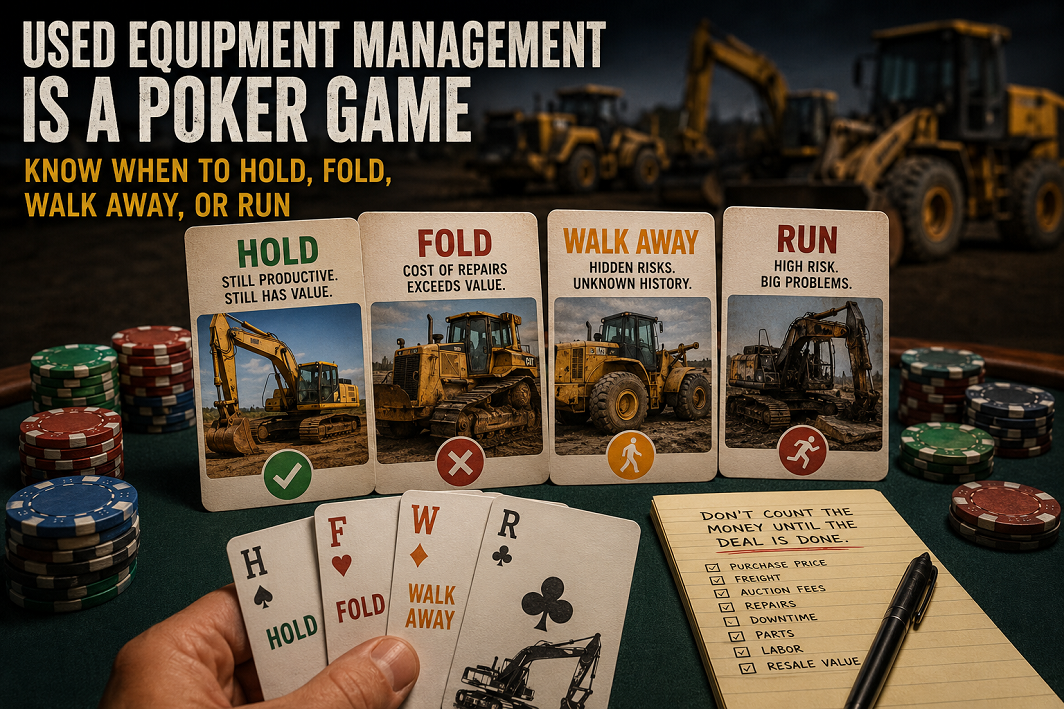
A good equipment owner has to know when to hold a machine, when to fold it, when to walk away from a deal, and when to run from a risk that cannot be priced.
And most important:
Do not count the money until the deal is done.
Read the table before you play the hand
Before deciding whether to buy, hold, repair, sell, trade, or auction a machine, the owner has to read the table.
That means looking beyond one auction result, one dealer listing, one market report, or one neighbor’s opinion.
Used equipment does not move in one simple market. Auction value, dealer retail value, private-sale value, trade value, wholesale value, and export value are different numbers. They reflect different levels of risk, support, buyer confidence, selling cost, freight exposure, and recourse.
A dealer may ask more because the dealer can often provide inspection, financing, parts support, service history, warranty options, and a relationship after the sale. A private seller may not offer any of that. An auction machine may sell as-is, where-is, with buyer fees, freight, inspection limits, and limited recourse. A wholesaler has to buy at a number that leaves room for repairs, holding time, transport, selling cost, and the possibility that the machine ends up back at auction.
That is why a single auction result can be misleading.
A machine may bring strong money at a major winter auction because bidders came from colder regions where spring work is about to start. Export buyers may be in town because they can see several machines in one place. A buyer from another country may pay more because the machine is unavailable in his market or because he cannot buy new through a dealer channel. A few serious bidders can push one machine above what the local market would support.
That does not automatically mean every similar machine is now worth that number.
The opposite is also true. A machine may bring weak money because of condition, hidden damage, poor photos, limited attendance, bad timing, freight cost, or a problem that was obvious to people on-site but invisible to someone looking only at results afterward.
The mistake is treating one sale as the market.
Used equipment management should be read more like a seasonal business. Compare February to February. Compare spring to spring. Compare similar machines by region, condition, seller type, hours, attachments, supportability, and timing. Do not compare one unusual auction result to another random sale and call it a trend.
That is the same reason HEPLANET has argued that used equipment market reports are easy to misread. Data is useful, but only when the buyer understands what the data does and does not show.
Auction results, dealer listings, and valuation tools all have a place. EquipmentWatch, for example, separates equipment values by disposition channel, including auction and retail/fair-market-value views through its Values & Market Data tools. That distinction matters because auction value and retail value are not the same hand.
A good player reads the table before betting the machine.
Know when to hold
A paid-off machine can be worth more to the owner than what the market says it is worth.
That is especially true when the owner still has work for it.
A machine that might only bring a modest price at auction can still be valuable if it saves the owner from renting a machine for a week here or a week there. It may not be a full-time production machine anymore, but it may still be a backup machine, a yard machine, a support machine, or a short-term project machine.
If it can do that work reliably enough, it may still be earning its keep.
The key question is not always:
What is this machine worth today?
The better question is:
What can this machine still do for me?
A high-hour machine can also be worth holding if the owner has already invested in the right repairs. The important part is not simply how much money has been spent. The important part is what has been done.
If the engine was rebuilt recently, the hydraulic pumps were replaced, the final drive was repaired, the undercarriage is still usable, and the swing bearing is not showing serious problems, the machine may have more useful life than its age or hours suggest. The owner already knows some of the biggest risks have been dealt with.
That does not mean the machine is perfect.
It means the owner understands the hand he is holding.
Wear items are part of the game. Bucket teeth, cutting edges, pins, bushings, tires, undercarriage, hoses, filters, belts, and other wear components are designed to take abuse so the machine does not. Keeping those parts within reasonable tolerance protects the larger machine.
Leaks should also be addressed. A small leak is not just a housekeeping issue. It can become a larger failure, contaminate other systems, create safety problems, or cause downtime at the worst possible time.
But not every worn machine needs to be sold.
An excavator with a weak undercarriage may be a poor choice if it needs to travel every day across rough ground. But that same machine may still be useful if it can sit in one area and load trucks, feed a crusher, dig in place, or serve as a backup machine with limited travel.
Application matters.
Reliability matters more than resale value when the machine has steady work in front of it. If the machine is paid off, supported, productive, and still fits the job, holding it may be smarter than chasing a high auction number.
This is where some owners misplay the hand.
They see a strong auction result and think they should cash out. They forget transportation, repair prep, commissions, fees, timing, and replacement cost. More importantly, they forget the machine’s production value.
If a machine can sell for $70,000, that sounds like money in the bank. But if that same machine can go to work and generate $20,000 of value before being sold later, the owner has to think carefully. Selling too early may feel like a win, but it can remove a productive asset from the fleet before the owner has finished using the hand.
Know when to hold.
Hold the machine when it is paid for, supported, productive, and still more useful to you than it is valuable to someone else.
Know when to fold
Holding too long is where many owners get hurt.
A machine enters the expensive part of its heavy equipment lifecycle when age, hours, and major component history start lining up against the owner.
A 10,000-hour machine is not automatically bad. But a 10,000-hour machine that has never had undercarriage work, hydraulic pump work, engine work, final drive work, or swing bearing work may be carrying several expensive repairs at the same time.
That is when the odds begin to change.
If the next likely repairs add up to 40% or 50% of the machine’s value, the owner should be thinking seriously about folding. In some cases, even a repair worth 25% of the machine’s value may not make sense if it does not improve resale value or protect a clear production need.
The repair type matters.
Some repairs improve heavy equipment resale value because they reduce the next buyer’s risk. A documented engine rebuild with low hours can help resale. Major hydraulic work can help if it is done properly and recorded. Recent major component repairs can make a buyer more comfortable because the buyer knows those failures are less likely to be immediately ahead.
Other repairs only keep the machine alive.
An undercarriage replacement may make a machine more sellable, but it may not always increase the price dollar for dollar. If the next buyer expects to put another few thousand hours on the machine, a good undercarriage helps, but it may not create the same value increase as a recent engine rebuild.
The owner has to separate repairs that improve value from repairs that only keep the machine moving.
A weak component is also different from a failed component.
A weak hydraulic pump may still allow the machine to run, demonstrate, and sell with a known discount. A failed pump changes the conversation. If the pump failed internally, it may have contaminated the hydraulic system. Now the problem may involve flushing lines, checking cylinders, cleaning the tank, replacing filters, inspecting valves, and dealing with unknown damage.
A machine that runs weak is still a machine.
A machine that is down becomes a gamble.
Once a machine cannot be run, the buyer cannot fully test what else is wrong. That uncertainty destroys value. A machine that might have been worth $50,000 while running could become a $10,000 problem after a major failure, because the next buyer has to price the unknowns.
That is why folding early can be the smart move.
Fold before the next repair forces your hand.
Do not wait until the machine is down, the job is waiting, and every option is bad.
Know when to walk away
Walking away is buying discipline.
A machine that needs work is not automatically a bad machine. Used construction equipment needs work. That is part of the business.
The problem is a machine hiding work.
If the seller is honest about the condition, the buyer can price the repairs. If the machine needs undercarriage, cylinders, tires, hoses, glass, pins, bushings, or service work, that can be included in the number. The buyer can decide whether there is enough room in the deal.
But when the seller tries to make the machine look better than it is, the question changes.
If someone removes a link from a track chain to make the undercarriage look tighter, that is not just an undercarriage issue. It is a trust issue. If someone replaces sprockets but leaves the rest of the worn undercarriage, the buyer has to ask what else is being dressed up. If the machine has careless paint, painted-over decals, new decals over old decals, mismatched panels, or a finish that hides more than it presents, the buyer should slow down.
Fresh paint is not always bad.
Many machines are painted for resale presentation. A good machine can be cleaned, painted, and detailed properly.
But a painted machine deserves a harder used equipment inspection than a machine wearing honest work clothes.
Structural damage is different. A machine that has rolled over, burned, been submerged, or suffered major frame damage carries unpredictable risk. Those machines may be repaired well enough to move, but the long-term effects can show up later in uneven wear, electrical failures, corrosion, stress cracks, hydraulic problems, or components that never sit exactly the way they should.
Saltwater exposure deserves special caution. Machines can be washed, cleaned, painted, and made to look presentable after flood or port exposure, but saltwater can hide in wiring, connectors, cavities, seams, pins, and places that do not show immediately. The damage may appear months or years later.
That is why insurance companies often treat flood-damaged machines as total losses.
A buyer should be careful about becoming the person who owns the problem after it has been cleaned up.
Seller language can also be a warning sign.
“Just needs a sensor” should make a buyer ask one simple question:
If it just needs a sensor, why did the seller not replace it?
Most sensors are cheaper than the value they can protect. If a minor fix would make the machine run properly and sell for more money, a rational seller usually fixes it. When the seller does not, the buyer should assume the problem may not be that simple.
The same applies to claims about recent repairs.
“We put a new engine in it” means very little without a date, hours, invoice, and details. A rebuilt engine installed 100 hours ago is different from a rebuilt engine installed 6,000 hours ago. At that point, it is just a used engine.
The more a seller talks to put the buyer at ease, the more careful the buyer should become.
A machine should sell itself through condition, records, performance, inspection, and supportability. A seller who is too eager, too vague, or too interested in explaining away problems may be telling the buyer that the story is stronger than the machine.
For buyers who want a more practical inspection framework, HEPLANET’s Used Excavator Inspection Guide explains how to look past appearance and evaluate repair exposure before bidding or buying.
Know when to walk away.
Walk away when the price looks attractive but the machine carries hidden condition, support, ownership, or market-fit risk that cannot be priced with confidence.
Know when to run
Walking away is discipline.
Running is survival.
There are some deals where negotiation is not the answer. The answer is to leave.
Run when the seller cannot prove ownership. Heavy equipment may not carry titles the way cars do, but the seller should still be able to provide a bill of sale, financing release, ownership record, invoice history, or some reasonable proof that the machine can be legally sold.
Run when the seller wants part of the deal off paper.
Run when someone asks for cash on the side.
Run when the machine has to be picked up immediately and the seller will not allow proper inspection.
Run when the seller refuses to let a mechanic inspect the machine.
Run when the serial number plate is missing and the backup frame stamp cannot be verified.
Run when the condition does not match the hours.
Suspicious hours are a major problem because hours help the buyer understand the machine’s lifecycle. A 4,000-hour machine and an 8,000-hour machine are at different points in their repair cycle. If the hour meter says one thing but the pedals, pins, bushings, undercarriage, seat, controls, panels, leaks, wear, and overall condition say something else, the buyer cannot trust the timeline.
That uncertainty matters more to an end user than to a broker.
A broker may buy a questionable machine if the price is low enough and the problems can be represented honestly. An end user who needs reliable production should be much more cautious. The end user has to live with the machine after the deal is done.
Electrical problems are another area where cheap can become expensive. A machine can be made to run with spliced wires, borrowed power, bypassed circuits, or field repairs that look clever in the moment but create years of troubleshooting later. Unless the buyer is prepared to replace a wiring harness or chase electrical problems properly, those machines can become nightmares.
Run when the problem cannot be defined.
If a machine will not start because a fuse is missing, the missing fuse may not be the problem. It may be the reason the seller does not want the machine to run. If a machine looks decent but someone has disabled it, the buyer should ask why.
The answer may be expensive.
One of the best cautionary examples is the cheap auction machine that looks odd but not obviously ruined.
A machine may have the wrong paint color, wrong decals, mismatched panels, an odd cab, or a presentation that does not line up with the model year. Each detail may seem small by itself. But together, those details can point to a machine that has been dressed up to distract from something larger.
In one case, an older wheel loader was painted in the wrong color and wrong paint scheme, with decals that did not match the machine series. It sold cheaply at auction. After it was loaded and headed toward the port, it began leaking badly. The machine had a hole in the transmission that had been patched, filled with oil, and painted over. Once the machine was run on the truck, the patch failed and the oil came out.
The buyer thought he had found an affordable machine.
Instead, he owned a major failure on an obsolete machine with parts that could not be found.
That is not a bad repair.
That is a hand you should never have played.
Know when to run.
Run when the paperwork is wrong, the story is wrong, the machine cannot be tested, the problem cannot be defined, or the seller is trying to pass risk to you that you cannot price.
Do not count the money until the deal is done
Buying a machine for less than expected is not the same as making money.
Selling a machine for more than you paid is not the same as making money either.
The real number is everything.
Purchase price is only the ante. The full equipment ownership cost may include auction fees, buyer premiums, taxes, freight, permits, insurance, cleanup, repair prep, service, oil samples, inspections, attachments, tires, undercarriage, field service, travel time, mileage, downtime, rental replacement, financing cost, interest, and the cost of keeping a customer happy if something fails right after delivery.
This is why auction buyers should review the actual auction terms and buyer fees before bidding. Ritchie Bros., for example, publishes its current buyer fees and terms of bidding and sale. The point is not that one auction company is good or bad. The point is that the hammer price is not always the final cost.
A buyer may think freight will be $3,000 without realizing that hauling a machine is not like driving a pickup across the state. The move may require permits, routing, escorts, a specialized trailer, and the first available truck. Suddenly the freight is $8,000.
A contractor may buy a machine at auction and send it straight to the job. But if the machine was not serviced, inspected, checked for oil, or gone through properly, the first job may reveal problems that were not obvious at sale time.
A seller may agree to include freight before knowing the real cost. The deal may still make money, but the margin can shrink quickly.
A dealer or reseller may sell a machine and then spend money after the sale because a problem shows up three days later. Now there is travel time, mileage, field labor, parts, phone calls, and customer pressure. The sale price looked good, but the final profit changed.
That is why used equipment people say you make your money when you buy the machine.
If you buy it right, you have room to survive the unknowns. If you overpay because you underestimated repairs, freight, downtime, or selling cost, the machine may never make the money you expected.
Owners should track everything from the day they buy the machine to the day it leaves the fleet.
What did the machine cost?
What did freight cost?
What repairs were done?
Which major components were replaced?
How many hours were added after each repair?
How much downtime occurred?
Did the machine require rental replacement?
Did it delay a crew?
Did it create emergency repairs?
What was it worth at sale, trade, or auction?
This matters because repair history tells the owner where the machine is in its lifecycle.
A swing bearing repair may make sense if the engine was recently rebuilt and the undercarriage is good. The same swing bearing repair may not make sense if the machine also needs undercarriage, pumps, final drives, and major structural work.
The decision is not just about today’s repair.
It is about the hand that is still coming.
Do not count the money until the deal is done.
And in used equipment ownership, the deal is not really done until the machine has worked, the costs are counted, and the exit is complete.
Parts support changes the odds
Every card game has odds. In used equipment management, parts support changes those odds.
A machine with strong dealer support, available parts, aftermarket depth, reman options, and local technician familiarity is easier to own, repair, and resell. A machine with weak support may still be useful, but it carries more risk.
That risk affects heavy equipment resale value.
A buyer may accept higher hours on a common machine with strong parts availability. The same buyer may discount a cleaner machine if parts are hard to identify, slow to ship, expensive to source, or poorly supported in the market where the machine will work.
That is why used equipment ownership is not only about condition. It is also about supportability.
HEPLANET’s How Parts Availability Affects Heavy Equipment Resale Value explains this in more detail. A used machine is worth more when the next owner believes it can be repaired quickly, supported affordably, and resold confidently.
A machine with poor parts support may still look like a playable hand.
But the odds are different.
Bottom line
Used equipment management is not about luck.
It is about discipline.
Hold the machine when it is paid for, supported, productive, and still useful to your fleet.
Fold when the next repair cycle is about to turn a running asset into a dead machine.
Walk away when the seller is hiding condition, support, or market-fit risk.
Run when the paperwork, serial number, seller story, structural condition, or undefined problem can turn a cheap machine into a total loss.
And never count the money until every cost is counted.
The best equipment owners do not simply buy machines.
They manage the hand.
They know the machine’s history. They understand the repair cycle. They read the used equipment market. They know the difference between production value and resale value. They know when auction results are signal and when they are noise. They know when a machine still belongs in the fleet and when it is time to let the next owner play the next hand.
That is the real skill in used equipment management.
Not guessing.
Not gambling.
Knowing when to make the next move.
About the Author
Frank Eusebio is a heavy equipment industry professional with more than 30 years of experience in construction equipment sales, equipment and fleet management, used equipment valuation, remarketing, dealer operations, and international equipment markets and auction consulting. His background includes Komatsu dealer operations, export markets, lease returns, dealer inventory strategy, and heavy equipment ownership economics. He also wrote, created, and implemented Develon’s remarketing program across its dealer network. At HEPLANET, he writes about equipment markets, fleet decisions, resale value, auction trends, parts availability, and the real-world costs that affect contractors, dealers, rental companies, and equipment owners.