Used Excavator Inspection Guide: What Buyers Should Check Before Bidding
Used excavators remain one of the most important machine categories in the heavy equipment market. Contractors, sitework companies, utility crews, demolition contractors, mining support fleets, and exporters all rely on excavators because they are versatile, productive, and widely supported across the construction equipment industry.
But buying a used excavator is not only about hours, paint, price, or brand. A machine that looks clean can still hide expensive problems in the undercarriage, hydraulic system, swing bearing, cylinders, engine, final drives, or electronic controls. For buyers at auction, the risk is even higher because inspection time may be limited and recourse after the sale may be minimal.
A proper used excavator inspection should answer one question:
Is this machine ready to work, or is it about to become someone else’s repair bill?
Why Used Excavator Inspection Matters
Used excavators can be excellent purchases when the machine has been maintained properly, inspected carefully, and priced according to its real condition. They can also become expensive mistakes when buyers focus only on the hour meter or the selling price.
The problem is that excavator wear is not always obvious from a quick walkaround. A machine may start, move, and dig during a short test, but still have problems that show up later under full load, heat, or production conditions.
Common hidden risks include worn undercarriage components, weak hydraulic pumps, leaking cylinders, sluggish travel motors, excessive swing play, contaminated hydraulic oil, engine blow-by, cooling system problems, electrical faults, cracked boom or arm structures, poor maintenance history, and limited local support.
For contractors, the cost is not only the repair itself. Heavy equipment downtime costs can delay jobs, increase rental expenses, reduce production, and create problems with bids and project schedules.
Start With the Machine’s Application History
Before inspecting the machine itself, try to understand what kind of life the excavator has had.
An excavator used in light utility work may age very differently from one used in demolition, quarry work, land clearing, pipe work, scrap handling, or heavy production digging. Two machines with the same hours can have very different wear levels depending on application, operator habits, ground conditions, maintenance discipline, and attachment use.
Look for evidence of previous owner type, type of work performed, region or ground conditions, dealer service records, maintenance intervals, attachment history, recent major repairs, and known issues disclosed by the seller.
A machine with 6,000 well-maintained hours may be a better buy than a poorly maintained machine showing 3,500 questionable hours.
Do Not Trust the Hour Meter Alone
Hour meters are useful, but they should never be the only basis for valuing a used excavator.
At auction especially, hour meters may not tell the full story. They can be replaced, disconnected, reset, malfunctioning, or simply misleading if the machine has spent most of its life in harsh work. Even when the hours are accurate, they do not tell you how the machine was treated.
A buyer should compare the hour meter against visible condition. Look at pedal wear, seat condition, control lever wear, cab interior wear, undercarriage condition, sprockets, rollers, pin and bushing movement, engine compartment condition, hydraulic hose age, paint wear around high-contact areas, and any weld repairs or cracks.
This is especially important when buying used heavy equipment at auction, where inspection time may be limited and hour meter risk can be difficult to verify before bidding.
If the hour meter says low hours but the machine looks heavily worn, trust the condition more than the meter.
Inspect the Excavator Undercarriage Carefully
The undercarriage is one of the most expensive areas of a used excavator, but it is also one of the easiest areas for a buyer to misunderstand.
An excavator undercarriage does not wear exactly like a dozer undercarriage. Dozers travel, push, and work under constant ground contact. Excavators may travel to reach the work area, but once they are positioned, they often spend much of the day digging, swinging, loading trucks, trenching, or working from one side.
That means excavator undercarriage wear can be uneven, internal, or harder to judge visually.
A buyer should not simply look at the track pads and assume the undercarriage is good. Excavator track shoes often show less obvious wear because the machine may not walk long distances every day. A bent track shoe can happen from walking over rock or uneven ground and is not automatically a sign of major damage unless several shoes are bent, cracked, loose, or damaged.
The more important concern is usually the track chain itself, especially the internal wear in the pins and bushings.
Count the Track Links Before You Trust the Undercarriage
One of the most practical auction-level checks is to count the track links.
Before buying or bidding on a used excavator, contact the local dealer with the machine model and serial number and ask how many links should be on the track chain. Then count the links on the machine one by one.
This matters because a worn excavator track chain can sometimes be made to look better by removing a link. Removing a link pulls the idler back and tightens the chain. That can reduce visible sag and make the undercarriage appear healthier than it really is.
The problem is that the wear may still be there internally. The pins and bushings inside the track chain may be worn, but because the chain has been shortened, the track looks tighter from the outside.
That is why link count matters. If the machine is supposed to have a certain number of links and one has been removed, the buyer should treat that as a warning sign. It does not automatically mean the machine is worthless, but it does mean someone may have already tried to extend the life of a worn chain instead of replacing it.
The track chain is usually the most expensive part of the excavator undercarriage. Rollers, pads, sprockets, and idlers matter, but if the chain is worn out or has been shortened to hide wear, the buyer needs to price the machine accordingly.
Listen for Squealing or Jumping Tracks
Noise can tell you a lot.
A squealing track chain should be looked at closely. It may be a sign that the track is too tight, which can happen after a link has been removed. Tight tracks can put extra stress on the undercarriage and can hide the real amount of internal chain wear.
Also watch the track chain as it moves around the sprocket and idler. The chain should flex smoothly as the links rotate. If the excavator has been sitting for a long time, some links can become stiff or partially seized. When that happens, the track may jump as it goes around the sprocket.
A jumping or stiff chain is not always the same as a completely worn-out chain, but it is still a problem. If the links are seized or do not flex properly, the machine may need track work even if the undercarriage does not look fully worn out.
A stiff or jumping track can also increase the risk of throwing a track, especially when turning or working on uneven ground.
Look at Rollers, Sprockets, Idlers, and Adjuster Position
Carrier rollers are often one of the more obvious visible wear points. At auctions, they may be replaced before sale because they are easy to see and relatively straightforward to dress up.
New carrier rollers are not automatically bad, but they should make the buyer look deeper.
Ask the basic question:
Why were the rollers replaced?
If the rest of the undercarriage looks worn but the carrier rollers are new, the seller may have replaced the most visible parts while leaving the expensive track chains for the next owner.
The sprockets should also be inspected. Worn sprocket teeth can indicate chain wear, poor engagement, or a chain that has been run too long.
The idler guides the chain around the front of the track frame, but idler condition can be difficult to judge visually unless wear or damage is severe.
The track adjuster is part of the same inspection. The adjuster holds pressure against the idler to keep the track properly tensioned. If the idler position looks unusually far back, or if the chain seems tight but the machine should have more visible wear, that can be another reason to verify the correct link count.
Do Not Overread Track Shoes Alone
Track shoes, also called pads, are important, but they should not be the only undercarriage clue.
Excavator shoes may not wear heavily if the machine has spent more time stationary and digging than traveling. A few bent shoes can happen in normal work if the excavator walks over rock, debris, or uneven ground. That does not automatically indicate major undercarriage failure.
However, widespread damage is different. Multiple bent shoes, missing bolts, cracked pads, loose hardware, or uneven shoe damage can suggest rough use, poor maintenance, or hard jobsite conditions.
The better inspection is not just:
Do the pads look good?
It is:
Are the correct number of track links still installed? Does the chain flex smoothly? Are any links seized? Do the tracks squeal or jump? Are the sprockets worn? Were visible rollers replaced while the chain was ignored? Does the idler and adjuster position make sense? Are pads, bolts, and hardware intact?
That is a much more useful undercarriage inspection than simply looking at the pads from a distance.
Check Pins, Bushings, Boom, and Arm Wear
Pins and bushings tell a lot about how an excavator has been maintained.
Start at the bucket linkage, then work back through the stick, boom, and main pivot areas. Watch for excessive movement, knocking, oval-shaped wear, loose joints, poor grease condition, and visible metal wear around the bosses.
Important areas include the bucket pins and bushings, H-link and bucket linkage, stick-to-bucket connection, stick cylinder mounting points, boom-to-stick connection, boom foot pins, swing frame area, grease lines, and grease fittings.
A small amount of movement may be acceptable on an older machine, but excessive play can affect digging accuracy, bucket control, attachment fit, and long-term structural wear.
Also look closely for cracks or repairs around the boom, arm, bucket linkage, and main frame. Weld repairs are not always a deal-breaker, but poor repairs, repeated cracks, or structural damage should raise serious concern.
Test the Hydraulic System Under Load
Hydraulics are the heart of an excavator. A used excavator with weak hydraulics can be expensive to repair and frustrating to operate.
Do not judge the hydraulic system only by whether the machine moves. A weak pump, leaking cylinder, relief valve issue, contamination problem, or control issue may not show up until the machine is hot or working under load.
During inspection, test the boom raise and lower speed, arm in and out speed, bucket curl power, swing speed and control, travel power, straight tracking, multi-function operation, hydraulic noise, hydraulic temperature, cylinder drift, and response under load.
A strong machine should be able to perform multiple functions smoothly. If the excavator becomes sluggish when using more than one function, or if it struggles once warm, the hydraulic system may need deeper diagnosis.
Check all visible cylinders for scoring, leakage, pitting, damaged rods, wet seals, or fresh cleaning that may hide leaks.
Look for Hydraulic Leaks and Contamination
Leaks are not just cosmetic. Hydraulic leaks can indicate worn seals, damaged rods, loose fittings, aged hoses, pressure issues, or poor maintenance.
Inspect the boom cylinders, arm cylinder, bucket cylinder, swing motor area, main control valve, hydraulic pump compartment, travel motors, final drives, hose connections, hydraulic tank, and cooler lines.
Also look at the hydraulic oil itself if possible. Milky oil, burnt smell, heavy discoloration, or visible contamination can indicate water, heat, internal wear, or poor service practices.
Hydraulic contamination is especially serious. A failed pump or motor can send metal through the system. Replacing the failed component without properly cleaning the hydraulic system can lead to repeat failures.
Inspect the Engine and Cooling System
A used excavator engine should start cleanly, idle smoothly, accelerate properly, and work without excessive smoke, overheating, knocking, or blow-by.
When inspecting the engine, check cold start behavior, smoke, blow-by, oil leaks, fuel leaks, coolant leaks, belt condition, fan condition, radiator and cooler cleanliness, exhaust condition, engine mounts, unusual noise, warning lights, and active codes.
A machine that starts easily after already being warmed up may not tell you much. A cold start is more revealing.
Pay close attention to the cooling package. Excavators often work in dusty, muddy, or debris-filled environments. Plugged radiators, oil coolers, and aftercoolers can cause overheating and shorten component life.
Understand What Oil Analysis Can and Cannot Tell You
Oil analysis can be useful, but only when the buyer understands what it is actually measuring.
A clean oil sample does not automatically mean a used excavator is healthy. At auction, many machines may have fresh oil before sale. That does not necessarily mean the machine was properly serviced through its life. It may simply mean the oil was drained and replaced because clean oil looks better.
That creates a problem for buyers.
Oil analysis measures what is in the oil at that moment. If the oil was recently changed, the sample may come back clean because the oil has not run long enough to collect wear metals, contamination, fuel dilution, coolant, or other warning signs.
On the other side, a poor oil sample does not always prove the machine is failing. If the oil was supposed to be changed at 250 hours but was run for 500 or 700 hours, the sample may show elevated metals simply because the oil was used beyond its normal interval. Without knowing when the oil was changed and how many hours are on that oil, the sample is hard to interpret.
The real value of oil analysis comes from history.
A strong oil sample program tracks the machine over time, at proper service intervals, across major compartments such as engine oil, hydraulic oil, final drives, swing drive, transmission or drivetrain compartments where applicable, and coolant when tested separately.
When samples are taken consistently, the reports can show trends. Rising copper, iron, aluminum, silicon, fuel dilution, coolant contamination, or other abnormal readings can point toward developing problems. But one isolated sample, especially from fresh oil, has limited value.
That is why buyers should be careful when a seller says:
“Oil analysis was done.”
The better questions are:
- When was the oil changed?
- How many hours are on the oil sample?
- Is there a history of previous samples?
- Were samples taken at proper intervals?
- Which compartments were tested?
- Are the reports available?
- Were any abnormal results disclosed?
- Was the oil changed immediately before sale?
For dealer-certified used equipment, oil analysis should be part of the inspection process. But even then, a single sample from a machine with unknown history should not be treated as proof that the machine is problem-free. It is one data point, not a guarantee.
The best oil analysis is not a one-time test. It is a maintenance history. Without that history, buyers should use oil sampling carefully and avoid letting a “clean” report replace a full inspection.
Check Swing Bearing and Swing Drive Condition
The swing system is another high-cost area that buyers sometimes overlook.
Rotate the upper structure slowly and listen for grinding, popping, clunking, or uneven movement. Check for excessive play between the upper frame and lower frame. A worn swing bearing, swing motor, or swing gearbox can be expensive and labor-intensive to repair.
Look for excessive swing play, noise while rotating, delayed swing response, oil leaks around the swing drive, uneven rotation, loose swing bearing bolts, damaged bolts, and poor grease condition around the swing bearing.
If possible, use the boom and bucket carefully to check for abnormal movement in the house. Excessive movement can indicate swing bearing wear.
Test Travel Motors and Final Drives
Travel motors and final drives are critical, especially for machines that move frequently around jobsites.
Test both travel directions and check whether the machine tracks straight. A machine that pulls to one side may have an issue with a travel motor, final drive, brake, hydraulic flow, or undercarriage resistance.
Inspect for final drive leaks, travel motor noise, weak travel power, uneven tracking, jerky movement, oil leakage, and damage around final drive housings.
A final drive problem can be expensive, and on some machines parts availability can affect downtime more than the repair itself.
Inspect the Cab, Controls, and Electronics
The cab can reveal how the machine was treated.
Check the monitor display, warning lights, fault codes, joystick response, pedals, travel levers, seat condition, air conditioning, heater, wipers, cameras, lights, safety alarms, windows, doors, and cab mounts.
Modern excavators rely heavily on electronics. Fault codes, intermittent wiring issues, sensor failures, and display problems can create downtime even when the engine and hydraulics are mechanically sound.
If the machine has multiple work modes, attachments, camera systems, grade control, telematics, or emissions systems, confirm they are functioning properly.
Review Bucket and Attachment Condition
The bucket and attachments are part of the machine’s real working value.
Inspect the bucket shell, cutting edge, side cutters, teeth and adapters, bucket ears, pin holes, quick coupler condition, hydraulic thumb, auxiliary hydraulic lines, attachment controls, cracks, and weld repairs.
A worn bucket may not be a major concern, but damaged couplers, loose pin bores, cracked attachment points, or leaking auxiliary lines can affect safety and productivity.
Also consider whether the machine is configured for the attachments you need. Adding auxiliary hydraulics, couplers, thumbs, or specialized attachments after purchase can increase the real cost of the machine.
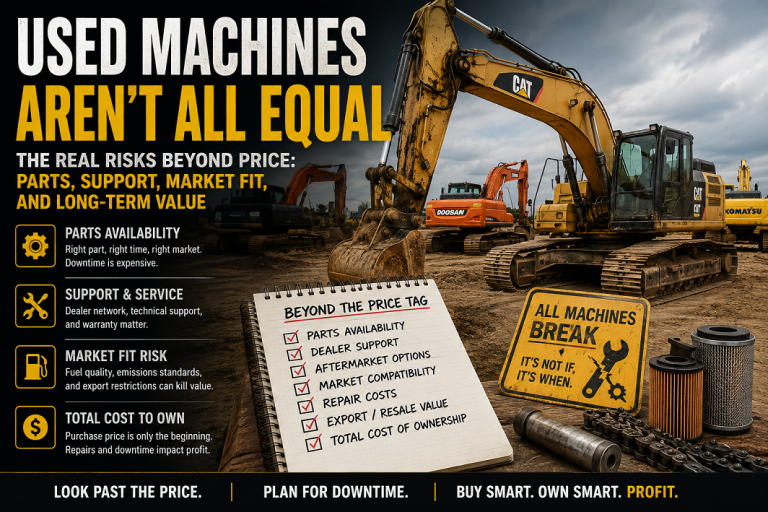
Check Parts and Support Risk Before You Buy
Parts availability matters, but it needs to be understood realistically.
If you are buying a major excavator brand with strong machine population in the U.S., such as Caterpillar, Komatsu, John Deere, Hitachi, Volvo, or similar established brands, you generally have multiple support paths. The dealer may not stock every major component locally, but there is usually a broader network behind the machine.
That support may include local dealer inventory, regional or national OEM warehouses, other dealer locations, aftermarket suppliers, used parts suppliers, independent mechanics familiar with the brand, and rebuild options for cylinders, pumps, motors, and components.
That does not mean every part is sitting on a shelf. Even major brands may not have a pump, wiring harness, cab part, or final drive immediately available at the local branch. But they usually have a system for sourcing parts, identifying components, checking other inventory, and supporting the machine.
The bigger risk comes when a buyer purchases a less-supported machine in their market.
Some brands may be good machines in the right country or region, but have weaker dealer coverage, thinner parts inventory, limited aftermarket support, and fewer technicians familiar with them in the U.S. A machine can be mechanically sound and still become difficult to own if the support network is weak.
That matters at auction because buyers may be attracted to a lower purchase price without understanding the long-term ownership risk. A less common machine may save money on sale day but cost more later if a simple repair turns into weeks of downtime.
The question is not just:
Can I buy this excavator cheaply?
The better question is:
Can I keep this excavator working when it breaks?
For contractors, downtime is often more expensive than the part itself.
Dealer-Certified Used Equipment Is Helpful, But Not Automatic Protection
Dealer-certified used equipment can reduce risk, but buyers should not treat it as a guarantee that the machine is perfect.
Used equipment certification programs were originally built around a practical dealer need. Dealers operate in territories, and keeping used machines in the territory helps support future parts sales, service work, technician utilization, and parts inventory turns. A dealer cannot justify strong parts inventory or a large service team if there are not enough machines working in its market.
Certified used programs also help dealers trade machines between locations or territories with a common understanding of condition. In theory, a certified machine should have been inspected, classified, repaired where necessary, and represented honestly.
In practice, certification quality depends heavily on the dealer.
Over time, “certified used” can become part inspection program, part marketing tool, and part financing strategy. A dealer may know a rental machine is generally good because it came out of its own fleet, but that does not always mean every step of a deep certification process was completed.
Buyers should also understand that certification levels can vary. A lower-grade certified machine may still be considered work-ready while allowing some leaks, wear, cosmetic problems, or components that are not at full performance. It may qualify for financing but not necessarily for full warranty protection.
The lesson is simple:
Dealer-certified is better than unknown, but it is not a substitute for inspection.
A serious dealer certification should include clear condition reporting, service history, repair documentation, warranty terms if applicable, and transparency about what was and was not repaired.
Auction Inspections Help, But They Do Not Remove Buyer Risk
Online auction inspection reports can be useful. Platforms such as IronPlanet and Ritchie Bros. may provide photos, descriptions, operational notes, and inspection details that help buyers feel more comfortable bidding remotely.
That has real value. A buyer who cannot physically inspect every machine can still review photos, see visible condition, check basic operation, and compare machines before bidding.
But buyers should understand what these inspections usually are — and what they are not.
Most auction inspections do not connect the engine to a dyno. They do not bench-test the hydraulic pumps. They do not fully measure every undercarriage component with dealer tooling. They usually do not simulate days of jobsite production under heat, load, dust, and real working conditions.
In many cases, the machine is started, photographed, operated through basic functions, and described based on what the inspector can observe at that time.
That is helpful, but it is not the same as a full dealer inspection, hydraulic performance test, oil analysis history, or component teardown.
Guarantee programs can also give buyers confidence, but the practical timing matters. By the time a buyer pays for the machine, arranges transport, receives it, puts it to work, and discovers a deeper problem, the guarantee window may be limited or already expired. These programs may still have value, but they should not encourage buyers to ignore risk.
The safest auction mindset is:
Use the inspection report, but bid as if you still own the uncertainty.
Auction buying can work well for experienced buyers, but it is still buyer-beware. The more expensive the machine, the more important it is to understand what the report does not prove.
A Practical Used Excavator Inspection Framework
A used excavator inspection should focus on the areas most likely to create expensive repairs or downtime.
1. Confirm the identity and history
Verify the serial number, model, year, hour meter, ownership history, and available service records. If the hour meter looks low but the machine condition looks heavily worn, trust the condition more than the meter.
2. Count the track links
Before judging the undercarriage visually, confirm how many track links should be on the machine and count them. A removed link can hide internal chain wear and make the track appear tighter than it really is.
3. Watch and listen to the tracks
Move the machine if possible. Listen for squealing, popping, jumping, or stiff links moving around the sprocket. The chain should flex smoothly. Stiff or seized links can mean track work is coming even if the undercarriage does not look completely worn out.
4. Test hydraulic performance under load
Operate the boom, arm, bucket, swing, and travel functions. Test more than one function at a time. A machine that works slowly, loses power when warm, drifts, or struggles under load may have hydraulic pump, valve, cylinder, or contamination issues.
5. Look for leaks, but do not stop at leaks
Visible leaks matter, but so do fresh cleaning, wet fittings, damaged cylinder rods, worn hoses, oil smell, hydraulic noise, and signs that a problem was wiped down before sale.
6. Inspect pins, bushings, boom, and arm structure
Check the bucket linkage, stick, boom, and main pivot areas for excessive play, cracking, poor weld repairs, missing grease, and loose movement. A machine with loose linkage may still work, but it should not be priced like a tight machine.
7. Test swing and travel
Check for swing play, swing noise, weak travel, final drive leaks, and whether the machine tracks straight. Swing bearing, swing drive, and final drive repairs can be expensive.
8. Evaluate support risk
For common major brands, support is usually available through dealers, aftermarket, rebuilders, and used parts channels. For less-supported brands in the local market, the buyer needs to think harder about downtime, technician familiarity, and parts access before bidding.
9. Price the machine after the inspection, not before
The selling price only matters after the buyer understands what the machine may need. A cheap excavator with hidden undercarriage, hydraulic, or support problems can quickly become more expensive than a cleaner machine that sold for more.
Final Thoughts: Buy the Condition, Not Just the Price
A used excavator should be judged by condition, supportability, and ownership risk — not just age, hours, paint, or auction price.
The best purchase is not always the cheapest machine. It is the machine that can go to work, stay productive, and be supported when repairs are needed.
For contractors and equipment buyers, a proper used excavator inspection can protect cash flow, reduce downtime, and prevent a low purchase price from turning into a high ownership cost.
Before buying or bidding, look beyond the surface. Inspect the undercarriage, hydraulics, engine, structure, swing system, travel motors, electronics, attachments, support network, and maintenance history. When in doubt, bring a qualified mechanic or inspector.
In the used heavy equipment market, the real value of an excavator is not what it looks like on sale day. It is what it costs to own after the job starts.