High-Reach Demolition Excavator Demand Is Growing
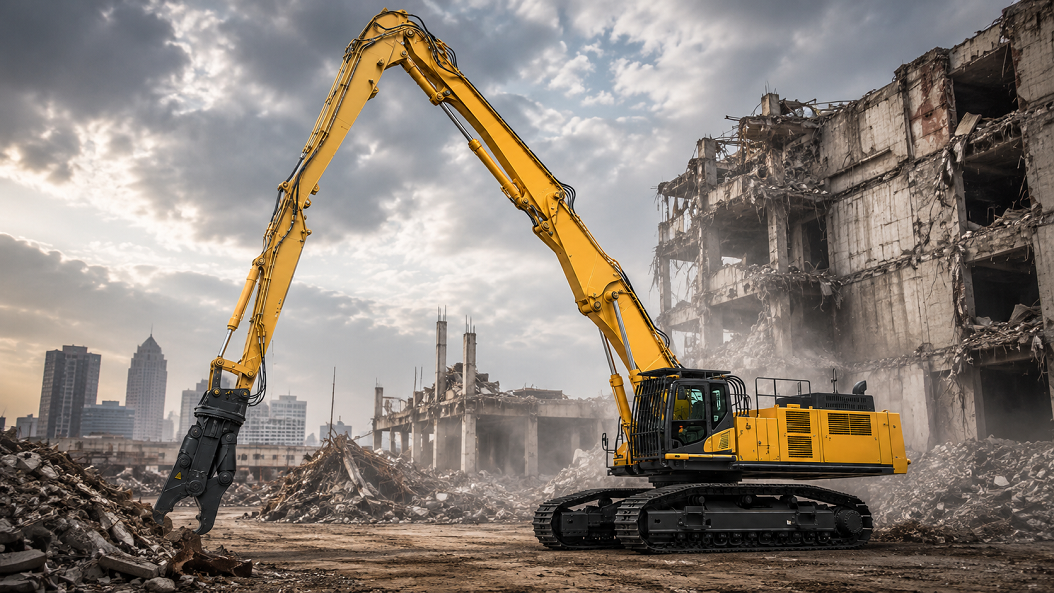
High-reach demolition excavator demand is growing as demolition work becomes more specialized, more urban, and more dependent on purpose-built machines.
A longer boom and arm solve a reach problem, but they also create a capacity problem. More reach means more leverage, more stress through the front, and less attachment capacity compared with a standard digging configuration. Contractors do not use a high-reach demolition excavator because they want to give up strength. They use it because the job requires reach, access, or controlled dismantling that a standard excavator cannot safely provide.
That is why Kobelco’s SK1300DLC-11 deserves attention.
Kobelco did not invent the high-reach demolition excavator, and it is not alone in the category. Cat, Komatsu, Volvo, Liebherr, Hitachi, Sennebogen, and specialty conversion companies all serve parts of the demolition, long-reach, high-reach, recycling, and material-handling market.
The signal is more specific: Kobelco and Volvo are using larger, purpose-built demolition excavators to stand out in a specialty segment where application engineering can matter more than general excavator population.
That matters because high-reach demolition is not a normal excavator market. The buyer is not shopping only by horsepower, bucket size, acquisition price, or dealer familiarity. He is asking whether the machine can safely reach the structure, carry the right tool, move between jobs, protect the operator, manage hydraulic demand, and stay working under a demanding demolition sequence.
In that market, a purpose-built high-reach demolition excavator can say something that a general excavator lineup cannot.
High-Reach Demolition Excavator Demand Is Changing
The physics of high-reach demolition have not changed.
A longer front still reduces practical capacity. A converted machine still carries compromises. Tool weight still drops as reach increases. Stability still matters. Transport is still expensive. The machine still needs the right operator, attachment, hydraulics, guarding, and dealer support.
What is changing is demand.
Cities are denser. Older structures are aging. High-rise redevelopment, selective demolition, bridge work, industrial teardown, and urban refit projects are creating more situations where a standard excavator cannot safely or efficiently do the work.
Not every demolition contractor needs a 130-foot or 160-foot machine. Most do not. But the jobs that do need that reach are specialized enough that OEMs are paying attention.
That is the better way to read the Kobelco SK1300DLC-11 and Volvo EC950 High Reach. They are not proof that every contractor needs a larger demolition machine. They are proof that OEMs see enough specialized demolition demand to justify larger purpose-built platforms at the top end.
For more market context, see our broader heavy equipment market report coverage and our related analysis of heavy equipment demand and support infrastructure.
Purpose-Built Demolition Excavators Reduce the Compromise
A high-reach conversion can solve an access problem, but it does not turn a standard excavator into a purpose-built demolition excavator.
When a standard machine is converted to a longer front, the contractor gains reach but gives up capacity. The load is farther from the machine, and the stress moves through components that were not originally optimized around that application.
Conversions still have a place. Long-reach and specialty fronts have been used for slope work, dredging, pond and river work, below-grade reach, selective demolition, and jobs where access mattered more than raw digging force.
Structural demolition is different.
A demolition excavator may be carrying a processor, shear, pulverizer, crusher, or grapple at height. It may be working around falling material, rebar, dust, unstable concrete, tight urban access, and limited sightlines. It may need to change fronts, move between jobs, meet transport limits, and support more than one demolition method.
That is where an OEM-built high-reach demolition excavator matters.
The base, counterweight, undercarriage, hydraulics, guarding, cab, boom-change system, stability monitoring, transport package, and attachment strategy are designed around the work from the start.
The point is not just more reach.
The point is reducing the compromise.
Kobelco Is Making a Specialty-Market Statement
The Kobelco SK1300DLC-11 is positioned as a 130-ton class demolition excavator with 512.3 horsepower and an operating weight range listed by Kobelco at 279,100 to 302,000 pounds.
The 130-foot reach gets the attention, but the configuration flexibility is the more important demolition story.
The SK1300DLC-11 is designed around multiple boom options and demolition configurations. In high-reach demolition, maximum height and maximum tool weight are not the same conversation. A machine may need a lighter tool at maximum height, then a much heavier tool in a lower-height or foundation configuration.
That is where Kobelco’s positioning gets interesting. Equipment World reported that the SK1300DLC-11 can handle up to 21,000 pounds in Normal mode, while Kobelco’s configuration strategy also supports heavier foundation work in lower-reach setups. Those figures should not be confused with maximum tool weight at full 130-foot reach. They show the value of a machine designed for multiple demolition configurations rather than one long-front application.
A contractor does not always need the highest possible reach. Sometimes he needs a heavy tool at a lower working height. Other times he needs reach, control, and sequence. A serious high-reach demolition excavator has to cover more than one version of the job.
Kobelco is not trying to beat Cat, Komatsu, or Deere by U.S. excavator population with a machine like this. It is trying to stand out in a specialty lane where the customer is already looking for a problem-solving machine.
In general excavation, population and dealer footprint are hard to overcome. In specialty demolition equipment, the conversation can shift toward whether the OEM has a machine that solves a job others cannot solve as efficiently.
Volvo Is Pushing the Same Idea at the Top End
Volvo’s EC950 High Reach shows the same market direction at an even larger scale.
Volvo introduced the EC950 High Reach as its largest demolition excavator, with an operating weight of more than 400,000 pounds, a maximum height of 161 feet, and a 7,500-pound tool rating.
That comparison matters.
Kobelco is not alone at the upper end. Volvo is also using a very large, purpose-built demolition excavator to make a specialty-market statement.
The difference is that Kobelco and Volvo are now highly visible in a part of the market where Cat and Komatsu’s current North American high-reach offerings, while serious, are generally smaller. The Komatsu PC490HRD-11 reaches 104.3 feet with a 5,512-pound max attachment in extended high-reach configuration. The Cat 352 UHD reaches up to 90 feet with an 8,157-pound tool.
That does not make Cat or Komatsu weak in demolition. It means their promoted North American models sit in a different size class.
Kobelco and Volvo are using size, modularity, and purpose-built demolition design to differentiate themselves in the upper reach segment.
Bigger Is Not Automatically Better
The danger in this category is assuming bigger automatically means better.
It does not.
A large high-reach demolition excavator only makes sense when the work supports the cost. Mobilization, transport, permits, escorts, setup time, teardown time, front changes, attachment selection, operator skill, service support, and utilization all affect the economics.
A machine with 130 feet or 161 feet of reach can be a competitive advantage on the right job. It can also become an expensive underutilized asset if the contractor does not have the project pipeline to keep it working.
That is why these machines should be viewed as specialty production assets, not general fleet additions.
The contractor buying one has to know the work is there. The rental company has to know regional demand exists. The dealer has to support the application. The lender has to understand the narrower buyer pool and used-equipment risk.
A standard excavator can move across many applications. A purpose-built high-reach demolition excavator has a more specific market. That specificity can create pricing power when the right job appears, but it can also limit liquidity when the owner needs to sell.
Tool Capacity Is the Real Buying Question
In high-reach demolition, reach gets the headline, but tool capacity decides the work.
A machine that reaches the structure but cannot carry the right attachment is not the right machine. Concrete, steel, mixed demolition, bridge work, industrial demolition, and foundation work all put different demands on the front.
That is why Kobelco’s configuration flexibility matters. The reported 21,000-pound Normal mode figure should not be confused with maximum tool capacity at the full 130-foot high-reach setup. It shows the value of a machine designed for multiple demolition configurations rather than one long-front application.
The practical question is not only, “How high does it reach?”
The better question is, “What tool can it carry at the height and position where I actually need to work?”
That is where purpose-built demolition excavators separate themselves from converted machines.
Transport Is Part of the Machine
Large demolition excavators do not earn money until they can be moved, assembled, inspected, and put to work.
Transport is not a side issue. It is part of the machine’s economics.
Counterweights, boom sections, stick sections, track frames, guarding, tools, and support equipment all have to be moved. Component weights, permits, escorts, route planning, cranes, rigging, setup time, and teardown time can decide whether the machine makes financial sense.
That is why modular design matters in high-reach demolition.
A large high-reach demolition excavator has to be more than strong. It has to be movable. It has to be set up efficiently enough that mobilization does not erase the job margin.
This is also where dealer and factory support matter. A contractor does not want to be learning the machine for the first time on a tight urban demolition job.
For related ownership math, see our guide to buying vs. renting construction equipment.
Operator Protection and Visibility Are Core Features
Demolition is not standard excavation.
Falling material, dust, steel, concrete, glass, utilities, unstable structures, changing work faces, and tight urban conditions put the operator in a different risk environment.
That is why cab protection, visibility, guarding, cameras, tilting cabs, emergency systems, and stability monitoring belong in the core machine discussion. They are not accessories in high-reach demolition. They are part of the production system.
The operator must be protected, but he also has to see and feel the job. That balance is hard to achieve with a converted machine.
Purpose-built demolition excavators are designed around the reality that the operator is working near what is being taken apart, often at height, with expensive consequences if the wrong move is made.
Used High-Reach Demolition Excavators Need a Different Inspection
High-reach demolition excavators do not age like clean dirt machines.
Hours matter, but application history matters more.
A used demolition excavator with relatively low hours can still have a hard life if those hours were spent carrying heavy attachments, working at height, running hot, moving around debris, or operating in severe demolition conditions.
The inspection has to go beyond the meter.
Boom and front repairs, cracks, pin bosses, bushings, cylinder rods, hydraulic heat, auxiliary lines, guarding, cab condition, swing bearing, carbody, undercarriage, electronic faults, cooling package, and attachment history all matter.
The front-end structure is especially important. Demolition loads are not the same as normal excavation loads. A machine can look good from a distance and still carry expensive structural or hydraulic risk.
That is why used high-reach demolition excavators are specialty assets.
The right machine can be valuable. The wrong one can be hard to unwind.
For related inspection logic, see our used excavator inspection guide and equipment downtime cost coverage.
What This Means for Dealers and OEMs
For OEMs, specialty demolition equipment offers a way to differentiate beyond general excavator market share.
That does not reduce the importance of dealer support. It increases it. A contractor buying a large high-reach demolition excavator needs confidence that the dealer can support the application, not just sell the model.
Parts availability, field service, technician knowledge, hydraulic support, attachment support, transport experience, and factory access all matter.
For brands with smaller general machine population, specialty machines can create visibility in a market where buyers are focused on capability. But that visibility only turns into credibility if the support system holds up.
That is the test for Kobelco.
The SK1300DLC-11 can get attention on size and configuration. Keeping contractors confident after the sale is where the market will judge it.
For a broader look at this issue, see our article on construction equipment dealer support.
FAQ: High-Reach Demolition Excavators
What is a high-reach demolition excavator?
A high-reach demolition excavator is a purpose-built or specially configured excavator designed to work at height with demolition attachments such as processors, shears, pulverizers, crushers, or grapples. The machine is used when a standard excavator cannot safely or efficiently reach the work.
Why are purpose-built demolition excavators different from converted excavators?
Purpose-built demolition excavators are designed around demolition from the start. The base machine, counterweight, undercarriage, boom system, hydraulics, guarding, cab protection, stability systems, and transport package are engineered for the application. A converted excavator may gain reach, but it usually gives up capacity and adds stress.
Is the Kobelco SK1300DLC-11 the largest high-reach demolition excavator?
No. Volvo’s EC950 High Reach is larger in maximum height and operating weight. The Kobelco SK1300DLC-11 is still a very large purpose-built demolition excavator and sits above common Cat and Komatsu North American high-reach models in reach and operating weight.
Why does tool capacity matter in high-reach demolition?
Tool capacity matters because reach alone does not remove concrete, steel, or structural material. The machine must carry the right attachment at the working height and position required by the job. Maximum reach and maximum tool weight are usually different configurations.
Should contractors buy or rent a high-reach demolition excavator?
Contractors should buy a high-reach demolition excavator only when they have the job pipeline, operators, transport plan, maintenance discipline, dealer support, and utilization to keep it working. For occasional high-reach work, renting or subcontracting may control risk better than ownership.
The Bottom Line
Kobelco’s SK1300DLC-11 is not important because Kobelco invented high-reach demolition.
It did not.
The machine matters because Kobelco is using a large, purpose-built demolition platform to compete in a specialized segment where application engineering can matter more than broad excavator population.
Volvo’s EC950 High Reach points in the same direction at an even larger scale. Cat and Komatsu remain serious players in demolition, but their current North American high-reach offerings sit in a smaller size class than Kobelco’s SK1300DLC-11 and Volvo’s EC950 High Reach.
The broader signal is that high-reach demolition excavator demand is becoming more visible as cities densify, older structures age, and contractors face more selective, complex, and urban demolition work.
A high-reach demolition excavator is still a compromise unless the job requires it.
Purpose-built machines are how OEMs reduce that compromise.
The contractor that buys the right one is buying capability.
The contractor that buys reach without the work, support, transport plan, and operator skill is buying risk.