How Parts Availability Affects Heavy Equipment Resale Value
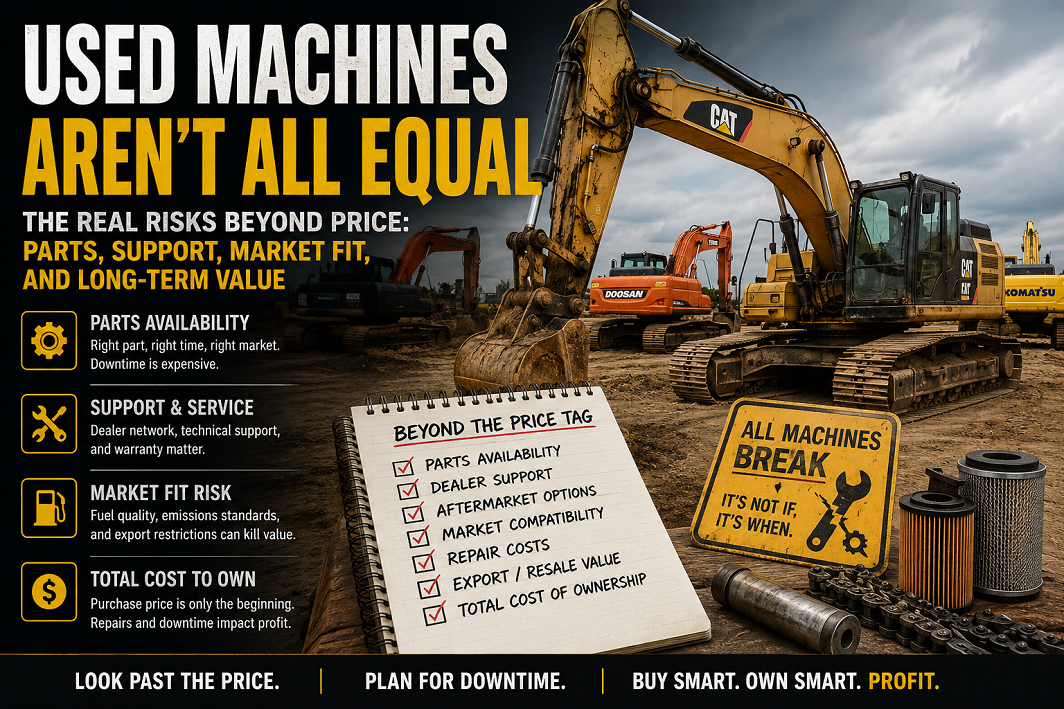
Parts availability affects heavy equipment resale value because buyers are not only buying the machine. They are buying the ability to keep that machine working.
Year, hours, brand, model, condition, attachments, and application all matter. But a clean used machine can still carry hidden value risk if parts are hard to identify, slow to ship, expensive to source, or poorly supported in the market where the machine will work.
A used excavator, wheel loader, dozer, backhoe, compact track loader, forklift, crane, paver, or truck is valuable because it can produce work. If the next owner is unsure whether the machine can be repaired quickly and affordably, that uncertainty affects what the machine is worth.
The real question is not only “Can it do the work?”
Contractors often evaluate equipment in practical terms: does it start, does it run strong, does the operator like it, can it do the job, and is the price attractive?
That makes sense. A machine has to work.
But the bigger ownership question is what happens after the machine goes to work.
All heavy equipment wears and eventually breaks. Pins, bushings, undercarriage, hydraulic cylinders, pumps, final drives, sensors, wiring, monitors, controllers, emissions systems, cooling systems, brakes, tires, tracks, and attachments all create repair risk over time. The harder the machine works, the more important the support system becomes.
The machine’s real value depends on how quickly and affordably the owner can bring it back to work.
A lower purchase price can disappear quickly if the machine sits for weeks waiting on the right part.
Parts availability is not just a brand question
It is easy to think parts support is only about the brand. That is part of it, but it is not the whole story.
A major OEM can have excellent support overall, but a specific machine can still create parts problems if it was built for a different market, imported from another region, or falls outside the serial-number range normally supported by local dealers.
Heavy equipment parts books are often serial-number specific. The same part location in a manual may show different part numbers depending on serial number, build date, market configuration, emissions arrangement, or machine specification.
That means two machines with the same brand name and similar size are not automatically equal from a support standpoint.
A machine built for the U.S. market may be easy for a U.S. dealer to support. A similar machine imported from Europe, Japan, or another region may be strong mechanically but harder to support locally. The dealer may need to cross-reference parts. Some components may not be stocked. Certain filters, pumps, electrical components, undercarriage arrangements, monitors, controllers, or emissions-related parts may be different.
That does not make the machine bad.
It means the buyer needs to understand the support risk before deciding what the machine is worth.
Market-fit risk can change used equipment value
One of the most overlooked used-equipment issues is market fit.
A machine may be a good machine, but not a good fit for the market where it is being sold.
For example, a nearly new imported machine may look attractive beside domestic used inventory. It may have low hours, strong cosmetics, and a lower price than a comparable local-market machine. On the surface, it looks like a good deal.
The risk appears later.
If the machine was not originally configured for the buyer’s market, the local dealer may not stock certain parts. The parts book may not match what the dealer normally sees. The same component may have a different number. The undercarriage may be slightly different. The hydraulic pump, engine pump, wiring, monitor, controller, fuel system, emissions system, or electrical arrangement may not match the local version.
Fuel and emissions systems can create another layer of risk. As machines moved through Tier 2, Tier 3, Tier 4 Interim, and Tier 4 Final emissions changes, export markets became more complicated. A machine that works well in the United States may not be practical in a country where fuel quality, sulfur content, service tools, emissions knowledge, or replacement components are different.
That can reduce export demand and lower resale value.
The same issue can work in reverse. A European-market machine may be built around different filters, sensors, emissions logic, fuel-system assumptions, or serial-number parts references than the U.S. machine that looks similar on the outside. In some cases, a U.S. component may physically fit, but that does not always mean the machine will operate exactly as intended.
Modern machines are computerized. The wrong component can affect performance, fault codes, fuel burn, emissions behavior, or serviceability.
A simple repair can turn into a delay.
That delay is value risk.
The $10,000 savings question
A buyer may save $10,000 on a $100,000 machine by choosing a clean used unit instead of a properly supported new or dealer-backed machine.
That sounds like savings.
But what happens if the used machine goes down and the needed part is not stocked locally? What happens if the part has to come from overseas? What happens if the machine sits for two weeks? What happens if the job is delayed, the operator is idle, a rental replacement is needed, and the repair takes longer because the machine does not match the local parts system?
At that point, the buyer may not have saved $10,000. The buyer may have accepted a different kind of risk.
That does not mean the cheaper machine was the wrong choice. It means the risk should have been priced into the deal.
The better question is not:
Which machine is cheaper today?
The better question is:
Which machine gives me the best balance of purchase price, support, uptime, repair cost, exit value, and ownership risk?
Resale value follows buyer confidence
Heavy equipment resale value follows buyer confidence.
A machine generally carries stronger value when buyers believe they can get parts, find technicians, diagnose problems, repair common failures, and resell the machine later.
That confidence comes from several things:
Dealer support
Parts availability
Aftermarket parts depth
Common model population
Trained technicians
Known repair procedures
Reman component availability
Diagnostic support
Strong buyer demand
Export-market support
A machine with a larger support ecosystem can attract more buyers. More buyers usually means stronger resale value.
This is one reason certain brands tend to hold value well. It is not only because of the machine itself. It is because buyers trust the support network behind the machine. Dealer strength, parts availability, trained technicians, aftermarket suppliers, used-parts availability, and global buyer familiarity all affect demand.
A higher resale price does not automatically mean one machine is mechanically better than another. It often means more buyers are comfortable owning, repairing, financing, and reselling it.
That comfort has value.
The aftermarket parts ecosystem matters because cost matters
OEM support is important, but it is not the only support system that affects resale value.
The aftermarket parts ecosystem matters because contractors do not repair machines in a vacuum. They repair machines against a job budget.
A contractor bids a job expecting a certain margin. Repairs can eat into that margin quickly. A failed pump, bad final drive, worn undercarriage, leaking cylinders, loose pins and bushings, electrical problem, or engine issue is not only a maintenance problem. It is a profit problem.
That is why parts availability and parts price both matter.
If the only option is a high-cost OEM component, the repair may be difficult to justify on an older or lower-value machine. If there are reliable aftermarket, reman, used, or rebuild options, the owner has choices. Those choices can keep the machine economically useful longer.
This is why a contractor may rebuild an engine instead of buying a complete replacement from the dealer. The dealer option may be faster or cleaner, but it may also be cost prohibitive. Rebuilding may take more planning, but it can keep the machine working at a cost that makes sense for the owner.
The repair decision also changes by region. In the United States, labor is expensive enough that many components are replaced rather than repaired. If an alternator or starter fails, it may be cheaper and faster to replace it than to spend labor diagnosing and rebuilding it. In Latin America and other lower-labor-cost markets, the calculation can be different. It may be faster and more economical to repair the component locally and reinstall it.
That difference affects export value.
A machine with broad aftermarket support, rebuild options, used-parts availability, and common components has more ways to stay alive in the secondary market. A machine that depends on one expensive supply chain may lose value faster as it ages.
Options reduce risk.
And lower risk supports stronger resale value.
Export value depends on support in the next market
A machine’s value does not end with the first buyer.
Many used machines move through several markets during their lives. A machine may start in the new equipment market. Then it may enter the secondary contractor market. Later it may move to a smaller contractor, farm, quarry, utility, or support application. Eventually it may be exported.
Each stage has a different buyer and a different value calculation.
A machine that is easy to support in the United States may not be equally easy to support in Latin America, Africa, the Middle East, or another export market. If parts must come from the U.S., the export buyer has to consider freight, customs, currency, delay, and downtime. A part that is available in the U.S. may still take weeks to reach the machine after shipping, customs, and inland transport.
That affects what export buyers are willing to pay.
This is why global support matters. A machine with strong dealer and aftermarket support across multiple regions may have a stronger exit value than a machine with limited support outside its original market.
For contractors who plan to trade or sell the machine after a few years, exit value matters from the day they buy it.
Your ownership plan changes the risk
Parts risk does not mean the same thing for every buyer.
A contractor who plans to keep a machine for ten years should think differently than a buyer who only needs it for one project.
If the machine is needed for a short-term job, the buyer may accept more risk. The plan may be to use it for a year and resell it before major repairs appear. That can work, but only if the buyer understands the next market.
If the machine is part of a long-term production fleet, the calculation changes. Uptime, dealer support, parts availability, technician access, diagnostics, reman options, and resale liquidity become more important.
If the machine is likely to be exported later, the buyer should think about whether the next market can support it.
The same machine can be a good buy for one owner and a bad buy for another because the ownership plan is different.
Dealer-used equipment is not apples-to-apples with auction or private sale
Dealer-used equipment often brings more money than auction or private-sale equipment. That is not just because the dealer wants a higher margin.
The dealer usually brings more to the table.
A dealer may provide inspection, financing, known service history, trained technicians, parts support, warranty possibilities, certified-used programs, and a long-term relationship. A dealer wants the buyer’s business after the sale, not only the sale itself.
That matters.
Many equipment buyers will never buy at auction. They may need financing. They may not understand the auction process. They may be afraid of getting burned. They may want inspection support. They may want someone to call if the machine has a problem. They may want a dealer relationship that supports the machine after delivery.
A private sale is different. Once the machine is on the truck, it is usually the buyer’s problem. The machine could fail while being loaded, and the deal may still be done.
An auction is also different. Auction buyers often accept limited inspection, buyer fees, freight risk, and limited recourse.
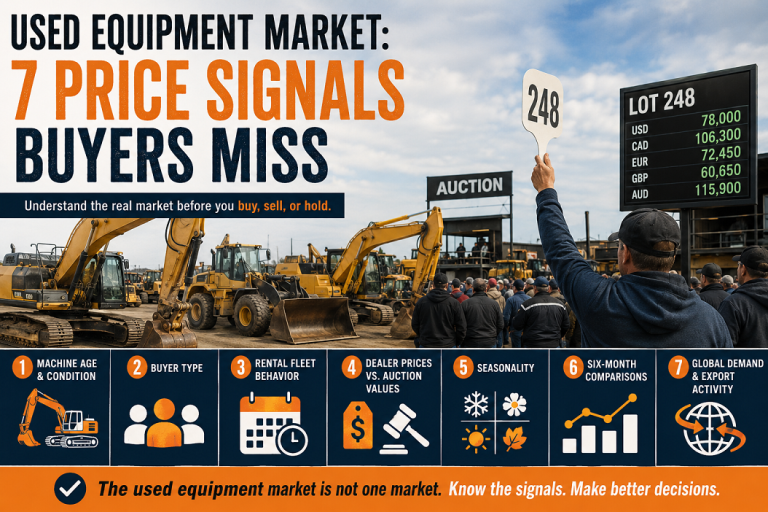
That is why dealer value, auction value, private-sale value, and reseller value are not the same number.
They are different markets with different levels of confidence.
For more on why broad used-equipment data can be misleading, see HEPLANET’s Used Equipment Market Reports Are Easy to Misread. Buyers evaluating used excavators should also review the Used Excavator Inspection Guide before bidding or buying.
Rental fleets think differently than contractors
Rental companies also care about parts availability, but they often think differently than contractors.
A large rental company may buy machines in packages. It may also buy recommended stock parts to support the fleet. It may rotate machines every three or four years before heavy repairs become common. It may judge profitability by the fleet package, not only by one individual unit.
Some rental machines will get high utilization. Others will get lower utilization. The rental company may still make the package work if the overall fleet generates enough return.
That is different from a contractor buying one machine for one job or one fleet position.
The contractor may not have stocked parts. The contractor may not have in-house technicians. The contractor may not have a replacement machine ready. The contractor may not be able to spread risk across a large fleet package.
That is why parts availability can be more painful for a small contractor than for a large rental fleet.
The same machine can carry different risk depending on who owns it.
Auction buyers should price parts risk into the bid
Auction buyers should not evaluate a machine only by age, hours, and appearance.
They should ask:
Was this machine built for this market?
Does the serial number match the local dealer’s parts system?
Are common parts stocked locally?
Is the undercarriage standard for the region?
Are hydraulic pumps, engine parts, electrical components, sensors, filters, and emissions parts supported locally?
Can local technicians work on the machine?
Are diagnostic tools required?
Are reman components available?
Is there aftermarket support?
Will this machine be easy to resell?
Will export buyers want it later?
If the answer is uncertain, the buyer should price that uncertainty into the bid.
A machine can be cheap for a reason. Sometimes the reason is obvious. Sometimes the reason is hidden in the parts book.
Two similar machines may not be equal
One of the biggest mistakes in used-equipment buying is assuming that two similar machines should be valued the same.
They may be the same brand, similar model, similar year, similar hours, and similar condition. But one may have better parts support, stronger dealer familiarity, deeper aftermarket coverage, better regional fit, stronger attachment setup, or better resale liquidity.
The other may be harder to support, even if it runs perfectly today.
That is why used-equipment valuation cannot stop at model and hours.
A machine’s value depends on what happens after the sale.
What buyers should check before purchasing
Before buying a used machine, buyers should ask:
Is this machine a domestic-market unit or imported?
Does the serial number match the local dealer’s parts system?
Is this model common in my region?
Are parts stocked locally?
Are undercarriage parts readily available?
Are reman components available?
Are aftermarket parts available?
Can independent repair shops support it?
Are diagnostic tools needed?
Are service manuals and parts books available?
Are there known parts delays?
Is the dealer familiar with this configuration?
How long would common repairs take?
Would this machine be attractive to the next buyer?
Would export buyers support it?
These questions are especially important for gray-market machines, low-volume brands, imported machines, unusual configurations, older machines, specialized attachments, and high-production equipment.
Parts availability should affect trade value
Dealers and fleet managers should consider parts support when setting trade value.
A machine that can be inspected, repaired, and resold quickly is easier to trade.
A machine that needs hard-to-find parts may require a larger deduction.
A machine with strong parts availability may be easier for the dealer to finance, warranty, retail, or wholesale.
A machine with weak support may need to be discounted, exported, wholesaled, or sold as-is.
That affects trade value before the machine ever reaches the next buyer.
Bottom line
Parts availability affects heavy equipment resale value because it affects confidence, cost, and uptime.
A used machine is worth more when the next owner believes it can be repaired quickly, supported affordably, and resold confidently. A machine is worth less when buyers are uncertain about parts, diagnostics, regional support, emissions compatibility, reman options, aftermarket coverage, export demand, or repair cost.
The best machine is not always the cheapest machine.
The better question is:
Can this machine be supported well enough, in this market, at a repair cost that still lets it make money after the sale?
That is why parts availability should be part of every used-equipment inspection, auction bid, dealer trade valuation, rental-fleet decision, and resale strategy.
About the Author
Frank Eusebio is a heavy equipment industry professional with more than 30 years of experience in construction equipment sales, equipment and fleet management, used equipment valuation, remarketing, dealer operations, and international equipment markets and auction consulting. His background includes Komatsu dealer operations, export markets, lease returns, dealer inventory strategy, and heavy equipment ownership economics. He also wrote, created, and implemented Develon’s remarketing program across its dealer network. At HEPLANET, he writes about equipment markets, fleet decisions, resale value, auction trends, parts availability, and the real-world costs that affect contractors, dealers, rental companies, and equipment owners.