Roadbuilding Equipment: The Machines Behind Modern Infrastructure
Roadbuilding equipment is one of the most important categories in the heavy equipment industry because roads are never built by one machine alone.
A road project may begin with land clearing, excavation, drainage, grading, aggregate production, base preparation, paving, compaction, striping, and long-term maintenance. Each stage depends on different types of construction equipment, from excavators and bulldozers to wheel loaders, motor graders, compactors, asphalt pavers, milling machines, dump trucks, crushers, and screeners.
That is why road construction equipment matters beyond highway contractors alone. Roadbuilding supports infrastructure, mining, quarry operations, subdivision development, utility construction, industrial projects, energy projects, ports, logistics facilities, and public works maintenance.
For contractors, fleet owners, equipment dealers, equipment rental companies, municipalities, and infrastructure planners, understanding the full roadbuilding equipment chain is essential. A road is not just paved. It is cleared, shaped, drained, stabilized, loaded, hauled, graded, paved, compacted, maintained, and eventually rebuilt.
Roadbuilding Starts Before the Asphalt Arrives
Many people think of roadbuilding equipment as asphalt pavers and rollers. Those machines are critical, but they usually arrive after a large amount of earthmoving, grading, drainage, and material handling has already been completed.
Before asphalt or concrete is placed, contractors often need to clear the site, remove unsuitable material, manage drainage, cut or fill the grade, move soil, build embankments, place aggregate base, and prepare the roadbed. This is where excavators, bulldozers, wheel loaders, articulated haulers, compact track loaders, motor graders, and compactors become essential.
Cat Rental lists graders, pavers, compactors, loaders, and excavators among key road construction machines available for roadwork rental, which reflects how roadbuilding usually requires multiple machine types working together rather than one single category of equipment.
That tells the real story. Roadbuilding is not one machine category. It is a full construction equipment system.
Excavators Handle Digging, Drainage, Utility Work, and Site Preparation
Excavators are among the most versatile machines on a roadbuilding jobsite.
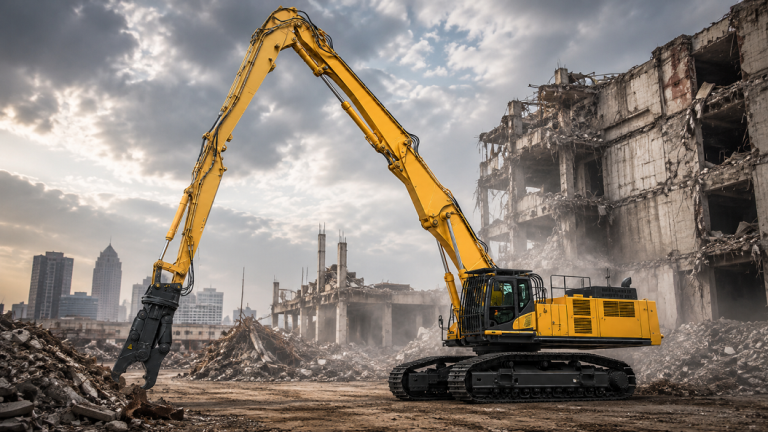
Hydraulic excavators are used for ditching, trenching, drainage work, culvert installation, slope shaping, clearing, demolition, mass excavation, loading trucks, and removing unsuitable material. On road projects, excavators may work before, during, and after the main roadway is built.
Large excavators may be used for heavy excavation and mass earthmoving. Mid-size excavators are common on drainage, site preparation, and utility work. Compact excavators can be used for smaller roads, sidewalks, shoulder work, tight urban jobsites, and utility repair.
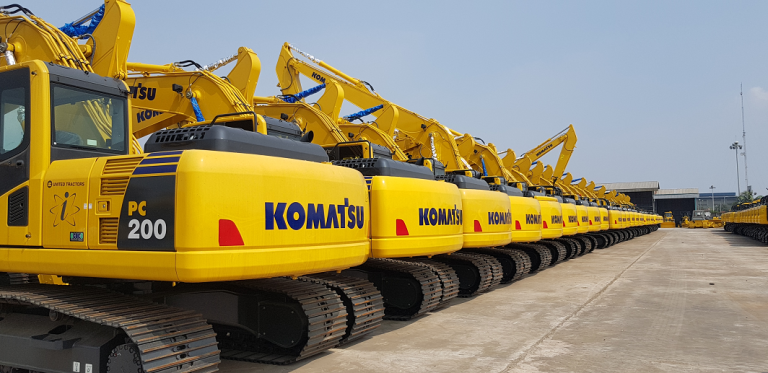
For contractors buying used excavators for road construction, the most important inspection areas usually include the undercarriage, hydraulic system, boom and stick condition, pins and bushings, final drives, swing bearing, cylinders, leaks, bucket condition, and overall machine response under load.
This is why excavators deserve their own HEPLANET machine category. They are not just digging machines. They are core roadbuilding, construction, utility, mining, quarry, and infrastructure machines.
Bulldozers Shape the Ground and Build the Roadbed
Bulldozers, often called dozers, remain one of the most important machines in heavy construction and roadbuilding.
A crawler dozer can clear land, push soil, spread fill, rough grade a roadbed, build embankments, support scraper work, manage stockpiles, and prepare areas for finish grading. On larger road construction projects, dozers are often used early in the project to shape the ground before motor graders, compactors, and paving equipment take over.
Dozers are especially valuable where traction and pushing power matter. Soft ground, uneven terrain, heavy clearing, and rough site conditions often favor crawler bulldozers over wheeled machines.
For used bulldozer buyers, the undercarriage is one of the biggest cost items. Rails, rollers, idlers, sprockets, track shoes, bushings, and pins can dramatically affect the value of a used dozer. Blade condition, frame condition, hydraulic response, ripper condition, steering, transmission performance, and final drive condition also matter.
In roadbuilding, bulldozers do the heavy shaping work that makes later precision grading possible.
Wheel Loaders Keep Road Projects Moving
Wheel loaders are essential support machines in roadbuilding because they keep material moving.
A wheel loader may load trucks, feed crushers and screeners, manage aggregate stockpiles, load asphalt plants, move base material, handle pipe and attachments, support cleanup work, and feed production equipment. In quarry and aggregate operations, wheel loaders are often among the most important machines in the fleet.
Roadbuilding depends heavily on materials. Aggregate base, stone, sand, asphalt, concrete, pipe bedding, and fill material all need to be loaded, moved, blended, and placed. Wheel loaders help keep that material flow organized.
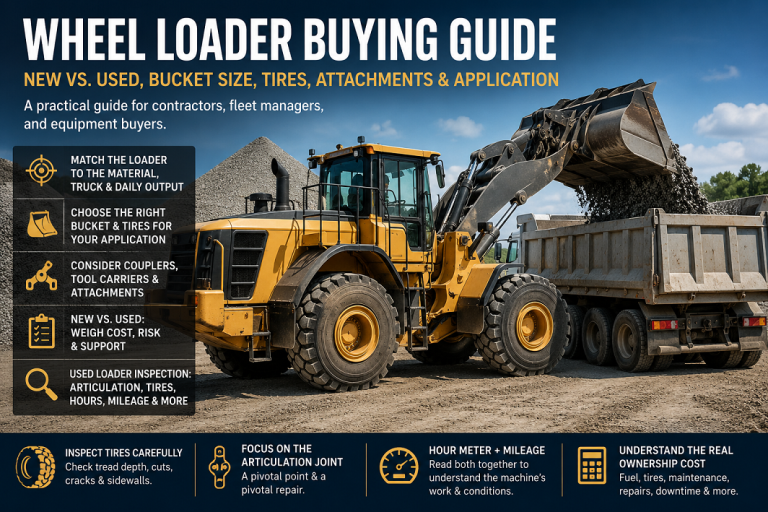
For contractors inspecting a used wheel loader, important areas include center pins, articulation joints, bucket linkage, loader arms, hydraulic cylinders, tires, brakes, transmission, axles, cooling system, and service history. A wheel loader may look simple from the outside, but worn pins, weak hydraulics, bad tires, or driveline problems can quickly become expensive.
Wheel loaders connect the roadbuilding jobsite to the aggregate supply chain.
Motor Graders Bring Precision to Roadbuilding
Motor graders are precision machines.
In road construction, motor graders are used for finish grading, shaping the road crown, maintaining drainage, cutting ditches, blending material, spreading aggregate, maintaining haul roads, and preparing surfaces before paving. In mining, quarrying, and large infrastructure work, motor graders also maintain access roads and haul roads that keep trucks and support fleets productive.
This is why roadbuilding contractors often treat motor graders differently from general earthmoving equipment. A bulldozer can push material and rough grade, but a motor grader is designed to create smooth, controlled surfaces.
For used motor grader buyers, inspection should focus on the circle, moldboard, blade slides, articulation joint, front axle, tires, hydraulic controls, transmission, steering response, frame condition, and cab controls. Wear in the circle or moldboard system can affect grading accuracy and machine value.
Motor graders are one of the clearest examples of how roadbuilding equipment depends on operator skill, machine condition, and precision.
Compactors Build Strength Into the Road
Compaction is one of the most important parts of road construction because a road is only as good as the base underneath it.
Soil compactors, padfoot compactors, smooth drum rollers, pneumatic rollers, tandem asphalt rollers, and combination rollers are used to compact soil, aggregate base, asphalt, and other materials. Without proper compaction, roads can settle, crack, rut, or fail prematurely.
Compactors may not always get as much attention as excavators or bulldozers, but they are critical to road quality. Poor compaction can create long-term maintenance problems that show up after the project is complete.
Volvo Construction Equipment describes compaction as central to roadbuilding and offers soil and asphalt compaction equipment as part of its broader construction equipment portfolio. Volvo also highlights services such as fleet monitoring, site management, and machine maintenance support around its compactors.
For contractors, compactor selection depends on material type, lift thickness, project size, required density, production rate, and whether the work involves soil, aggregate, or asphalt.
Asphalt Pavers and Milling Machines Complete the Surface
Asphalt pavers are the machines most people associate with roadbuilding.
A paver receives asphalt mix, spreads it across the road surface, and creates a controlled mat before rollers compact it. Paving quality depends on machine condition, screed setup, material temperature, truck flow, operator skill, and compaction timing.
Cold planers, also called milling machines, are used to remove old asphalt before resurfacing. They are essential in road rehabilitation, highway repair, airport work, parking lots, and municipal paving. Milling allows contractors to remove damaged pavement, correct surface issues, and prepare the road for a new asphalt layer.
Roadbuilding contractors need production and timing. If trucks, asphalt pavers, compactors, and milling machines are not coordinated, road quality and productivity can suffer.
This is why paving equipment is often managed as a system rather than as individual machines.
Crushers, Screeners, and Aggregate Equipment Support the Roadbuilding Supply Chain
Roadbuilding depends on aggregate.
Before base material can be placed or asphalt can be produced, rock and aggregate must often be crushed, screened, sorted, loaded, hauled, and stockpiled. Crushers, screeners, conveyors, wheel loaders, haul trucks, and aggregate plants are all part of the roadbuilding supply chain.
This connection matters because infrastructure projects do not only create demand for machines on the road project itself. They also create demand at quarries, pits, asphalt plants, concrete plants, material yards, and logistics operations.
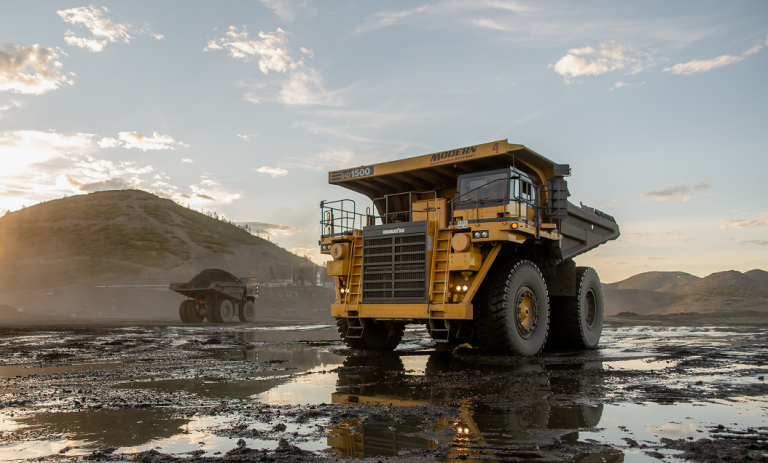
A strong roadbuilding cycle can support excavators, wheel loaders, crushers, screeners, articulated haulers, off-highway trucks, compactors, and material-handling equipment.
This is one reason roadbuilding should be treated as a major HEPLANET category. It connects construction equipment, quarry equipment, aggregate equipment, infrastructure investment, material processing, and fleet support.
Compact Equipment Plays a Bigger Role on Modern Road Jobs
Compact equipment is becoming more important in roadbuilding and infrastructure work, especially on smaller jobsites, urban projects, utility work, sidewalks, drainage repairs, landscaping, and road maintenance.
Skid steers, compact track loaders, mini excavators, compact wheel loaders, backhoe loaders, and small rollers can perform work that larger machines cannot easily handle in tight spaces. With attachments, compact construction equipment can grade, trench, sweep, mill, lift, break concrete, move material, and clean up after larger machines.
This is especially important for municipalities, utility contractors, paving crews, and small contractors. Not every road job requires a large excavator or dozer. Some jobs require flexible machines that can move quickly between tasks.
Compact equipment also fits well with construction equipment rental strategies. Contractors may own core machines while renting specialized compact equipment, attachments, rollers, or support machines for specific jobs.
Roadbuilding Equipment Rental Is Part of the Industry
Roadbuilding contractors do not always own every machine used on a project.
Equipment rental is common because road construction projects may require specialized machines for short periods. A contractor may own excavators, dozers, wheel loaders, and trucks but rent compactors, rollers, asphalt pavers, milling machines, light towers, skid steers, attachments, or support equipment depending on the job.
Cat Rental highlights graders, pavers, compactors, loaders, and excavators as common road construction rental machines, which reflects how roadbuilding often requires flexible fleet planning.
Rental can help contractors control cost, access newer technology, fill short-term production needs, or avoid owning machines that may sit idle between projects.
For fleet managers, the decision is not simply whether to own or rent roadbuilding equipment. The better question is which machines are core to the company’s regular work and which machines should be rented based on project size, schedule, utilization, maintenance exposure, and heavy equipment parts availability.
Technology Is Changing Roadbuilding Equipment
Roadbuilding equipment is becoming more connected, more precise, and more data-driven.
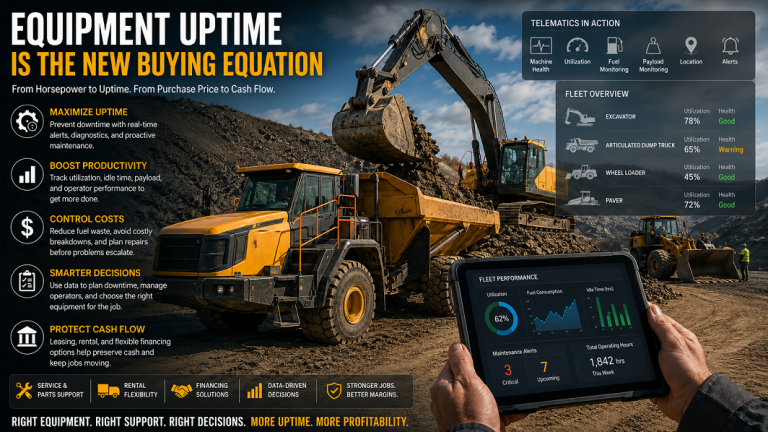
Grade control, telematics, machine health monitoring, compaction measurement, GPS guidance, payload tracking, fleet management software, paving control, and automated machine functions are changing how contractors manage production and quality.
Trimble describes civil construction technology that includes machine control and guidance, grade control, paving control, site positioning, and drilling or piling control, showing how digital tools are becoming part of earthmoving and road construction workflows.
This is especially important in grading, paving, compaction, and fleet coordination. A road project can lose time and money through rework, poor grade control, bad truck timing, improper compaction, or machine downtime.
Technology does not replace the need for experienced operators and strong supervision. But it can help reduce mistakes, improve productivity, document work, and support better construction fleet management.
For contractors, the real value of roadbuilding technology is not only precision. It is fewer passes, less rework, better material control, improved road quality, stronger production management, and more predictable project execution.
Heavy Equipment Parts Availability and Maintenance Matter in Roadbuilding
Roadbuilding equipment often works under demanding conditions.
Dust, heat, vibration, long hours, abrasive material, heavy loads, and tight schedules all affect machine life. Excavators, bulldozers, wheel loaders, motor graders, compactors, asphalt pavers, milling machines, crushers, and screeners all need strong maintenance support to stay productive.
For contractors, heavy equipment parts availability can directly affect job schedules. A failed hydraulic hose, worn cutting edge, undercarriage issue, bad bearing, damaged roller, electrical problem, paving equipment failure, or crusher breakdown can interrupt production and create costly delays.
This is especially important in roadbuilding because many tasks are sequential. If excavation, grading, base placement, paving, or compaction falls behind, the entire schedule can be affected.
The best roadbuilding fleets are not only built around machine ownership. They are built around machine support: preventive maintenance, daily inspections, operator reporting, parts planning, dealer support, rental backup, and repair discipline.
Roadbuilding Equipment Connects to Every Part of Infrastructure
Roadbuilding equipment supports far more than highways.
The same machines used in road construction also support subdivision development, industrial site preparation, mining access roads, quarry haul roads, utility construction, bridge approaches, airport work, port and logistics facilities, energy projects, wind and solar access roads, municipal road maintenance, rural road improvement, disaster recovery, and emergency repairs.
That broad use is why roadbuilding equipment matters to the entire heavy equipment industry.
Excavators, bulldozers, wheel loaders, motor graders, compactors, asphalt pavers, milling machines, crushers, screeners, compact equipment, and haul trucks are not isolated machine categories. They are part of the infrastructure system that allows people, goods, energy, materials, and equipment to move.
Key Takeaway
Roadbuilding equipment is not limited to asphalt pavers and rollers.
Modern road construction depends on a full chain of heavy equipment and construction equipment, including excavators, bulldozers, wheel loaders, motor graders, compactors, asphalt pavers, milling machines, crushers, screeners, trucks, and compact equipment.
Each machine has a role. Excavators dig and handle drainage. Bulldozers shape the ground. Wheel loaders move material. Motor graders create precision surfaces. Compactors build strength into the base and pavement. Pavers place the surface. Milling machines remove old pavement. Crushers and screeners support the aggregate supply chain. Compact equipment handles tight-space work and support tasks.
For contractors, fleet owners, dealers, rental companies, municipalities, and infrastructure planners, roadbuilding equipment should be understood as a system. The best fleets are not only selected by machine size or purchase price. They are selected based on production needs, project type, machine support, heavy equipment parts availability, operator skill, rental strategy, and long-term maintenance planning.
As infrastructure demand, utility work, road maintenance, mining access, quarry production, and industrial development continue shaping the construction market, roadbuilding equipment will remain one of the most important categories in the heavy equipment industry.