Wheel Loader Buying Guide: New vs. Used, Bucket Size, Tires, and Application
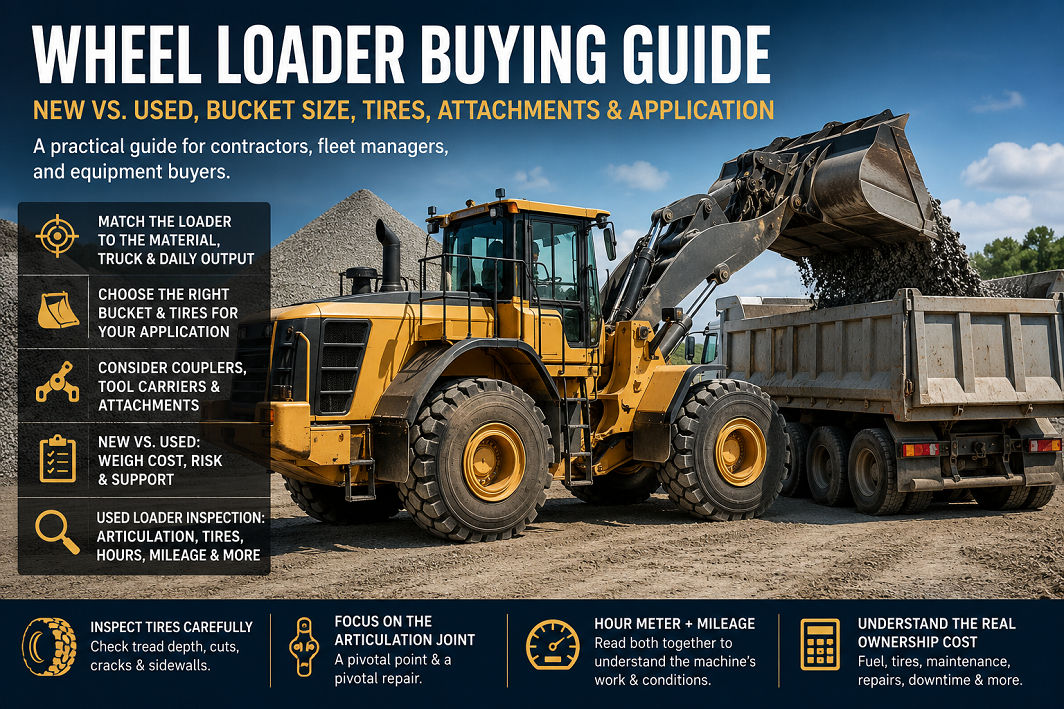
What contractors and fleet managers should know before buying a standard construction wheel loader
A wheel loader looks simple from the outside.
It has four tires, a bucket, an engine, a transmission, and a cab. Compared with excavators, cranes, crushers, or paving equipment, it can seem like one of the easier machines to buy.
That is exactly where buyers get into trouble.
A wheel loader is not just a general-purpose yard machine. In many fleets, it is one of the highest-utilization pieces of equipment on the property. It loads trucks, feeds plants, moves stockpiles, handles pallets, clears snow, supports crews, and keeps material moving. If it is sized wrong, spec’d wrong, or bought with hidden wear, it can slow production, raise tire costs, burn fuel, damage components, and tie up money in repairs.
This wheel loader buying guide focuses on standard construction wheel loaders — the machines commonly used by contractors, aggregate yards, sitework companies, roadbuilders, municipalities, recycling operations, mulch and material yards, and general fleet owners.
It does not cover compact wheel loaders or mining-class wheel loaders. Compact wheel loaders serve a different buyer and application category. Mining loaders are a separate production class with different scale, support requirements, tire economics, component planning, and ownership costs.
For standard wheel loaders, the right machine is not the biggest one you can afford. It is not automatically the cheapest one at auction. It is not always the newest one on the dealer’s lot.
The right wheel loader is the machine that matches your material, loading target, ground conditions, travel distance, attachments, utilization, operator skill, support network, and ownership budget.
That is why a good wheel loader buying decision should not start with horsepower or bucket size. It should start with the work.
Start with the work, not the model
Before looking at brands, models, hours, price, financing, or warranty, define the job.
A loader used to load tri-axle dump trucks all day is not the same machine as a loader moving pallets around a pipe yard. A loader feeding a crusher is not the same as a loader loading landscapers with mulch. A loader working in a recycling yard is not the same as a loader used by a municipality. A loader carrying wet material across a large yard is not the same as a loader taking short trips from a pile to a truck.
The first question is not, “What size loader should I buy?”
The first question is, “What work has to get done every day?”
A buyer should know:
- What material will the loader handle?
- How heavy is that material?
- Will the loader load trucks, feed a plant, stockpile material, handle pallets, clear snow, or support jobsites?
- What is the size of the truck, hopper, trailer, crusher, or bin being loaded?
- How many hours per week will the loader work?
- Is it a primary production machine or a support machine?
- How far will it travel during a normal cycle?
- Will it work on concrete, asphalt, gravel, mud, rock, snow, landfill debris, or uneven jobsites?
- Will it need to change attachments?
- Is transport between jobs required?
Those answers drive the buying decision.
A buyer who chooses too small loses production. A buyer who chooses too large pays for unnecessary fuel, tires, transport difficulty, higher repair exposure, and a machine that may be awkward in tight spaces.
Match the loader to the material first
The material being loaded is one of the most important buying factors.
A loader handling mulch, wood chips, compost, snow, or other light material can often use a larger light-material bucket because the material does not weigh as much. In that application, a smaller loader may still be productive because it can carry more volume without overloading the machine.
That same thinking does not work with heavy material.
If the loader is handling stone, wet dirt, asphalt millings, recycled concrete, demolition debris, or other dense material, an oversized bucket can become a problem. The bucket itself may need to be heavier-duty, which adds weight before any material is loaded. If the loader cannot safely fill the bucket, the buyer has not gained anything by buying the larger bucket. In some cases, the oversized bucket only makes the machine slower, less stable, harder on tires, and more expensive to operate.
For normal dirt work, a standard general-purpose bucket may be enough. But even dirt is not always the same. Dry dirt, wet dirt, clay, topsoil, and mixed material all load differently. In wet applications, some buckets are designed with openings that let water drain instead of carrying unnecessary water weight into the truck.
That matters because water is weight. If the loader is carrying water trapped in the material or bucket, the truck is being loaded with weight that does not help production.
Before choosing a loader or bucket, ask:
- Is the material light, medium, or heavy?
- Is it dry, wet, compacted, sticky, sharp, or abrasive?
- Will the loader dig from a bank or load loose stockpiles?
- Will the material damage the bucket or tires?
- Can the loader safely fill the bucket?
- Is the goal maximum volume or controlled loading?
Bucket capacity only matters when it is matched to material density and machine capacity.
Match the loader to the truck, hopper, customer, and daily output
The loader also has to match what it is loading into — and how much material the operation needs to move in a normal day.
A mulch yard may not need a large production loader if most customers are landscapers with pickup trucks, dump trailers, or small landscape trucks. A big loader with a large bucket may only be filled halfway to avoid overloading the customer’s vehicle. In that case, the loader may be larger, more expensive, and less efficient than the work requires.
The same logic applies in heavier applications. A loader loading tri-axle dump trucks, highway trucks, articulated trucks, hoppers, crushers, or screeners needs enough reach, lift height, breakout force, stability, and cycle speed to keep production moving.
The goal is to match the loader to the daily output requirement.
If the loader is too small, the operation may have to work extra hours to move the same amount of material. That does not only affect the loader. It also means trucks, support equipment, operators, fuel trucks, service people, and the rest of the job may have to run longer. A loader that saves money on the purchase price can become expensive if it slows the whole operation.
But buying too much loader creates the opposite problem. Some buyers oversize the machine because they might need the extra capacity occasionally. That can be a costly mistake. If the larger loader is only needed once in a while, it may be cheaper to work a little longer on those days, rent a larger machine, or plan around peak demand. Every other day, the oversized loader burns more fuel, wears more expensive tires, costs more to maintain, and carries higher ownership cost than the job requires.
Buyers should ask:
- What size trucks, hoppers, crushers, or containers will the loader load most often?
- How much material needs to be moved in a normal day?
- How many passes should it take to load the truck or hopper?
- Is the loader loading small customer trucks or production trucks?
- Will a smaller loader force the whole crew to work longer?
- Will a larger loader be underused most days?
- Does the machine need high-lift arms?
- Does the operator need visibility into the truck or hopper?
- Is the loading area tight or open?
- Will the loader spend more time carrying material or loading?
A wheel loader should be sized for normal daily production, not for the biggest possible day that only happens once in a while.
Consider how far the loader travels every day
A wheel loader that only loads trucks from a nearby stockpile has a different life than one traveling long distances across a yard, quarry, recycling site, or jobsite all day.
Travel distance affects fuel burn, tire wear, transmission heat, brake wear, operator fatigue, and cycle time. A loader that looks properly sized on paper may become inefficient if it has to run long distances between the pile and the truck, hopper, crusher, or work area.
Before buying, estimate the loader’s daily travel:
- Is it loading from a pile directly beside the truck?
- Is it carrying material across a yard?
- Is it feeding a plant or crusher from multiple stockpiles?
- Is it moving between buildings, bins, or work zones?
- Is it traveling on concrete, asphalt, gravel, mud, or rock?
- Is speed, ride control, or operator comfort important because of travel distance?
A loader that runs miles per day should be evaluated differently from a loader that works in a tight loading area.
Long travel can make ride control, tire selection, transmission condition, cooling, brakes, and operator comfort much more important. It can also change whether buying a larger loader actually helps. Bigger is not always faster if the machine is burning fuel and tires while traveling too far every cycle.
For a broader look at how uptime and production affect equipment economics, see HEPLANET’s guide to equipment uptime and cash flow.
Choose the right bucket
The bucket is not just an attachment. It is part of the machine’s production system.
The wrong bucket can make the right loader perform poorly. The right bucket can make a properly sized loader productive without overloading it.
Common wheel loader bucket choices include:
- general-purpose buckets
- light-material buckets
- heavy-duty buckets
- rock buckets
- high-dump buckets
- side-dump buckets
- grapple or clamping buckets
- skeleton buckets
- mulch buckets
- specialty material-handling buckets
A light-material bucket can be a smart choice for mulch, compost, chips, snow, or other low-density material. It gives the loader more volume without overloading the machine. But that same bucket is not designed for heavy aggregate, demolition debris, or harsh digging.
A heavy-duty bucket may be necessary in rock, recycling, demolition, or abrasive material, but it adds weight. That extra bucket weight reduces how much material the loader can carry. Buyers should not assume a larger, heavier bucket is automatically better.
A skeleton bucket can help separate rock from dirt or let smaller material fall through. A high-dump bucket can solve a loading-height problem but adds weight, complexity, and stability considerations. A clamping bucket can help hold loose or irregular material during travel.
The right bucket depends on what the loader will do most of the time.
If the machine handles several materials, the buyer should decide whether the loader needs multiple buckets, a coupler, or a more versatile setup.
Choose tires based on the application
Tires are one of the biggest ownership-cost items on a wheel loader.
Buyers often spend too much time comparing horsepower and not enough time thinking about tires. That is a mistake. Tire choice affects traction, ride, fuel efficiency, stability, cut resistance, flotation, snow performance, heat, and replacement cost.
The right tire depends on the application.
A loader working in general dirt and yard work may use a different tire than a loader working in rock, recycling, snow, concrete, asphalt, or waste. A tire that performs well in a clean aggregate yard may be wrong for demolition debris. A tire that survives sharp rock may not be the best choice for icy pavement. A loader traveling long distances on hard surfaces may wear tires differently than one making short loading cycles in loose material.
Wheel loader tires commonly use L-series designations. For example, L2, L3, L4, and L5 tires are built for different traction, rock, tread-depth, and severe-service needs. Trade coverage from ForConstructionPros explains that L-type tire codes apply to wheel loaders and wheeled dozers, with L2 generally associated with traction, L3 with rock regular tread, L4 with rock deep tread, and L5 with rock extra-deep tread. Read more about wheel loader tire classifications.
Buyers should consider:
- radial vs. bias tires
- tread depth and compound
- sidewall protection
- L2, L3, L4, or L5 tire patterns
- snow tires or chains
- foam-filled or solid options
- cut resistance
- heat buildup
- hard-surface wear
- replacement cost
A used loader with poor tires can look like a bargain until the buyer prices a full replacement set.
Tires should be matched to the job before the buyer worries about small differences in model specs.
Decide whether the loader needs a coupler
A coupler can make a wheel loader much more useful, but buyers should think carefully about how often attachments will actually change.
A hydraulic coupler allows the operator to switch attachments from the cab. That is valuable when the loader changes between a bucket, forks, grapple, snow pusher, broom, rake, or other attachments during normal work. It saves time, reduces manual labor, and makes the loader more versatile.
But not every buyer needs a hydraulic coupler.
If the loader will use the same bucket almost all year and only change attachments once or twice, a manual wedge-style coupler may be enough. The manual coupler requires someone to get out and lock or unlock the attachment by hand, but it avoids some hydraulic components and reduces one more maintenance point.
The cost difference may not be huge, but the maintenance difference can matter. A hydraulic coupler adds hoses, cylinders, fittings, switches, and potential leak points. If the loader rarely changes attachments, the buyer should ask whether that extra complexity is worth it.
The right question is not simply, “Do I want a coupler?”
The better question is, “How often will this machine change attachments, and does that attachment flexibility create enough value to justify the added complexity?”
Know when a tool carrier makes more sense
Some buyers do not need a wheel loader mainly for bucket production. They need a machine that handles pallets, pipe, block, barriers, trees, attachments, and materials around a yard or jobsite.
That is where a tool carrier can make sense.
A tool carrier is similar to a wheel loader, but the front linkage is different. A standard wheel loader normally uses a bell crank or Z-bar style linkage that gives strong breakout force and good bucket performance. The tradeoff is visibility. The linkage sits between the lift arms and can block the operator’s view straight ahead.
A tool carrier uses a different lift-arm configuration that improves forward visibility, especially when using forks or handling materials. That makes it useful for pallet work, pipe yards, landscape suppliers, municipalities, nurseries, and other applications where the operator needs to see the load clearly.
The downside is that a tool carrier usually gives up some bucket breakout force and loading performance compared with a standard loader. It can still use a bucket, but if the machine’s main job is heavy bucket loading, a standard loader is usually the better choice.
Buyers should consider a tool carrier when visibility and attachment handling matter more than maximum bucket production.
Think through attachments before choosing the loader
A standard wheel loader can do far more than load with a bucket. The right attachment can save a contractor from renting another machine or buying a separate piece of equipment for occasional work.
Common wheel loader attachments include:
- forks
- grapple or clamping buckets
- snow pushers
- brooms
- root rakes
- skeleton buckets
- mulch buckets
- tree booms
- pipe handling attachments
- high-dump buckets
- side-dump buckets
- specialty material-handling tools
Each attachment changes the buying decision.
Forks can make the loader useful for pallets, pipe, block, barriers, and jobsite materials. A tree boom can help move large trees at an angle without abusing the loader or the load. A root rake can help clear brush and roots from a field. A skeleton bucket can help separate rock from dirt or let fine material fall through. A clamping bucket can hold loose or irregular material that may fall out during travel.
The buyer does not need every attachment. In fact, buying unnecessary attachments only ties up money.
But understanding the attachment possibilities helps the buyer choose the right loader, coupler, hydraulic setup, visibility package, lift configuration, and counterweight package. Sometimes the attachment the buyer needs once a month is what determines whether the machine is truly useful or only useful for one job.
This is also where buyers need to be honest. If the loader will never use forks, a grapple, a snow pusher, or a rake, do not pay for features that add no value. But if one attachment can prevent renting another machine several times a year, it may be worth planning for from the start.
As Volvo Construction Equipment notes in its wheel loader attachment materials, attachments should be matched to the machine’s link-arm geometry, breakout force, rim-pull, and lifting force — another reason buyers should not treat attachments as an afterthought. See Volvo CE’s wheel loader attachment reference.
New vs. used wheel loader: which makes more sense?
The right answer depends on utilization, uptime requirements, available capital, support, and risk tolerance.
A new wheel loader can make sense when uptime is critical, the machine will work high hours, the buyer needs a specific configuration, warranty matters, financing is attractive, emissions compliance is important, or the dealer relationship is a major part of the decision.
A used wheel loader can make sense when utilization is moderate, the price gap is meaningful, the machine has known history, condition can be verified, repairs are budgeted, and parts and dealer support are strong.
A rental-return loader can be a good middle ground if service records are available and the machine was maintained properly. Rental machines may have honest hours and documented service, but they may also have many operators and a wide range of applications.
An auction loader can be a good purchase for the right buyer, but only if the buyer understands the risk. Auction machines may offer value, but they also leave less room for assumptions. If the buyer cannot inspect the loader properly, verify major components, understand tire cost, and budget repairs, a cheap auction price can disappear quickly.
The best channel depends on the buyer:
- New is best when uptime, warranty, exact spec, and dealer support matter most.
- Dealer used is best when the buyer wants some support, history, and inspection confidence.
- Rental return can work when records are strong and the spec fits the job.
- Auction can work when the buyer has inspection skill, repair budget, and discipline.
- Private sale can work when the machine history is known and the seller is credible.
The buying channel changes the risk profile.
HEPLANET has covered related buying-channel risks in its article on buying used heavy equipment at auction.
If buying used, inspect the expensive areas first
A wheel loader does not have undercarriage in the way an excavator or dozer does, but that does not make it cheap to repair.
Used wheel loaders hide expense in different places.
Center pins and articulation
The articulation joint is one of the most important areas to inspect on a used wheel loader.
A wheel loader steers by articulating in the center. That center joint is a normal maintenance item, but it is not something buyers should take lightly. Bucket pins and bushings may be serviced more often, but the articulation point is critical to the whole machine.
If the articulation joint is badly worn, the loader may not be able to work at all. This is not like some wear items that can sometimes be managed temporarily while waiting for parts. A failed articulation joint can shut the machine down.
Buyers should look for movement, poor steering response, knocking, uneven wear, visible repairs, loose pins, and signs that the machine has been run beyond normal wear limits.
The bigger risk is frame damage. If the articulation joint is allowed to wear past specification, it can damage the frame bores. Once that happens, the repair may require line boring, which adds significant cost and downtime. What could have been a planned maintenance repair can become a major structural repair.
This is why the articulation point should be inspected carefully before buying a used wheel loader. It is a pivot point, but it is also a pivotal repair.
Loader linkage and bucket pins
Bucket pins, linkage pins, bellcranks, bushings, and tilt linkage should be checked carefully. Excessive play affects control, bucket angle, cutting edge wear, and future repair cost.
Brakes and axles
Wheel loader brake and axle repairs can be expensive. Buyers should test braking performance, listen for noises, check oil condition where possible, and look for signs of contamination or overheating.
Transmission and shifting
A loader should shift smoothly under load. Delayed engagement, harsh shifts, slipping, overheating, or transmission warnings should be taken seriously.
Hydraulic system
Hydraulic leaks, weak lift, cylinder drift, noisy pumps, slow functions, and contaminated oil can all indicate expensive problems. Cylinders, hoses, valves, pumps, and coolers should be inspected.
Cooling package
Loaders often work in dusty, dirty, high-idle environments. A plugged or damaged cooling package can lead to overheating, engine damage, hydraulic issues, and poor air conditioning performance.
Tires
Tires can make or break a used loader deal.
Do not judge loader tires by appearance alone. Wheel loader tires can look better than they really are, especially to someone who does not inspect them every day. Tread depth should be measured, not guessed. A tire that looks usable from a distance may be much closer to replacement than expected.
That matters because a full set of loader tires can be a major expense. A buyer does not want to purchase what looks like a good used loader and then find out shortly afterward that the machine needs thousands of dollars in tires.
Inspect:
- tread depth
- uneven wear
- sidewall cuts
- inside sidewall damage
- exposed cords
- chunking
- mismatched tires
- foam fill
- flat spots
- weather cracking
- application suitability
Check the inside sidewalls, not just the outside. A tire can be flipped to hide a cut, gash, or sidewall problem. From the outside, the tire may look acceptable, but the inside may show damage that will significantly reduce tire life.
Also look closely for cracking in the rubber. This is common on machines that have been underutilized and left sitting for long periods. The tires may still have tread, but the rubber can become brittle. Small cracks are easy to dismiss, but once the loader goes back to work under load, those cracks can spread. The tires are carrying both the weight of the machine and the weight of the material, so dry, cracked rubber can lead to premature tire failure even when the tread does not look worn out.
Tires should also match the application. A tire that is acceptable for light yard work may be wrong for rock, recycling, demolition debris, snow, or long travel on hard surfaces.
Frame, loader arms, and cracks
Look for cracks, weld repairs, twisted loader arms, damaged stops, and signs of abuse. A loader that has been used hard with oversized attachments, heavy buckets, or poor operators may show structural stress.
Cab, controls, and electronics
Modern wheel loaders may have electronics, emissions systems, cameras, scales, telematics, ride control, and other features. These systems can be useful, but they also add repair exposure if neglected.
A used wheel loader should be inspected based on what it did for a living. A snow loader, quarry loader, recycling loader, mulch loader, municipal loader, and rental loader may all have similar hours but very different wear patterns.
For broader used-equipment inspection principles, see HEPLANET’s used excavator inspection guide. The machine category is different, but the larger lesson still applies: condition, application history, support, and repair exposure matter more than a low price.
Hours and mileage should be read together
Hour meters matter, but they do not explain the whole machine.
Wheel loaders often have both an hour meter and a mileage or distance meter. Buyers should look at both together because the relationship between hours and mileage can reveal clues about how the machine worked.
A loader with high hours and low mileage may have spent much of its life idling, loading in a tight area, or working short cycles. A loader with high mileage relative to hours may have spent more time traveling across a yard, quarry, recycling site, plant, or jobsite. That matters because travel distance affects tires, brakes, transmission heat, axles, fuel burn, and operator fatigue.
Hours and mileage can also help raise questions about whether the reported hours make sense. They do not prove the machine’s history by themselves, but they can help a buyer spot inconsistencies.
A 6,000-hour wheel loader in a clean municipal yard may be in better condition than a 3,500-hour loader from a harsh recycling, salt, quarry, or demolition environment. A loader that idled for long periods may have lower production wear but more engine hours than expected. A loader that traveled long distances every day may have tire, brake, axle, and transmission wear that the hour meter alone does not explain.
Buyers should ask:
- What application did the loader work in?
- How many miles or kilometers are shown?
- Does the mileage make sense for the hours?
- Was the loader working short loading cycles or long travel cycles?
- Was it a primary production machine or a support machine?
- Did it run one shift or multiple shifts?
- Are service records available?
- Was it maintained by a dealer, rental company, municipality, contractor, or owner-operator?
- What attachments were used?
- Did it work in salt, recycling, rock, mud, heat, dust, or long-travel conditions?
Hours are only one data point. Application history, mileage, and condition often explain more.
Understand the real ownership cost
The purchase price is only the entry point.
Wheel loader ownership cost includes fuel, tires, brakes, pins, bushings, hydraulic hoses, filters, cutting edges, bucket repairs, service labor, transport, insurance, financing, downtime, and resale value.
The biggest ownership-cost surprises often come from:
- tires
- brakes
- articulation repairs
- hydraulic leaks
- cooling system problems
- transmission or axle issues
- emissions problems
- poor attachment match
- weak dealer or parts support
- buying too large or too small for the job
A loader that is cheap to buy but expensive to own is not a good deal.
This is where buyers should think like fleet managers. The question is not only, “Can I afford to buy it?” The better question is, “Can this machine produce enough work to justify its total cost?”
For more on the financial impact of downtime, see HEPLANET’s article on heavy equipment downtime costs.
When renting may be better than buying
Buying is not always the right answer.
Renting may be better when the work is seasonal, project-based, uncertain, or below the utilization needed to justify ownership. Snow work, short-term site support, temporary plant feeding, storm cleanup, and backup-machine needs can sometimes be handled better with rental.
Renting can also make sense when the buyer is testing a new application or unsure what size loader is needed.
Buying usually makes more sense when the machine has steady utilization, a clear role in production, available operators, predictable maintenance, and enough work to justify ownership.
A contractor should be careful not to buy a wheel loader just because one is available at a good price. If the machine does not have enough work, it becomes parked capital.
HEPLANET has also covered the broader ownership decision in Rent or Buy Heavy Equipment?.
Final wheel loader buying checklist
Before buying a wheel loader, answer these questions:
- What material will the loader move most often?
- How heavy is that material?
- Is the material light, dense, wet, abrasive, sharp, or sticky?
- What will the loader load: trucks, hoppers, crushers, bins, pallets, snow, or stockpiles?
- What size trucks or containers will it load most often?
- How much material must be moved in a normal day?
- How many passes should it take to load a truck or hopper?
- How far will the loader travel during a normal cycle?
- Is it a production machine or support machine?
- Is the bucket matched to material density?
- Are the tires right for the application?
- Does the loader need a coupler?
- If it needs a coupler, should it be manual or hydraulic?
- Does the loader need forks, a grapple, a rake, a tree boom, a snow pusher, or another attachment?
- Would a tool carrier be better than a standard loader for the application?
- Is new, used, rental-return, dealer-used, auction, or rental the best channel?
- If used, what is the application history?
- Do the hours and mileage make sense together?
- Are center pins, articulation, linkage, brakes, axles, transmission, hydraulics, cooling, and tires in good condition?
- Has tire tread depth been measured?
- Are there sidewall cuts, inside tire damage, or cracking in the rubber?
- Are parts and dealer support strong enough?
- What is the real ownership cost?
- Will the loader produce enough work to justify the purchase?
A wheel loader can be one of the most useful machines in a fleet. It can load trucks, feed plants, handle materials, support jobsites, clear snow, move pallets, and keep a yard productive.
But it has to be the right loader for the job.
The best wheel loader buying decision starts with the application, not the price. Match the machine to the material, the loading target, the daily output requirement, the travel distance, the ground conditions, the attachments, the utilization, and the support system.
Do that first, and the choice between new, used, rental-return, auction, or rental becomes much clearer.
About the Author
Frank Eusebio is a heavy equipment industry professional with more than 30 years of experience in construction equipment sales, equipment and fleet management, used equipment valuation, remarketing, dealer operations, and international equipment markets and auction consulting. His background includes Komatsu dealer operations, export markets, lease returns, dealer inventory strategy, and heavy equipment ownership economics. He also wrote, created, and implemented Develon’s remarketing program across its dealer network. At HEPLANET, he writes about equipment markets, fleet decisions, resale value, auction trends, parts availability, and the real-world costs that affect contractors, dealers, rental companies, and equipment owners.