Used Equipment Market: 7 Price Signals Buyers Miss
The used equipment market is not one market.
That is the first thing contractors, dealers, rental companies, lenders, and used equipment buyers need to understand before trusting any headline about used equipment prices.
A used excavator does not move like a forklift. A wheel loader does not trade like a compact track loader. A dealer-owned rental return does not behave like an auction consignment. A late-model, low-hour machine does not attract the same buyer as an older export machine. And a strong auction result in February does not always mean the market will stay strong through November.
That is why broad reports about used construction equipment prices can be useful but misleading. One report may show inventory tightening. Another may show sales cooling. Dealer asking prices may remain firm while auction values soften. Rental companies may hold machines longer, reducing late-model supply, while contractors stay cautious about buying.
None of those signals are necessarily wrong. They are just incomplete.
The real question is not whether the used equipment market is “up” or “down.”
The real question is: which market are you in?
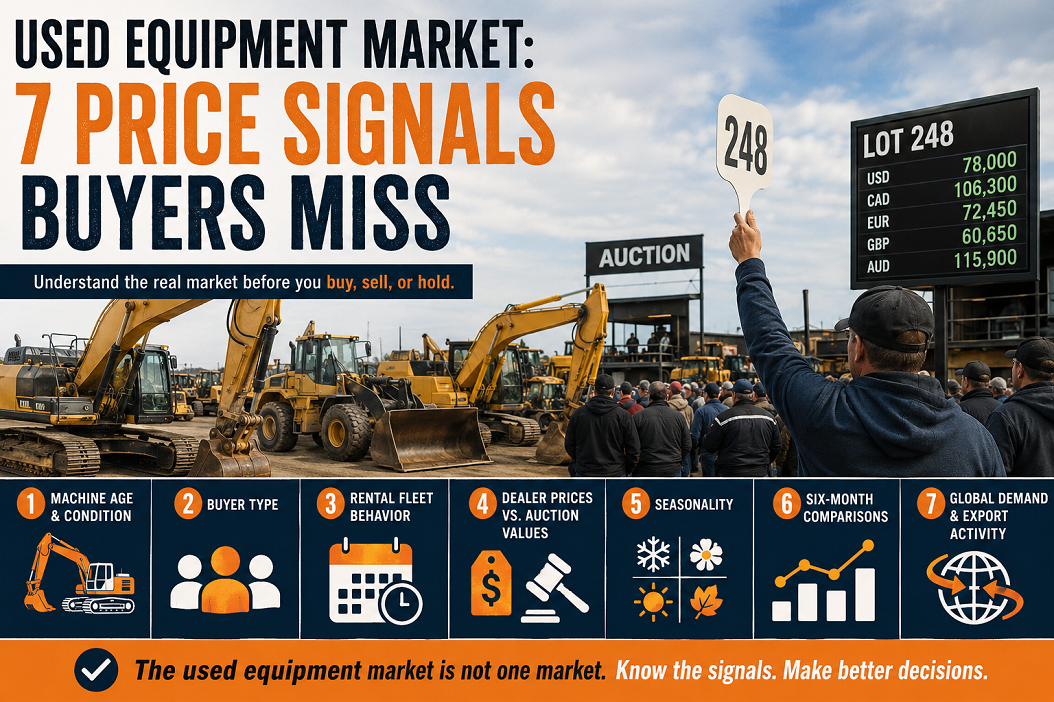
This guide breaks down seven used equipment market signals buyers should understand before they buy, sell, trade, rent, or hold a machine:
- Machine age and condition
- Buyer type
- Rental fleet behavior
- Dealer asking prices versus auction values
- Seasonality
- Six-month market comparisons
- Global demand and export activity
1. The used equipment market is divided into several markets
Used construction equipment is a collection of smaller markets that overlap, separate, and influence each other.
At a broad level, the equipment market can be divided into four groups.
The first is the new equipment buyer market. These are contractors, rental companies, municipalities, and fleet owners with the credit strength, cash flow, and backlog to buy new machines. They may still buy used, but usually only when the machine is late model, low hour, clean, and priced far enough below new to justify the tradeoff.
The second is the late-model, low-hour used equipment market. These buyers want near-new productivity without paying full new-machine pricing. This market often overlaps with the new equipment buyer market because the same buyer may be capable of buying either. The used machine has to make sense. It cannot just be available. It has to save enough money, carry acceptable risk, and be ready to work.
The third is the secondary productive market. These are machines that may be four to ten years old but still have enough life left to work every day. This is where many contractors, smaller fleets, municipalities, independent operators, site contractors, and used equipment buyers live. These buyers are not necessarily looking for the newest machine. They are looking for production at the right price.
The fourth is the older, lower-price farm, utility, and export market. These machines may have high hours, cosmetic issues, older technology, or repair needs. But they still have value to buyers with mechanical ability, lower utilization needs, access to parts, or markets where purchase price matters more than downtime risk.
Those four markets are connected, but they do not move together. A change in one can affect the others, but not evenly and not immediately.
For more on how machine prices can be misread, see HEPLANET’s guide to why most excavator price guides are misleading.
2. Late-model equipment creates its own used equipment market
Late-model, low-hour equipment attracts almost every buyer group, but not every buyer is participating for the same reason.
For a contractor, the late-model machine may be the only machine in the sale that matters. There may be ten excavators in the lineup, but only one has the age, hours, condition, specifications, warranty comfort, financing profile, and job-readiness that fits the job. That buyer is not shopping the whole auction. He is shopping that machine.
A used equipment broker or export buyer may look at the same machine differently. Late-model, low-hour equipment is desirable, but it is not always the target. Many broker and export markets are still dictated first by price. A clean late-model machine becomes interesting when there is enough margin, a clear resale path, or a specific customer waiting for that model. Otherwise, the broker may pass and wait for an older, cheaper unit that better fits the buying power of his market.
That difference matters. The same machine can create different levels of auction participation depending on age, hours, condition, brand, emissions configuration, location, and price.
This is why late-model used equipment often behaves like its own market. It can pull in contractors, rental companies, dealers, brokers, exporters, and end users at the same time, but each buyer has a different ceiling. The contractor may be buying production. The dealer may be buying retail inventory. The broker may be buying margin. The exporter may be buying only if the price still works after freight, duty, currency, and resale risk.
A strong price on one late-model excavator or wheel loader does not automatically mean the entire used equipment market is hot. It may simply mean the right buyer needed that exact machine.
3. Used excavators do not trade like forklifts
A 50,000-pound crawler excavator and a warehouse forklift may both appear in used equipment inventory reports, but they are not exposed to the same buyer base.
A used excavator is tied to sitework, utilities, demolition, drainage, land clearing, roadwork, aggregates, and heavy civil construction. Buyers are looking at undercarriage condition, hydraulic performance, final drives, pump health, swing bearing play, boom and arm cracks, bucket linkage wear, emissions systems, attachment history, and transport requirements.
A forklift is tied more closely to warehouses, manufacturing plants, distribution centers, ports, yards, industrial operations, and material-handling fleets. The buyer base is different. The duty cycle is different. The maintenance exposure is different. The resale channels are different.
Putting both into one “used equipment” headline may be useful for a broad market snapshot, but it is not enough to guide a buying decision.
The same applies across machine categories. A used articulated truck does not behave like a skid steer. A compact track loader does not behave like a motor grader. A late-model wheel loader does not behave like a 20-year-old dozer. Each category has its own market.
4. Used equipment inventory can fall while buyers stay cautious
One of the more confusing signals in the heavy equipment market is when used inventory declines while sales activity cools.
At first, that sounds contradictory. If inventory is lower, should used equipment prices be stronger?
Not always.
Inventory can decline for several reasons. Dealers may not be getting as many trade-ins. Rental companies may be holding machines longer. Contractors may be delaying fleet replacement. Sellers may hold machines because replacement cost is too high. Export buyers may pull certain models out of the domestic market. Some owners may keep older machines because financing a replacement no longer works.
At the same time, buyers may still be cautious. They may need machines, but not at any price. They may rent instead of buy. They may chase only low-hour, late-model units. They may avoid machines with emissions risk, weak dealer support, or uncertain repair history.
That is why lower inventory does not automatically mean every seller has pricing power. It depends on the machine, condition, hours, application, location, buyer pool, and timing.
Sandhills Global’s June 2026 market report is a good example of why category detail matters. The report showed used heavy-duty construction equipment inventory down 11.55% year over year in May, with crawler excavators posting the largest month-over-month inventory decline and wheel loaders posting the largest year-over-year decline. At the same time, used forklift inventory moved in the opposite direction, rising 17.28% year over year. That is not one market. That is multiple markets moving under the same headline. External source: Sandhills Global used equipment market report
5. Rental fleets can distort the used equipment market
Rental companies are some of the most important buyers in the equipment market because they buy in volume. When they change behavior, the effect can ripple through new equipment, used equipment, dealer inventory, OEM production, and auction supply.
If rental companies keep machines longer, fewer late-model rental returns reach the used construction equipment market. That can tighten used supply and support values in certain categories.
But the next question is more important: why are they keeping machines longer?
They may be getting strong utilization and choosing to sweat the fleet. They may be cautious about new-machine pricing. They may be waiting for better financing. They may be uncertain about demand. They may be delaying replacement because parts, labor, and interest costs have changed the ownership equation. Or they may be waiting for the right time to place a large order.
That matters because rental companies holding machines longer may also mean they are not placing as many new orders. If they are not buying new, that weakens demand for OEMs and dealers that were counting on rental fleet replacement. Eventually, OEMs may respond with discounts, financing programs, dealer incentives, or inventory pressure to move iron.
Then the cycle can reverse quickly. A large rental company may finally pull the trigger and buy tens of millions of dollars in equipment. On paper, that can make the market look suddenly strong. But it may not mean broad contractor demand has improved. It may simply mean one large fleet moved after delaying purchases.
That is why equipment market intelligence cannot stop at the headline. You have to know who is buying, why they are buying, and whether the activity represents broad demand or one buyer group catching up.
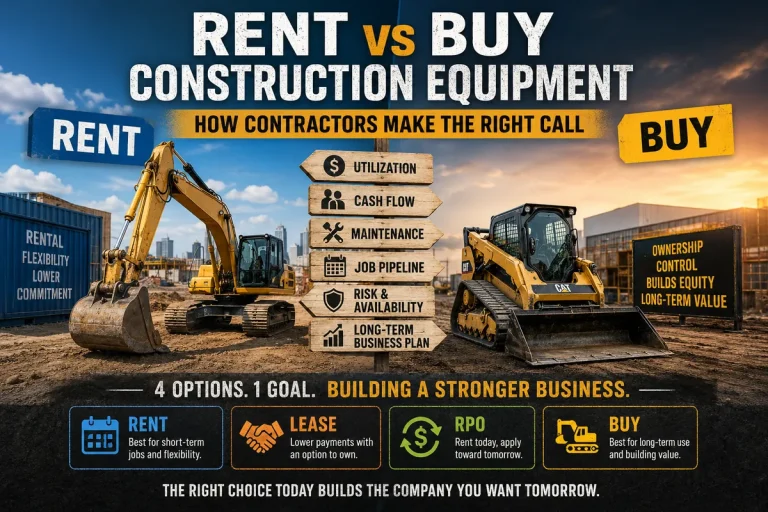
For contractors weighing ownership against rental, HEPLANET’s rent vs. buy equipment guide explains why the right answer depends on utilization, job duration, capital cost, and risk.
6. Dealer asking prices are not equipment auction values
Another mistake buyers make is comparing dealer asking prices and auction results as if they are the same number.
They are not.
A dealer asking price usually includes room for negotiation, reconditioning, warranty exposure, financing support, transportation coordination, and retail margin. A dealer may also be holding the machine because it fills a specific inventory need. Clean, popular machines can sit at strong asking prices because the dealer only needs one buyer.
Auction values are different. Equipment auction prices measure what qualified bidders were willing to pay on a specific day, under specific terms, with limited or no post-sale support. Auction results can be very useful, but they must be interpreted carefully. A major regional auction with export buyers, rental fleets, contractors, and dealers participating can produce a different result than a smaller local sale.
The same machine can have three different numbers:
The dealer asking price.
The expected negotiated retail price.
The auction-clearing value.
None of those numbers is automatically wrong. They represent different selling environments.
For more context, see HEPLANET’s article on how to read used equipment market reports.
7. Seasonality still changes used equipment prices
Seasonality is one of the easiest market signals to misread.
In northern states with harsh winters, construction seasons are shorter. When the ground is frozen in upstate New York, Michigan, Minnesota, the Dakotas, or parts of Canada, most contractors are not doing the same excavation and sitework they do in April, May, and June. Equipment may still be working in snow removal, material handling, emergency work, utility repair, or winter-specific applications, but normal construction activity slows.
That affects auctions and used equipment demand.
November and December auctions in cold-weather regions are often weaker in many construction categories. That does not necessarily mean the used equipment market is collapsing. It may simply be normal seasonal softness. Contractors are not rushing to buy machines they cannot immediately put to work.
There are exceptions. Wheel loaders, skid steers, trucks, and attachments tied to snow removal can see stronger seasonal demand. A wheel loader that looks expensive in a December snow market may not be telling you the same thing as a crawler excavator sitting in a frozen-ground region.
By February, the mindset changes. Contractors are looking at signed work, backlog, municipal contracts, road programs, utility jobs, site packages, and the short window they have to get production done. If they need machines ready by late March or early April, they often start buying before the season begins.
That is one reason February and March auctions can create stronger signals than late-year sales.
But even that has to be interpreted carefully. A strong February market may reflect seasonal preparation, not a permanent reset in used equipment values.
Six-month used equipment market comparisons need context
Professionals often look at six-month comparisons because one sale does not make a market. A single auction result can be distorted by location, weather, buyer attendance, financing availability, seller quality, export participation, or one buyer needing one specific machine.
Six months gives a better window.
But even six-month comparisons have limits. The six months after February and March may include a heavy volume of auction results because so much equipment trades during that period. The following six months may be lighter. If there are fewer comparable machines, the data can become thinner and less reliable.
The better approach is to compare the most recent six-month period against the same six-month period last year. That helps account for seasonality. February through July should be compared with February through July, not automatically with August through January.
Even then, the number is only part of the story. A buyer also has to understand where the market is going next.
If you are buying for your own fleet, the question is whether the machine can go to work and earn money.
If you are buying for resale, the question is different. You need to know what the next six months are likely to look like. Buying in November can make sense for a used equipment manager if the price is right and there is a clear exit in February or March. But buying too high late in the year can leave you carrying a machine into a softer seasonal window with no margin left.
Dealers face the same issue from a different angle. They are not only reading the market to buy trades or price used inventory. They are also deciding what to do with rental fleets, aged inventory, and machines sitting on floor plan. If a dealer has equipment on floor plan, every month carries a cost. Interest, curtailments, insurance, storage, depreciation, and internal pressure all affect the decision.
Floor plan financing is a form of inventory financing used by dealers, and it can affect how long inventory is held before pricing pressure increases. External source: OCC Comptroller’s Handbook on floor plan lending
That means dealers also have to look forward. Do they hold inventory into a stronger seasonal window? Do they reduce pricing before the market softens further? Do they move rental fleet units now, or keep them working another season? Do they dump machines into the market before carrying costs eat the margin?
That is why the used equipment market cannot be read only by looking backward. Historical comps matter, but the resale window matters just as much. A machine can be priced correctly based on the last six months and still be a bad buy if the next six months are moving against you.
Global demand can change used equipment values
Used equipment does not trade in a bubble.
A machine sitting in Florida, Texas, Georgia, Illinois, Alberta, or Rotterdam may be priced locally, but the buyer pool can be global. Export demand can pull machines out of one market and into another, changing supply and values for everyone else.
Large international projects can distort demand. When Dubai was being built, used machines moved in large numbers toward the Middle East. Abu Dhabi, Qatar, Saudi Arabia, and other major construction markets have created similar waves at different times. Those markets do not just buy machines for local jobs. They can also become redistribution hubs for equipment moving deeper into the Middle East, Africa, and surrounding regions.
But even that does not mean all used equipment is strong.
That is part of the problem with treating used equipment as one market. A major project may create heavy demand, but it usually creates demand for certain kinds of equipment at certain stages. Early site development may pull large excavators, dozers, wheel loaders, trucks, and support equipment. As vertical construction accelerates, the demand can shift toward cranes, lifting equipment, telehandlers, forklifts, aerial lifts, generators, compressors, and concrete-related equipment.
So when someone says the used construction equipment market is strong because a region is buying heavily, the next question should be: which equipment, and when?
At one stage, large earthmoving machines may be moving aggressively. Later, those same categories may cool while lifting, access, and material-handling equipment strengthen. The market did not simply go from good to bad. Demand moved to a different phase of construction.
Currency matters too. When the U.S. dollar is weak and European or other foreign currencies are strong, overseas buyers can participate more aggressively in U.S. auctions. When currency moves the other way, some of those buyers disappear or lower their bids. The same machine can bring a different price depending on who is financially able to participate.
This is why a contractor, dealer, or used equipment manager cannot only watch local activity. The local number may be affected by buyers who are not local at all. It may also be affected by a project cycle that is not obvious unless you are watching the broader world market.
RB Global’s May 2026 Edmonton auction is a reminder of how broad the buyer pool can be. Ritchie Bros. reported more than CA$175 million in gross transaction value, more than 10,300 items sold, and more than 18,600 registered bidders from around the world at its May 11–15 Edmonton sale. External source: RB Global Edmonton auction result
Condition still beats averages
Market averages are useful, but condition still drives value.
Two machines with the same year, model, and hours can be worth very different amounts. A clean used excavator with tight pins and bushings, strong hydraulics, good undercarriage, clean oil samples, no structural cracks, and documented service history is not the same asset as a machine that has been run hard with poor maintenance.
The same applies to wheel loaders, dozers, graders, articulated trucks, compact equipment, telehandlers, forklifts, and aerial lifts.
Hours matter, but hours are not everything. Application matters. Maintenance matters. Operator quality matters. Idle time matters. Support equipment matters. Dealer support matters. Parts availability matters.
The market may set the range, but condition determines where the machine belongs inside that range.
Before buying, use HEPLANET’s used excavator inspection guide to understand how wear points, hydraulics, undercarriage, linkage, and machine history affect real value.
What buyers should ask before trusting a market report
Before buying used equipment, buyers should narrow the question.
Do not ask only, “Are used equipment prices high?”
Ask what is happening in that machine class. Are used excavators moving the same way as wheel loaders? Are compact machines moving differently than heavy earthmoving equipment? Are auction prices following dealer asking prices? Are rental companies holding machines longer? Are export buyers active? Are late-model machines scarce, or only certain models? Are older machines still moving, or sitting?
Those questions matter more than the broad headline.
A contractor buying a used excavator should not make a decision based on a general report that includes forklifts, trailers, aerial lifts, and trucks. A dealer pricing a wheel loader should not rely only on national averages if local seasonal demand is about to change. A buyer looking at a rental-return machine should not assume low hours mean light use.
The used equipment market is really a collection of smaller markets. The better you understand the specific category, the better your buying decision will be.
The market is not black and white
Used equipment values are shaped by more than age, hours, and condition.
They are shaped by buyer type, financing, rental fleet behavior, OEM production, dealer inventory, floor-plan pressure, seasonality, export demand, currency, regional weather, infrastructure spending, commodity markets, and replacement cycles.
That is why the same headline can mislead different buyers.
Inventory may be down, but only in certain categories.
Auction values may be strong, but only for late-model, low-hour machines.
Rental demand may be strong, but contractors may still be avoiding ownership.
A large rental order may make the new equipment market look hot, even if broad contractor buying is still cautious.
A dealer may reduce prices because floor-plan costs are forcing action, not because the market collapsed.
A weak late-year auction may reflect normal seasonality, not real market weakness.
A strong February auction may reflect seasonal preparation, not a permanent price reset.
A major global project may lift demand for earthmoving equipment in one phase, then cranes, lifts, forklifts, and support equipment in another.
This is the market HEPLANET is built to study. Contractors, fleet managers, dealers, used equipment managers, rental companies, lenders, exporters, and parts suppliers do not always have time to track every signal. A contractor buying one machine may not have time to follow auction volume, dealer inventory, rental fleet replacement, OEM incentives, currency movement, regional construction cycles, export demand, and global project phases.
Used equipment managers can also get tunnel vision because they are moving fast, buying machines, pricing trades, watching inventory, managing floor-plan exposure, and trying to make decisions every day.
The purpose of market intelligence is to step back and see the whole picture.
Not just what sold.
Who bought it.
Why they bought it.
What season they bought it in.
What category it belonged to.
What project cycle may have influenced it.
What the next six months may look like.
And whether the price tells you something real about the market — or only something about that one machine, on that one day, in that one selling environment.
Frequently asked questions about the used equipment market
Is the used equipment market going up or down?
The used equipment market cannot be judged as one market. Used excavators, wheel loaders, compact track loaders, forklifts, trucks, trailers, rental returns, and older export machines can all move differently. Buyers should look at machine category, condition, hours, auction values, dealer asking prices, rental fleet behavior, seasonality, and export demand before deciding whether prices are strong or weak.
Why do used equipment prices differ so much by machine?
Used equipment prices differ because each machine category has a different buyer base, application, maintenance risk, transport cost, parts availability, and resale market. A late-model excavator with low hours may attract contractors, dealers, rental companies, and exporters. An older high-hour machine may only attract buyers who have the labor, parts access, and mechanical ability to repair it.
Are auction prices a good way to value used equipment?
Auction prices are useful, but they are not the whole market. Equipment auction prices show what bidders were willing to pay on a specific day under specific terms. Dealer asking prices, negotiated retail prices, rental fleet behavior, export demand, and machine condition all need to be considered before using an auction result as a true value benchmark.
Why does HEPLANET track the used equipment market?
HEPLANET tracks the used equipment market because contractors, dealers, rental companies, lenders, exporters, and fleet owners do not always have time to follow every auction result, dealer inventory shift, rental fleet decision, OEM incentive, seasonal change, currency move, and global project cycle. The goal is to turn market noise into practical equipment intelligence.
Bottom line
The used equipment market is not one market.
A crawler excavator, a wheel loader, a forklift, a compact track loader, a trailer, and an aerial lift may all appear in the same inventory report, but they do not share the same buyer behavior or value drivers.
For contractors, dealers, rental companies, lenders, exporters, and fleet owners, the real question is not whether used equipment prices are up or down. The real question is which category is moving, why it is moving, and whether the machine in front of you is priced correctly for its condition, application, support, timing, and resale value.
Broad market reports are useful. Auction results are useful. Dealer asking prices are useful. Rental fleet activity is useful. Export demand is useful.
But none of them tells the whole story alone.
The buying decision still comes down to the machine, the buyer, the timing, and the market behind it.
That is where HEPLANET provides value: watching the heavy equipment market globally, month to month, and translating the noise into practical equipment market intelligence buyers can use.
About the Author
Frank Eusebio is a heavy equipment industry professional with more than 30 years of experience in construction equipment sales, equipment and fleet management, used equipment valuation, remarketing, dealer operations, and international equipment markets and auction consulting. His background includes Komatsu dealer operations, export markets, lease returns, dealer inventory strategy, and heavy equipment ownership economics. He also wrote, created, and implemented Develon’s remarketing program across its dealer network. At HEPLANET, he writes about equipment markets, fleet decisions, resale value, auction trends, parts availability, and the real-world costs that affect contractors, dealers, rental companies, and equipment owners.