You Built This
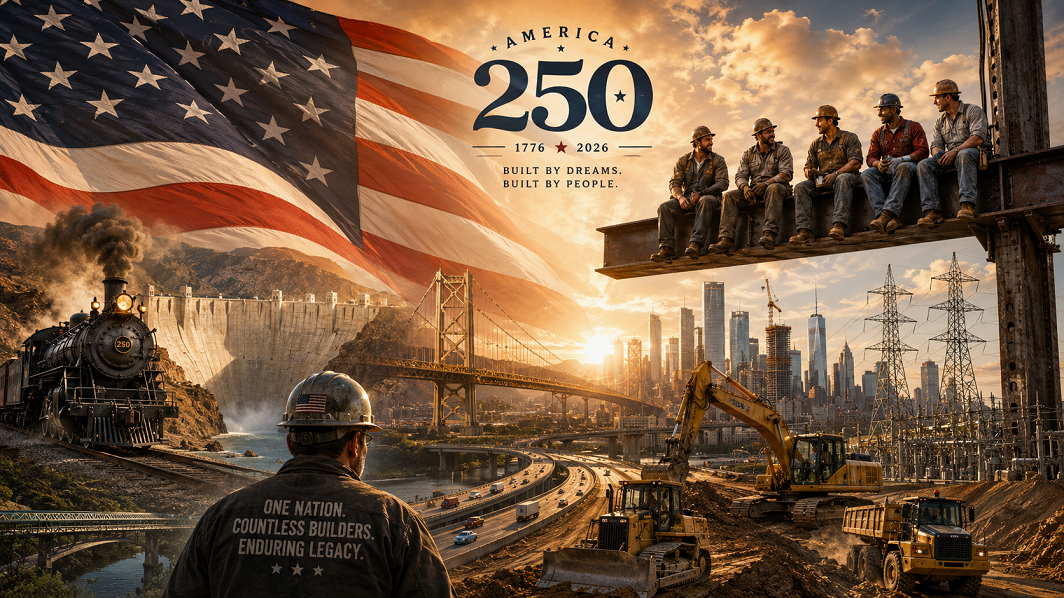
A 250-Year Salute to the Americans Who Built the Roads, Railroads, Cities, Factories, Machines, and Infrastructure That Made a Nation
This country was not built by speeches alone.
It was built by hands that blistered, backs that bent, shoulders that carried, boots that wore out, and families that sacrificed.
On July 4, 1776, the United States was created on paper. The Declaration of Independence gave America its political birth. It gave language to liberty, self-government, and the belief that a new nation could stand on its own. On July 4, 2026, America marks the 250th anniversary of the signing of the Declaration of Independence.
But the country itself still had to be built.
And it was built by Americans.
It was built in fields, forests, rivers, quarries, mines, rail yards, steel mills, factories, shipyards, roads, bridges, tunnels, dams, ports, power plants, and construction sites.
Before engines and hydraulic machines, much of that work was done by hand, by horse, by oxen, and by sheer human endurance.
Before the dozer, there was the man with the axe.
Before the excavator, there was the man with the shovel.
Before the crane, there was the rigger, the rope, the pulley, and the risk.
Before America had machines, it had Americans willing to build.
That is the America 250 infrastructure story worth remembering.
America was founded by an idea. But it became real through work — through roads cut into wilderness, canals dug through mud, railroads pushed across mountains, mines opened, steel poured, factories raised, bridges set, cities lifted into the sky, highways paved coast to coast, power lines stretched across open country, and machines built to do what the human body could no longer bear alone.
There is a phrase people know: “the men who built America.”
It usually points to the industrial giants — Vanderbilt, Rockefeller, Carnegie, Morgan, Ford.
Those names matter. They built systems. They changed transportation, energy, steel, finance, production, and mobility.
But America was not built by famous industrialists alone.
They built industries.
Americans built the country.
The canal laborer. The railroad worker. The miner. The steelworker. The road builder. The mechanic. The truck driver. The lineman. The welder. The farmer. The engineer. The operator. The soldier. The factory worker. The bridge crew. The quarryman. The concrete finisher.
They turned ambition into physical reality.
America was founded in 1776.
For the next 250 years, America was under construction.
And for the next 250 years, it will continue to be under construction.
The tools will change. The machines will get smarter. The jobs will include data centers, power grids, autonomous equipment, electric fleets, ports, factories, mines, transmission lines, water systems, and infrastructure previous generations could not have imagined.
But the truth will remain the same.
A country does not build itself.
It takes Americans willing to do the work.
You built this.
Roads, Canals, and the First Connections
The early United States was small by today’s standards. Thirteen colonies along the Atlantic coast declared independence from Britain, but the future country was still largely a coastal economy. Ports mattered. Rivers mattered. Farms mattered. Roads were rough, slow, and seasonal. Moving people and goods inland was difficult and expensive.
In the early republic, infrastructure was not a luxury.
It was survival.
A young country needed roads to connect towns, bridges to cross rivers, ports to handle trade, mills to process grain and timber, and canals to open inland markets. Before engines and machines, much of that work was done with muscle, animals, simple tools, and endurance most people today can barely imagine.
Every road widened the market.
Every bridge shortened the trip.
Every canal turned distant land into productive territory.
Every port tied local producers to the wider world.
One of the great early examples was the Erie Canal. Built between 1817 and 1825, the original canal stretched from Albany to Buffalo and helped connect the Great Lakes region to the Hudson River and New York Harbor. It lowered transportation costs, opened inland markets, and helped turn New York into a commercial powerhouse.
But the canal was not just an engineering project.
It was hard labor.
It was men digging through mud, rock, trees, roots, water, weather, and risk. It was families moving with the work. It was towns rising along the route. It was America learning that if you build the connection, the country grows around it.
That lesson has never gone away.
Today, contractors talk about access roads, haul routes, utility corridors, ports, rail yards, intermodal terminals, and logistics hubs. The names have changed. The equipment has changed. But the idea is the same.
Infrastructure does not simply serve growth.
Infrastructure creates growth.
That is one reason American infrastructure history is not just a story about roads and bridges. It is a story about how a country became connected enough to become powerful.
Railroads Made the Continent Work
If canals opened the interior, railroads connected the continent.
The completion of the first transcontinental railroad in 1869 was more than a transportation milestone. It changed the scale of the country. For the first time, coast-to-coast movement was no longer a months-long overland ordeal. People, freight, mail, machinery, raw materials, and finished goods could move across the nation with new speed and reliability.
Railroads turned distance into an advantage.
They tied farms to cities, mines to mills, ports to factories, and small towns to national markets. They made it possible to move coal, timber, grain, cattle, steel, stone, equipment, and people on a scale wagon roads could never match.
But again, the finished railroad hid the work behind it.
Every mile had to be surveyed, graded, blasted, bridged, drained, ballasted, supplied, and maintained. Mountains had to be crossed. Rivers had to be spanned. Timber had to be cut. Steel had to be made. Ties had to be laid. Crews had to work through heat, cold, dust, mud, and danger.
America’s geography was enormous.
Railroads made it usable.
And in times of crisis, railroads became more than commerce. During the Civil War, rail lines moved troops, food, ammunition, supplies, and equipment. They became supply lines. They became military targets. They became proof that infrastructure was not only an economic tool. It was a national survival tool.
The country that could move men and material could fight, supply, rebuild, and endure.
That was true then.
It is still true now.
The Industrialists Built Systems. Americans Built the Country.
The late 1800s and early 1900s brought names that became part of American business history.
Vanderbilt represented transportation. Rockefeller represented oil and energy. Carnegie represented steel. Morgan represented capital. Ford represented production and mobility.
Each of them changed the systems around American growth.
Transportation made markets larger.
Oil made energy more available.
Steel made bridges stronger and buildings taller.
Capital financed projects too large for one man or one town.
Mass production changed how machines, vehicles, and tools could be built.
But systems are not the same as a country.
Steel still had to become bridges, skyscrapers, rail lines, ships, cranes, buckets, blades, machine frames, and power plants.
Oil still had to become fuel, asphalt, lubricants, diesel, hydraulic fluids, trucking capacity, and mobile equipment.
Railroads still had to become graded corridors, bridges, tunnels, stations, yards, terminals, sidings, and maintenance systems.
Factories still had to become buildings, loading docks, roads, rail connections, power systems, water systems, sewer systems, and communities.
That is the part of history that often gets compressed into one word: progress.
But progress was never automatic.
It had to be built.
The famous names may have organized industries, but millions of Americans turned those industries into physical reality. They mined the coal. They quarried the stone. They poured the steel. They drove the rivets. They laid the rail. They paved the roads. They repaired the engines. They loaded the trucks. They built the factories.
The names became famous.
The work was done by millions.
Hoover Dam and the Public Works Spirit
Some projects become symbols because they are too large to be seen as ordinary construction.
Hoover Dam was one of them.
Built during the Great Depression, it was more than concrete across a canyon. It was a statement that even in hard times, America could still build. Workers came to the desert looking for wages, purpose, and survival. The work was dangerous, hot, physical, and unforgiving.
It took engineers, laborers, drillers, high scalers, concrete crews, equipment operators, truck drivers, mechanics, electricians, and support workers. It took roads, camps, supply lines, materials, machines, and courage.
The dam helped control the Colorado River, store water, and generate power. But it also represented something deeper: the belief that American labor, American engineering, and American determination could turn a brutal landscape into a working asset for the country.
That kind of work does not happen cleanly or easily.
It happens with risk.
It happens with sacrifice.
It happens when people show up in places most others would avoid and do the work anyway.
You built this.
World War II and the Arsenal of Democracy
When America entered World War II, the country’s strength was not measured only by the number of soldiers it could send overseas.
It was measured by what it could build.
Factories that once made automobiles, tools, appliances, and civilian machinery were converted to wartime production. Shipyards expanded. Tank plants ran. Steel mills poured. Mines fed industry. Ports loaded ships. Railroads moved freight. Trucks hauled parts, engines, weapons, and supplies.
American workers built aircraft, tanks, ships, trucks, rifles, engines, ammunition, tools, and the industrial backbone of victory.
Willow Run became one of the great symbols of that transformation. Ford’s bomber plant showed what could happen when mass production, skilled labor, machinery, urgency, and national purpose came together. The home front became a manufacturing front.
The war was fought overseas.
But the machinery of victory was built at home.
It was built by men and women in factories, shipyards, rail yards, mines, mills, foundries, machine shops, ports, and farms. It was built by people who worked long shifts, rationed at home, sent sons and daughters to war, and still kept the country producing.
America did not become the Arsenal of Democracy by accident.
It became that because Americans built.
Highways Turned America Into a Mobile Economy
The railroad built the continental economy.
The highway system changed how America lived.
The Federal-Aid Highway Act of 1956 launched one of the largest public works programs in U.S. history. The Interstate Highway System reshaped transportation, defense planning, suburban growth, trucking, logistics, tourism, commuting, and regional development.
Highways changed the country because they changed movement.
They made trucking more important. They connected cities to suburbs. They supported shopping centers, warehouses, industrial parks, ports, airports, military bases, and long-distance freight. They created demand for asphalt, concrete, aggregate, graders, pavers, compactors, dozers, excavators, loaders, trucks, batch plants, crushers, service fleets, and construction crews on a national scale.
But a highway is not just pavement.
Before the pavement comes clearing, drainage, earthmoving, grading, utilities, bridges, culverts, base material, compaction, traffic control, and constant maintenance.
The public sees the road.
The builder sees the job behind it.
That is true of almost all infrastructure. The public sees the bridge, the airport, the port, the building, the highway, or the power line.
The worker remembers the mud, the heat, the cold, the night shift, the breakdown, the deadline, the detour, the repair, the lift, the pour, the haul, the grade, and the day the job finally opened.
Heavy Equipment Multiplied American Labor
For much of the country’s history, the limit on construction was physical effort.
How many people could dig?
How many animals could pull?
How much material could be moved in a day?
How far could supplies travel before the cost became impossible?
Heavy equipment changed those limits.
Steam shovels and draglines moved earth at a scale hand labor could not match. Crawler tractors gave contractors the power to clear land, push material, and shape grade. Cable cranes lifted loads that would have been impossible for manual crews. Motor graders improved road construction and maintenance. Wheel loaders changed how material was handled in quarries, yards, plants, and jobsites. Hydraulic excavators changed digging, trenching, demolition, loading, utility work, and site development.
This is the heavy equipment history behind the country’s modern construction economy. It is the story of the machines that built America, but it is also the story of the people who made those machines matter.
That shift matters.
Every major increase in construction productivity has followed the same basic pattern: better machines, better materials, better logistics, better support systems, and better operators.
But none of it started with the machine.
It started with the American worker.
Before a steam shovel ever moved earth, men moved it by hand. Before a truck hauled material, men and animals dragged it over rough roads. Before a crane lifted steel into the skyline, workers carried, rigged, balanced, and risked their lives to raise structures piece by piece.
Machines multiplied the work.
They did not erase the sacrifice that came before them.
The story of American construction is not a story of iron replacing people. It is a story of people using iron, steel, fuel, hydraulics, electricity, and intelligence to build more than the body alone could bear.
The machine made the work faster.
The American made the machine matter.
The Hidden Builders Behind Every Project
The most visible machines on a jobsite are usually excavators, dozers, loaders, cranes, haul trucks, graders, pavers, compactors, and lifts.
But the visible machines are only part of the story.
Behind every major construction project are support systems most people never see.
There are quarries producing aggregate. Asphalt plants producing mix. Concrete plants batching material. Parts warehouses supplying filters, seals, pins, bushings, hoses, pumps, electronics, undercarriage, tires, teeth, edges, and wear parts. There are service trucks, lube trucks, fuel trucks, lowboys, mechanics, welders, dispatchers, inspectors, estimators, surveyors, and project managers.
A machine down for a day can delay a crew.
A missing part can stop production.
A support truck that fails can park a fleet.
A tire shortage, hydraulic leak, emissions fault, failed pump, broken final drive, or worn undercarriage can turn a profitable job into a problem.
That is the part of construction history that rarely makes the national story.
America’s infrastructure was not built only by famous projects. It was built by the support networks that kept those projects moving.
That was true in the canal era.
It was true in the railroad era.
It was true in the interstate era.
It is still true today.
The same lesson still applies to modern fleets. Equipment only creates value when it stays working, which is why equipment uptime, parts availability, and smart heavy equipment repair decisions matter so much to the contractors, mechanics, operators, and fleet owners who keep projects moving.
The Next 250 Years Are Still Under Construction
The next American buildout will not look exactly like the last one.
The country still needs roads, bridges, ports, airports, water systems, rail improvements, utility upgrades, and industrial capacity. But the next 250 years will also be shaped by power generation, grid modernization, data centers, domestic manufacturing, mining supply chains, battery plants, semiconductor facilities, renewable energy, natural gas infrastructure, transmission corridors, and equipment previous generations could not have imagined.
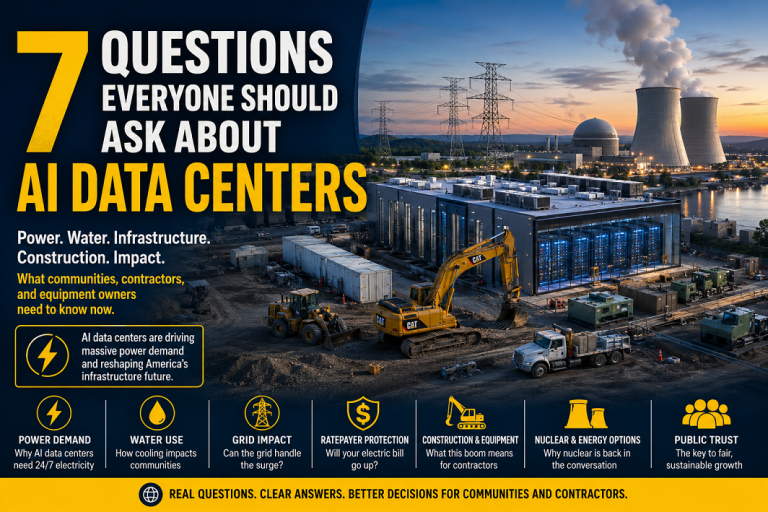
Data centers may sound like a technology story, but before the servers arrive, construction has to happen.
Land has to be cleared. Sites have to be graded. Roads have to be built. Utilities have to be installed. Substations have to be constructed. Power has to be generated and delivered. Concrete has to be poured. Steel has to be erected.
Cranes, telehandlers, lifts, trenchers, excavators, loaders, trucks, generators, pumps, and service equipment all become part of the buildout.
That is why data centers and support infrastructure are already becoming one of the clearest examples of how modern technology still depends on physical construction.
The digital economy still needs dirt work.
Artificial intelligence still needs power.
Cloud computing still needs concrete, copper, steel, water, roads, backup generation, cooling systems, and people who can build and maintain physical infrastructure.
The tools are changing. Machines are gaining sensors, cameras, telematics, grade control, payload systems, electric drives, autonomous features, and digital support. In mining and heavy construction, electric mining trucks and smart haulage systems show how the next generation of machines may reduce risk, improve productivity, and change how jobs are planned.
But the mission is familiar.
Build the systems that allow the country to function and grow.
The next 250 years will not be built by technology alone.
They will be built by people who know how to turn technology into infrastructure.
The Country Is Still Being Built
At 250 years old, the United States is not finished.
No country ever is.
The roads need rebuilding. Bridges need repair. Ports need capacity. Water systems need investment. The grid needs modernization. Housing needs infrastructure. Cities need maintenance. Rural communities need access. Mines, quarries, factories, power plants, warehouses, and data centers need machines and people to build and support them.
That should be part of the Independence Day story.
America was not only founded by statesmen.
It was built by workers.
It was built by people who cleared land, dug canals, laid rail, mined coal, made steel, poured concrete, paved highways, assembled machines, repaired engines, loaded trucks, set beams, pulled cable, cut grade, moved dirt, served in uniform, and kept going when the job got hard.
The Declaration created the nation on paper.
Americans built it on the ground.
And as America enters its next 250 years, the same truth remains: the future will not build itself.
It will take people, machines, materials, capital, risk, maintenance, and the ability to turn plans into physical reality.
To every American who built, hauled, welded, mined, paved, lifted, graded, powered, repaired, protected, and kept going:
You built this.
And the next 250 years will be built by Americans like you.
About the Author
Frank Eusebio is a heavy equipment industry professional with more than 30 years of experience in construction equipment sales, equipment and fleet management, used equipment valuation, remarketing, dealer operations, and international equipment markets and auction consulting. His background includes Komatsu dealer operations, export markets, lease returns, dealer inventory strategy, and heavy equipment ownership economics. He also wrote, created, and implemented Develon’s remarketing program across its dealer network. At HEPLANET, he writes about equipment markets, fleet decisions, resale value, auction trends, parts availability, and the real-world costs that affect contractors, dealers, rental companies, and equipment owners.