Heavy Equipment Repair Decisions: Why the Right Answer Is Not Always the Fastest or Cheapest Fix
When a critical machine goes down, the pressure starts immediately.
The crew is waiting. The job schedule is tightening. Trucks may be idle. The next job may already be lined up. Someone wants an answer, and they usually want it fast.
That is exactly when expensive repair decisions can go wrong.
In heavy equipment, the right repair decision is not always the cheapest part, the fastest part, or even the most familiar option. The right decision depends on the machine, the failure, the job schedule, the supplier, the warranty, the condition of the rest of the machine, and whether the repair is actually being done correctly.
A contractor is not just trying to get the machine moving again.
The real goal is to restore dependable production without creating the next failure.
The Failed Part May Not Be the Whole Failure
One of the biggest mistakes in heavy equipment repair is treating the failed part as if it is the entire problem.
Sometimes it is. A leaking hose, failed sensor, worn seal, broken belt, damaged starter, or isolated electrical issue may be straightforward.
But major component failures are different.
A failed hydraulic pump, final drive, transmission, engine, differential, swing motor, or control valve can be more than a single bad part. It may be the visible result of a larger system problem. If the underlying issue is not corrected, the replacement part may fail too.
That is where contractors can lose serious money.
The invoice may show a pump, motor, or component, but the real repair may involve contamination control, flushing, oil replacement, filter replacement, pressure testing, cylinder inspection, valve inspection, and careful diagnosis of why the failure happened in the first place.
The question should not be only:
How fast can we replace the failed part?
The better question is:
What caused the failure, and what has to be done to keep the next part from failing too?
Hydraulic Pump Failure Is a Good Example
Hydraulic pump failure is one of the clearest examples of why shortcuts can become expensive.
When a hydraulic pump fails internally, it may grind itself apart. Metal particles and contamination can move through the hydraulic system. Those particles may enter lines, valves, cylinders, tanks, filters, and other components.
In that situation, replacing the pump alone may not be a complete repair.
A proper repair may require draining the hydraulic oil, inspecting the hydraulic tank, replacing filters, cleaning or flushing lines, checking screens, inspecting valves, and making sure cylinders have not been contaminated or scored internally.
That takes time.
It also costs money.
But skipping that work can destroy the replacement pump.
In some cases, a contractor may feel forced to take the chance because the job is waiting. The dealer or repair shop may warn that the system needs to be cleaned and inspected, but the owner may choose to move forward without the full procedure because the machine is needed immediately.
That can turn a repair that should have been expensive but manageable into a much larger failure.
A $20,000 problem can become a $40,000 problem if the replacement component fails because the system was never properly cleaned.
That is not a dealer-versus-aftermarket issue. It is a repair-quality issue.
The same mistake can happen with an OEM part, an aftermarket part, a rebuilt part, or a remanufactured part. A good component installed into a contaminated system is still at risk.
Fast Is Not Always Fast
When a machine is down, speed matters. No contractor wants a machine sitting while production stops.
But the fastest apparent repair may not be the fastest real recovery.
If a pump is available today but the system needs several days of proper cleaning, inspection, and preparation, the contractor may not actually save much time by rushing the component decision. In some cases, waiting a few extra days for the right part may make sense if the repair work behind the repair still has to be done.
This is where experienced judgment matters.
A contractor has to separate two different timelines:
The part timeline
How fast can the component be sourced?
The repair timeline
How long will it take to repair the machine correctly?
Those are not always the same thing.
If the machine needs hydraulic cleanup, cylinder inspection, oil replacement, filtration, and testing, the contractor may have more time to source the right component than it appears at first glance.
That does not mean delay is always acceptable. Sometimes the machine is too critical, and the fastest available component is the right decision. But the decision should be based on the full repair timeline, not just the part’s availability.
A Trusted Supplier Is Part of the Downtime Plan
Contractors should have more than one path to parts.
A strong dealer relationship is valuable, especially for diagnostics, service information, warranty work, software support, and urgent parts availability. But contractors should also have at least one trusted supplier outside the dealer network.
That does not mean buying the cheapest part available online.
It means having an aftermarket, rebuilt, reman, or used-parts source whose judgment the contractor trusts before the emergency happens.
The value of a trusted supplier is not just price. It is knowing whether the supplier understands the application, knows the source of the part, can explain the warranty, can confirm fitment, and will stand behind the sale if something goes wrong.
That distinction matters.
A part that saves 50% but carries only a short warranty from an unknown seller may not be a true comparison to an OEM option with longer coverage. The lower price may still be useful in some situations, but the risk is different.
On the other hand, if a contractor can save 30% or 40% and receive warranty coverage comparable to the original option from a supplier that has proven reliable, that savings becomes much more meaningful.
That is not a generic aftermarket argument. It is a supplier-trust argument.
Aftermarket parts vary widely. Some are high-quality replacement parts backed by serious companies. Some are basic low-cost parts that may work fine in less critical applications. Others may not be worth the risk on a machine that is central to production.
The contractor needs to know the difference before the machine is down.
Price Only Matters When the Comparison Is Fair
Contractors are right to compare prices. Major components can be extremely expensive, and repair costs can affect cash flow, job margins, and fleet decisions.
But price alone can be misleading.
A real comparison should include:
- part cost
- availability
- freight time
- warranty length
- warranty terms
- supplier reputation
- testing documentation
- core requirements
- return policy
- application accuracy
- support if the part fails
- labor risk if the part has to be removed again
A cheaper component is only cheaper if it works, fits, lasts, and is supported.
That does not mean the most expensive option is always best. It means the contractor should avoid comparing parts as if all warranties, sources, and suppliers are equal.
They are not.
A used component from a reputable dismantler that has been tested may be a good solution for an older machine. A rebuilt component from a reliable shop may be the best value. A quality aftermarket component with strong warranty support may make more sense than the OEM option. An OEM component may be the safest choice when timing, risk, or warranty coverage makes it worth the premium.
The point is not to choose by category.
The point is to choose by risk.
The Machine You Know Is Different From the Machine You Don’t
Replacement is often discussed too casually.
When a machine has a major failure, it is easy to say, “Maybe it is time to replace it.” Sometimes that is true. But a broken machine is rarely in its best selling position.
A machine that is down may only bring salvage value or a heavily discounted price. Even if the owner plans to sell it, repairing it may preserve far more value than selling it broken.
There is also the “devil you know” problem.
If a contractor has owned a machine from 4,000 hours to 6,000 hours, that contractor may know the machine well. They may know the engine condition, hydraulic strength, undercarriage history, electrical issues, maintenance record, operator feedback, and previous repairs.
If several major repairs have already been completed, another large repair does not automatically mean the machine is a bad investment. It may be the repair that gets the machine through a difficult life-cycle stage and back into productive service.
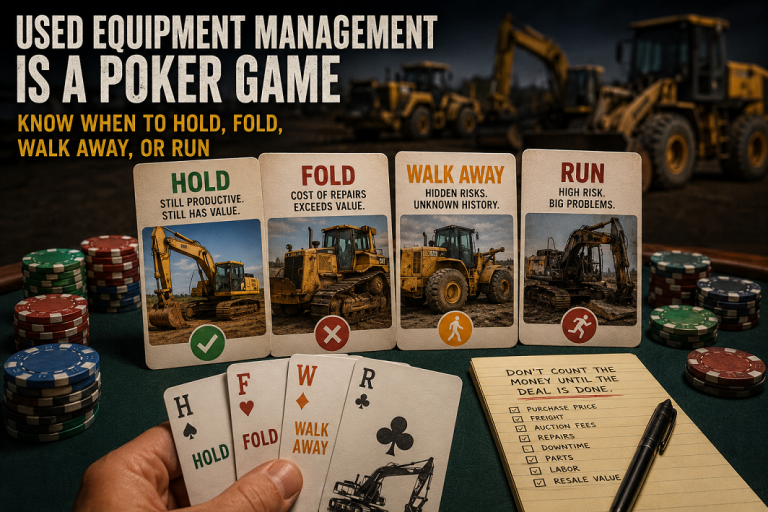
A known machine with a known repair history is different from an unknown machine bought at auction with no records, uncertain maintenance, questionable hours, and no clear operating history.
Buying another used machine may solve the immediate emotional problem of being tired of repairs, but it may introduce a different set of unknowns.
The contractor has to ask:
Am I replacing a known problem with an unknown problem?
That question matters.
Machine Life Cycle Changes the Repair Decision
Heavy equipment repairs do not happen evenly over a machine’s life.
A machine may run well for years and then enter a stage where several expensive items come due. Undercarriage, pumps, cylinders, pins and bushings, engines, transmissions, final drives, electrical issues, cooling systems, and structural wear may all begin to appear as the machine ages.
That can feel like the machine is becoming unreliable.
Sometimes it is.
But sometimes the owner is simply working through a major repair cycle.
If the contractor has already repaired several key systems and the machine is otherwise productive, the next repair may be easier to justify. The owner may be closer to a solid machine than the repair invoice makes it feel.
But if the machine was purchased with unknown history and the first major failure reveals deeper neglect, the calculation changes.
A major repair on a well-known, well-maintained machine is not the same as a major repair on an unknown machine that may have been passed along because the previous owner knew trouble was coming.
That is why machine history matters.
The repair decision should consider not only what failed today, but what has already been repaired, what is likely to fail next, and whether the machine still has a productive future.
Replacement Should Not Be a Reflex
There are times when replacing a machine makes sense.
If parts are no longer available, downtime is constant, the machine no longer fits the work, structural problems are serious, or the owner has lost confidence in the machine, replacement may be the right move.
But replacement should not be treated as the automatic answer to a large repair.
A machine that is broken may be worth far less than the same machine repaired and running. A contractor may take a major loss selling it as-is. Buying another used machine may require more cash, financing, transport, inspections, setup time, and still carry unknown repair risk.
Newer machines may offer better fuel efficiency, productivity, operator comfort, technology, and emissions performance. Those benefits are real. But they come with their own costs: higher purchase price, financing, electronics, emissions systems, insurance, and sometimes more complex diagnostics.
The question is not simply whether a newer machine would be better.
The question is whether the current machine still produces profit when repaired correctly.
If the answer is yes, fixing it may be the better decision.
Used Parts Can Be a Practical Option on Older Machines
For older machines from major brands, used parts can sometimes be a practical solution.
Caterpillar, Komatsu, John Deere, Hitachi, Volvo, and other widely supported brands often have used components available through dismantlers, rebuilders, and independent suppliers. That can matter when new parts are expensive, unavailable, or difficult to justify on an older machine.
Used parts are not automatically the right answer, but they should not be dismissed.
A tested used hydraulic component, final drive, axle, transmission, cylinder, or structural part may solve the immediate problem at a cost that makes sense for the machine’s age and value.
The important issue is the source.
Has the part been tested?
Was it removed from a running machine?
Is there a short trial period or warranty?
Does the supplier know the application?
Can the supplier confirm compatibility?
What happens if the part does not work?
Even a one- or two-week test period can be useful if it gives the contractor enough time to install, run, and evaluate the component.
Again, the issue is not whether used is good or bad.
The issue is whether the part, supplier, and application make sense.
Rental Can Buy Time to Repair Correctly
Rental is often treated as a last resort, but it can be a smart repair strategy.
If a critical machine goes down and the repair requires proper cleaning, inspection, or sourcing time, renting a replacement may protect the job while allowing the owner to repair the machine correctly.
That is different from renting because no one knows what else to do.
Rental can create breathing room.
It may allow the contractor to avoid rushing into a poor component choice. It may allow time to wait for a better-priced part with a stronger warranty. It may allow the shop to flush the hydraulic system properly, inspect cylinders, drain oil, check contamination, and complete the repair without pressure to skip steps.
Rental has costs: delivery, pickup, weekly or monthly rate, fuel, insurance, attachments, operator adjustment, and availability. But those costs should be compared against the risk of a rushed repair and the cost of a failed replacement part.
Sometimes the rental bill is cheaper than doing the same repair twice.
The Dealer Still Has an Important Role
None of this means contractors should avoid dealers.
Dealers are often the best source for diagnostics, technical information, software support, trained technicians, warranty repairs, urgent OEM parts, and machine-specific service knowledge.
The hydraulic pump example proves the point.
If a dealer warns that the system needs additional cleanup or inspection after a pump failure, that warning should be taken seriously. If the customer chooses to skip that work because the machine is needed immediately, the risk belongs to the decision, not simply to the dealer or the replacement part.
A good dealer, a good independent mechanic, and a good aftermarket supplier can all be valuable.
The contractor’s advantage comes from knowing when to use each one.
The Best Contractors Build Options Before They Need Them
A contractor should not be searching for a trustworthy parts source for the first time after a machine has failed.
The better approach is to build options ahead of time.
That means knowing:
- the dealer contacts who can move quickly
- at least one trusted aftermarket supplier
- a reliable hydraulic shop
- a qualified rebuilder
- a used-parts source for older machines
- rental companies with comparable machines
- mechanics who understand the brand and application
- which parts are long lead-time items
- which machines are most critical to production
This is not overcomplicating the business.
It is protecting production.
When a machine is down, every hour becomes more expensive. A contractor who already knows whom to call can make better decisions under pressure.
The Real Question: Are You Restoring Reliability?
The purpose of a major repair is not just to make the machine run again.
It is to restore reliability.
That is the difference between a repair that solves the problem and a repair that only delays the next failure.
Before approving a major repair, the contractor should ask:
- Do we understand why the part failed?
- Are we correcting the cause or only replacing the result?
- Is the system clean enough to protect the replacement component?
- Is the supplier trustworthy?
- Is the warranty meaningful?
- Is the machine worth repairing based on its history?
- Would selling it broken destroy too much value?
- Would another used machine carry more unknown risk?
- Would rental allow us to repair this correctly?
- Does this repair get the machine over the hump or just buy a little time?
Those are the questions that matter.
Conclusion: The Right Repair Protects the Machine, the Job, and the Business
Heavy equipment repair decisions are rarely simple when a critical machine is down.
The cheapest part may not be the cheapest repair. The fastest fix may not be the fastest recovery. The dealer option may be worth the premium. A quality aftermarket option may offer better value. A rebuilt or used component may make sense on an older machine. Rental may buy the time needed to do the job correctly.
The answer depends on timing, trust, warranty, machine history, repair quality, parts availability, and the cost of downtime.
Contractors do not need to treat every major repair as a reason to replace the machine. They also should not keep repairing a machine blindly just because they already own it.
The best decision is the one that restores dependable production at a risk level the business can live with.
In heavy equipment, getting the machine running is only part of the job.
Getting it repaired right is what keeps the next failure from costing even more.