Critical Minerals Are the New Mining Race — But the Hard Part Is Processing Them
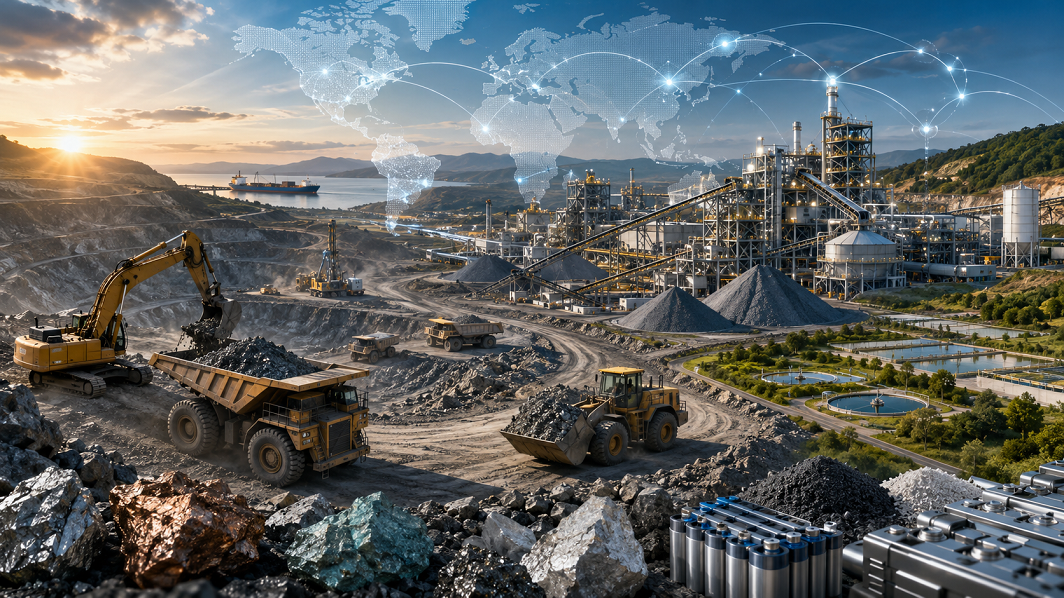
Why critical minerals mining, processing, supply chains, and heavy equipment are becoming part of the same global race
Critical minerals mining is becoming one of the most important industrial races in the world.
Not because these minerals glitter like gold or sell like diamonds, but because modern economies increasingly depend on them. Electric vehicles need batteries. Phones need specialty metals. Wind turbines need magnets. Defense systems need advanced materials. Data centers, grid storage, semiconductors, and advanced manufacturing all depend on mineral supply chains most people never see.
That is changing the global map of value.
Countries that once had limited leverage in the industrial economy may now hold resources the world needs. Countries that control processing, refining, and export access can gain even more power than countries that simply own the ore.
That is the part most people miss.
The hard part is not only finding critical minerals. The hard part is turning raw material into usable supply — safely, legally, economically, and at industrial scale.
For the heavy equipment industry, the opportunity is not simply that more minerals may be mined. The opportunity is that the critical-minerals race requires an entire industrial system: roads, power, water, permits, processing plants, loaders, excavators, trucks, crushers, screens, conveyors, pumps, maintenance shops, parts support, and trained operators.
The mineral may be the headline. The infrastructure behind it is where the work happens.
Critical minerals mining is changing what the world values
For most of history, mineral wealth was easy to understand. Gold, silver, diamonds, copper, iron ore, coal, and oil were obvious sources of economic power.
Critical minerals are different.
Their value is tied less to appearance and more to function. Lithium, cobalt, nickel, graphite, manganese, and other materials are central to batteries. Rare earth elements are used in magnets, motors, electronics, defense systems, wind turbines, and advanced manufacturing. Copper is essential to electrification, grid infrastructure, electric motors, charging systems, and data centers. Gallium and germanium matter to semiconductors and defense applications. Uranium is tied to nuclear power and energy security.
Some of these materials have been used for decades. Cobalt, for example, has long been used in alloys, tools, pigments, and industrial applications. But the battery economy changed the scale and urgency. A mineral that once mattered mainly to specialized industrial uses can become strategic when it becomes part of electric vehicles, grid storage, military systems, phones, laptops, and energy infrastructure.
That is the shift.
The modern economy is making new winners and losers based on minerals many people could not name twenty years ago.
“Critical” does not always mean rare
The word “critical” can be misleading.
A critical mineral is not always rare like a diamond or a scarce precious metal. A mineral can be critical because supply is concentrated in a few countries, processing is difficult, substitutes are limited, or the material is essential to national security, clean energy, electronics, or manufacturing.
In other words, critical minerals are not just about geology. They are about vulnerability.
A country may have mineral deposits and still be dependent on foreign supply if it does not have the processing capacity. A manufacturer may need batteries, motors, electronics, or defense components but still be exposed if one country controls the refining, separation, or export channel.
That is why critical minerals mining is no longer only a mining issue. It is a national-security issue, a trade issue, an industrial-policy issue, and an infrastructure issue.
The International Energy Agency’s Global Critical Minerals Outlook has warned that critical-mineral processing and refining capacity remains highly concentrated. That concentration creates supply-chain risk even when mineral deposits exist in multiple countries.
Owning the rock is not the same as owning the supply chain.
Electric vehicles, electronics, and defense changed the mining map
The rise of electric vehicles changed the critical-minerals conversation, but EVs are only part of the story.
Batteries require minerals. Motors require magnets. Charging networks require copper and grid upgrades. Renewable power requires transmission, storage, turbines, inverters, and electronics. Data centers and AI infrastructure require enormous electrical systems, backup power, cooling, and semiconductor supply chains.
At the same time, phones, laptops, satellites, drones, military electronics, industrial controls, and advanced manufacturing all depend on mineral inputs that are invisible to the consumer.
Most people do not think about cobalt when they charge a phone. They do not think about graphite when they hear about batteries. They do not think about rare earths when they use an electric motor. They do not think about copper when a new data center is announced.
But the supply chain thinks about all of it.
That is why minerals that once sat in the background of the industrial economy are now part of front-page politics.
The critical minerals race is already geopolitical
The critical-minerals race is already reshaping global strategy.
The U.S.-Ukraine minerals agreement is one example. It did not simply hand Ukraine’s mineral rights to U.S. companies, but Reuters reported that the deal gave the United States preferential access to new Ukrainian minerals deals and created a structure tied to investment and reconstruction. That matters because it shows critical minerals becoming part of wartime diplomacy, reconstruction policy, and strategic alignment.
Greenland is another example. Its location matters, but so does its mineral potential. Greenland has drawn attention because of resources such as rare earths, graphite, copper, nickel, zinc, and uranium. Reuters has reported on the connection between U.S. interest in Greenland and the island’s critical-mineral potential.
China’s role is even larger. China has spent years building influence across mineral-rich regions through infrastructure investment, mining deals, processing capacity, and trade relationships. In parts of Africa, infrastructure-for-resources deals helped secure access to minerals needed for batteries and advanced manufacturing. Reuters reported that China has returned to Africa with renewed focus on minerals after years of Belt and Road infrastructure investment.
The G7 response shows how serious this has become. In 2026, Reuters reported that the G7 created a critical minerals alliance and crisis platform aimed at reducing dependence on China and limiting reliance on any single supplier.
This is the new resource map.
Critical minerals may push countries toward tighter economic blocs, stronger regional supply chains, and more aggressive industrial policy. North America is one obvious example. The United States, Canada, and Mexico may remain separate countries, but critical minerals, batteries, autos, defense, energy, and manufacturing could push them toward deeper supply-chain coordination.
The same logic applies elsewhere. Europe wants less dependence on China. China wants secure overseas mineral access. The United States wants domestic and allied supply chains. Resource-rich countries want more value from their minerals instead of exporting raw material while others capture the processing margin.
This is not just mining. It is global alignment.
The human cost cannot be ignored
The critical-minerals race also has a human side.
Some important minerals are mined in places where labor conditions, environmental controls, safety standards, and enforcement are weak. Cobalt from the Democratic Republic of Congo is the best-known example.
The DRC is one of the world’s most important cobalt producers. Cobalt is used in many lithium-ion batteries and industrial applications. But parts of the cobalt supply chain have long been associated with dangerous artisanal mining, child labor, poverty, tunnel collapses, dust exposure, and unsafe working conditions.
Amnesty International documented children and adults mining cobalt by hand in hazardous conditions, with that cobalt entering global electronics and battery supply chains.
This is where the critical-minerals conversation becomes uncomfortable.
The world wants clean energy, electric vehicles, smartphones, batteries, and advanced technology. But some of the materials behind those products may come from dangerous and poorly regulated conditions.
Mechanized mining does not automatically solve every problem. Industrial mines can still create environmental damage, community conflict, water concerns, pollution, and labor issues. But regulated, mechanized, properly engineered operations can reduce some of the worst risks of informal hand mining when paired with labor standards, environmental controls, inspection, training, and enforcement.
This is one place where heavy equipment enters the story naturally.
Hand-dug pits and informal mineral recovery are not a sustainable model for a global battery and electronics supply chain. If countries and companies want safer, higher-volume, more transparent mineral production, they need modern mine planning, haul roads, loaders, excavators, haul trucks, crushers, screens, dust control, water systems, tailings management, trained operators, maintenance shops, and accountable site management.
The equipment does not make mining harmless. But it can be part of moving from dangerous informal extraction to controlled industrial production.
Mining is only the first step
Even when minerals are mined responsibly, mining alone does not solve the critical-minerals problem.
Raw ore is not the same as usable material. A battery manufacturer cannot use a pile of rock. A defense contractor cannot use unprocessed ore. A magnet producer cannot use rare earths that have not been separated. A semiconductor supply chain cannot run on minerals that have not been refined to specification.
The supply chain usually involves exploration, permitting, mine development, extraction, crushing, separation, concentration, chemical processing, refining, waste handling, water treatment, transportation, quality control, and offtake agreements.
Any one of those stages can become the bottleneck.
A country can have deposits but lack permits. It can have mines but lack processing. It can have processing but lack refining. It can have refining but lack customers. It can have customers but lack financing. It can have financing but lack water, power, roads, or skilled labor.
This is why processing is the hard part.
The mine gets the attention because it is visible. The processing plant may decide whether the resource actually becomes part of the supply chain.
Critical minerals processing is where leverage is created
Processing is not glamorous, but it is where much of the strategic value sits.
Rare earths are a good example. The phrase “rare earth” makes people think the problem is finding the material. But rare earths are difficult because separating and refining them is technically complex, environmentally sensitive, and highly concentrated in a small number of countries.
The same principle applies across critical minerals. Mining material is one thing. Turning that material into battery-grade, magnet-grade, semiconductor-grade, or defense-grade supply is another.
Critical minerals processing requires chemistry, metallurgical expertise, water, power, permitting, environmental controls, tailings management, skilled labor, testing, quality control, steady operating discipline, capital investment, and long-term customers.
That is why countries are trying to build domestic and allied processing capacity.
If a country mines critical minerals but sends them abroad for processing, it has not fully secured the supply chain. The country that processes, refines, and controls exports may hold the greater leverage.
The new mining race is really a supply-chain race.
Can coal waste and mine waste become part of the solution?
This is where the story gets more interesting.
As critical-mineral demand rises, companies and governments are looking again at materials once treated mainly as waste: coal ash, coal refuse, mine tailings, acid mine drainage, industrial byproducts, and old waste piles.
These sources are attractive because the material has already been mined, disturbed, processed, or stored. In some cases, recovery may offer two benefits at once: reclaim valuable minerals and reduce an environmental problem.
But that second benefit is not automatic.
Recovering critical minerals from waste only counts as cleanup if the process actually reduces the hazard, treats water, stabilizes material, or leaves the site safer than it was before. If a project simply reworks waste, creates new waste, or uses poor environmental controls, it may move the problem rather than solve it.
The best projects are different.
Acid mine drainage, for example, can contain recoverable rare earth elements and critical minerals. The U.S. Department of Energy’s National Energy Technology Laboratory has described acid mine drainage processing as a way to recover valuable rare earths and critical minerals while returning environmentally impacted areas to healthier ecosystems. Penn State has also described research that modifies existing acid mine drainage treatment so valuable materials separate during cleanup, helping recover minerals while treating polluted water. Read Penn State’s overview of coal mine waste recovery.
That is the double benefit.
A coal region that once carried the environmental cost of mining could potentially become part of a domestic mineral supply chain while also treating legacy waste. That does not erase the history of pollution, and it does not make every coal-waste project good. But it creates a different conversation: some waste streams may become cleanup targets and feedstocks at the same time.
The U.S. has already moved in this direction. Reuters reported that the Interior Department has pushed to recover critical minerals from mine waste, coal refuse, tailings, and abandoned uranium mines, with the stated goal of turning environmental liabilities into economic opportunities while reducing foreign dependence. Reuters also noted that environmentally safe processing and property-rights issues remain challenges. Read Reuters’ report on critical minerals from mine waste.
That tension is exactly the point.
Waste recovery could help. But it has to be done right.
Where heavy equipment fits in critical minerals mining
Heavy equipment is not the reason critical minerals matter. But it is part of how critical minerals become real supply.
Once a country decides it needs more domestic or allied mineral production, the work has to happen physically. Roads have to be built. Sites have to be cleared. Overburden has to be moved. Ore has to be mined. Waste has to be managed. Material has to be crushed, screened, conveyed, pumped, stored, processed, and transported.
That requires equipment.
Depending on the project, the equipment chain may include excavators and dozers for site development, drainage, reclamation, and mine work; wheel loaders for feedstock handling, stockpiles, trucks, and plant support; haul trucks or articulated trucks for material movement; crushers, screens, and conveyors for sizing and material flow; pumps and water-treatment systems for slurry, drainage, process water, and environmental control; and maintenance shops, service trucks, parts inventory, hoses, filters, bearings, wear parts, and field service.
The equipment need will depend on the project. A hard-rock lithium mine is not the same as a copper mine. A rare-earth separation facility is not the same as a cobalt operation. A tailings recovery project is not the same as a greenfield mine. A coal-waste recovery project is not the same as an underground mining operation.
But the pattern is the same: industrial-scale mineral supply requires industrial-scale support.
This is where contractors, dealers, rental companies, and parts suppliers should pay attention. Critical minerals may create demand not only for mining machines, but for the infrastructure around mining and processing: roads, pads, drainage, power, water, conveyors, pumps, service trucks, and maintenance support.
For HEPLANET readers, this connects to a broader equipment-market theme: machines do not work in isolation. They depend on power, water, access roads, maintenance, parts, service, and uptime. HEPLANET covered this same support-system logic in Heavy Equipment Demand Is Really Support Infrastructure Demand and Equipment Uptime and Cash Flow.
The equipment market follows the work. And the work follows the supply-chain pressure.
What contractors and equipment businesses should watch
Not every critical-minerals announcement will become an equipment opportunity.
The projects to watch are the ones that move from policy to permits, from exploration to development, from pilot plant to commercial plant, and from funding announcement to actual site work.
The strongest signals include:
- critical minerals mining permits
- processing plant announcements
- rare-earth separation projects
- lithium refinery projects
- cobalt, nickel, copper, and graphite offtake agreements
- tailings recovery projects
- coal waste and coal ash recovery projects
- government grants tied to named sites
- environmental approvals
- utility upgrades
- road and rail work
- equipment orders
- contractor mobilization
- local dealer support
For equipment owners, the opportunity may not always be the mine itself. It may be the infrastructure that makes the mine or processing plant work.
For dealers and rental companies, early-stage pilot projects may create temporary equipment demand first. If those projects scale, they may lead to permanent fleets, maintenance contracts, parts support, and regional service opportunities.
For contractors, the work may include access roads, pads, drainage, site clearing, reclamation, water systems, concrete, utilities, stockpile areas, haul roads, and plant support.
For parts suppliers, the opportunity may come from uptime. Processing plants cannot afford constant shutdowns. Pumps, conveyors, screens, loaders, trucks, valves, hoses, filters, bearings, cylinders, and electrical systems all need support.
This is also why parts availability and dealer support matter in industrial equipment markets. HEPLANET covered that issue in Parts Availability and Heavy Equipment Resale Value.
Critical minerals are a global supply-chain story, but they still come down to work on the ground.
FAQ: Critical minerals mining and processing
What is critical minerals mining?
Critical minerals mining is the extraction of minerals that are important to energy, defense, electronics, batteries, manufacturing, and national security. These minerals include lithium, cobalt, graphite, rare earth elements, copper, nickel, manganese, gallium, germanium, and others.
Why are critical minerals important?
Critical minerals are important because modern industries depend on them. Electric vehicles, batteries, wind turbines, phones, semiconductors, defense systems, data centers, grid storage, and advanced manufacturing all rely on minerals that must be mined, processed, refined, and delivered through secure supply chains.
Why is critical minerals processing difficult?
Critical minerals processing is difficult because raw ore usually has to be separated, concentrated, chemically processed, refined, and tested before it can be used in batteries, magnets, semiconductors, defense systems, or advanced manufacturing. Processing also requires water, power, permits, environmental controls, skilled labor, and major capital investment.
How does heavy equipment support critical minerals mining?
Heavy equipment supports critical minerals mining through site development, road building, overburden removal, loading, hauling, crushing, screening, material handling, reclamation, drainage, water management, and plant support. Excavators, wheel loaders, haul trucks, dozers, crushers, conveyors, pumps, and service trucks all play roles depending on the project.
Can critical minerals be recovered from coal waste or mine waste?
Yes, some critical minerals can be recovered from coal waste, mine tailings, acid mine drainage, coal ash, and other industrial byproducts. But recovery only creates an environmental benefit if the process treats water, stabilizes waste, reduces hazards, and leaves the site safer than it was before.
HEPLANET takeaway
Critical minerals mining is becoming the new resource race because the modern economy cannot function without these materials.
Electric vehicles, batteries, phones, defense systems, wind turbines, data centers, semiconductors, and advanced manufacturing all depend on minerals most people rarely think about. That is changing the value of countries, regions, companies, and supply chains.
But the hard part is not only finding the minerals.
The hard part is mining them responsibly, processing them domestically or through trusted allies, protecting workers, managing water and waste, building infrastructure, and turning raw material into usable industrial supply.
That is where the mining race becomes a processing race.
And that is where heavy equipment enters the story naturally. Excavators, loaders, trucks, crushers, screens, conveyors, pumps, power systems, water treatment, maintenance shops, and parts support are not the headline. They are the machinery behind the headline.
The winners may not be only the countries that have the resources. They may be the countries that can mine, process, finance, regulate, transport, and support those resources at scale.
That is why critical minerals are not just another mining trend.
They are becoming one of the defining industrial races of the next decade.