Weekly Heavy Equipment Intelligence: Fuel & Auctions

June 9–16, 2026
Not every week changes the heavy equipment market.
Some weeks produce hard data. Some produce noise. Others produce signals that are worth watching because they may affect equipment cost, uptime, financing, resale value, or project timing if they continue.
The week of June 9–16 was a signal week.
Fuel risk moved again. Financing offers remained active. Auction channels showed activity, but not enough to declare a broad used-equipment trend. Parts and maintenance stayed important as buyers weighed repair against replacement. Mining, infrastructure, and manufacturing projects continued to support long-cycle equipment demand. Technology stories pointed less toward flashy machine launches and more toward power, logistics, diesel demand, and operating cost.
For contractors, dealers, rental companies, fleet owners, auction buyers, exporters, repair shops, and parts suppliers, the question is not, “Did the market change this week?”
The better question is:
Which signals could affect machine cost, payment, fuel exposure, parts support, resale value, or uptime if they continue?
1. Fuel remains a cost signal, not just an oil headline
Oil moved lower after reports of a U.S.-Iran framework, with Reuters reporting that crude prices fell on expectations that the Strait of Hormuz could reopen and oil flows could normalize. But contractors do not buy crude oil. They buy diesel, haul material, move machines, pay freight, price asphalt, deliver equipment, and write fuel-surcharge language into bids.
That is why the useful question is not whether crude moved down on one trading day.
The useful question is whether lower oil eventually reaches diesel, trucking, asphalt, rental delivery, equipment transport, and contractor bids.
Fuel remains one of the fastest ways outside events can move into equipment economics. A change in diesel cost can affect hauling, paving, quarry production, mining, trucking, equipment delivery, idle-time discipline, and whether a contractor rents, repairs, or delays replacement.
Reader takeaway: fuel only becomes an equipment story when it affects diesel, freight, asphalt, fuel surcharges, equipment transport, or bids. That is what contractors should watch.
2. Auction activity is useful, but it is not the whole used-equipment market
Auction activity remained a major topic this week, especially after RB Global reported Q1 2026 gross transaction value up 13% year over year to $4.3 billion.
That is a real signal, but it should not be overread.
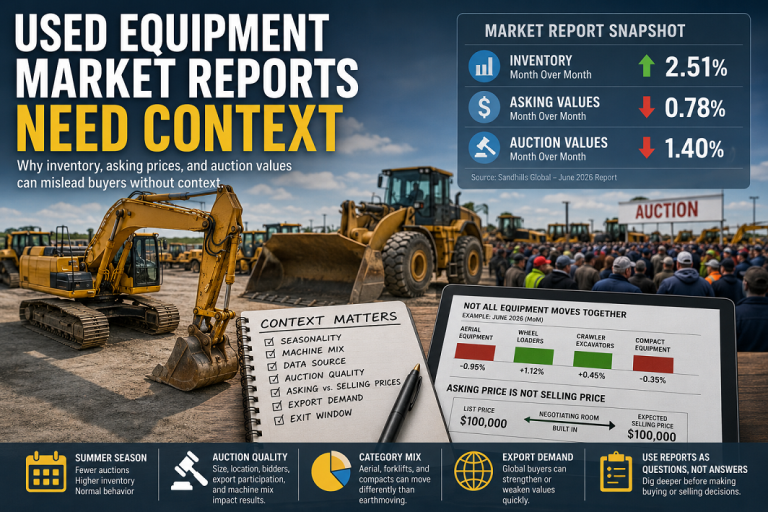
Higher auction volume or higher transaction value does not automatically mean used equipment is getting cheaper. Auction growth can reflect stronger buyer participation, better equipment mix, larger seller packages, more online reach, international bidding, fleet rotation, or a major platform winning more business from sellers.
It can also happen while clean used machines remain hard to buy.
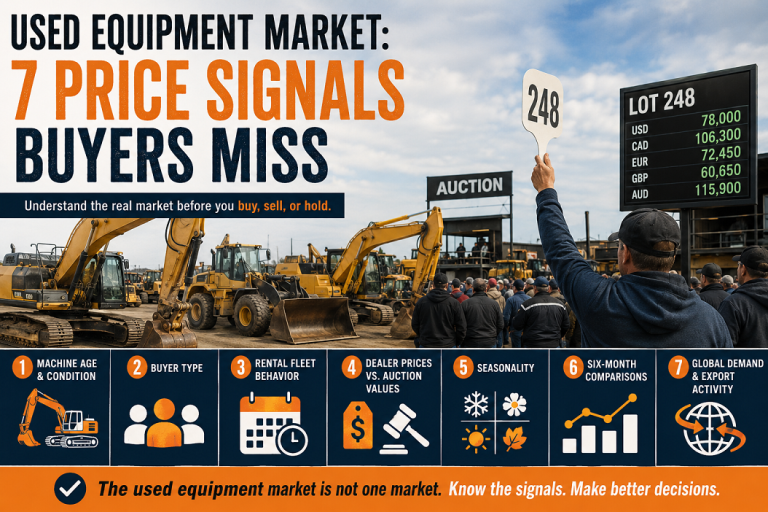
No single public source captures the whole used-equipment market. Auction platforms see one part of it. Listing marketplaces see another. Dealer retail listings show another. Valuation services, private contractor sales, regional auctions, rental-fleet disposals, and finance data all show different pieces.
Auction results also need context. The same machine can appear in more than one sale. Seller expectations, freight cost, location, bidder depth, condition, attachments, auction terms, and whether the machine actually changed hands can all affect the apparent number.
That does not make auction data useless. It makes interpretation important.
Auction results can show buyer appetite. They can reveal regional demand. They can show whether buyers are chasing clean machines, exportable machines, trucks, compact equipment, or higher-hour machines. But they should be treated as evidence, not as the entire market.
For more on interpreting broad used-equipment data, see HEPLANET’s Used Equipment Market Reports Are Easy to Misread. Buyers tracking current sales can also use the June 2026 Heavy Equipment Auction Calendar as a starting point, then evaluate actual results by machine class, seller type, condition, and region.
Reader takeaway: auction data matters, but it is not the whole market. Buyers should look at machine class, age, hours, seller type, condition, attachments, freight, fees, and whether clean machines are actually becoming easier to buy.
3. Financing offers are becoming buyer intelligence
Financing offers are not unusual in equipment sales, but they are still useful market signals.
When OEMs and dealers promote 0% financing, rebates, or rate programs, they are not only advertising machines. They are helping buyers solve the payment problem.
This week, John Deere was advertising 0% APR for 48 months on qualifying new compact construction equipment, with the offer running through June 30, 2026. Bobcat also had special offers across multiple equipment categories, including forklifts, utility tractors, compact/support equipment, telehandlers, light compaction, portable power, large excavators, and large wheel loaders.
That matters because the buyer’s real decision is rarely based on price alone.
A contractor comparing a compact excavator, skid steer, compact track loader, utility tractor, forklift, wheel loader, telehandler, or portable power unit has to think about:
Monthly payment, rebate value, warranty, dealer support, freight, insurance, attachments, maintenance, fuel use, downtime risk, and resale value.
The better deal is not always the lowest payment. A rebate may be better for one buyer. A low-rate offer may be better for another. A rental may make more sense if backlog is uncertain. A repair may be smarter if the existing machine can stay reliable.
This is why financing belongs in fleet strategy, not just sales promotion.
Reader takeaway: equipment buyers should compare financing offers by total ownership cost, not headline rate alone.
4. If buyers delay replacement, maintenance matters more
When buyers hesitate, machines stay in service longer.
That can be smart. A paid-off excavator, wheel loader, dozer, backhoe, forklift, aerial lift, truck, or compact machine can be a good asset if it is reliable.
But delayed replacement only works when maintenance discipline improves with it.
A machine that avoids a new payment but creates emergency downtime is not saving money. Hydraulic repairs, undercarriage problems, final drives, pins and bushings, tires, brakes, batteries, electrical faults, emissions issues, and unavailable parts can quickly erase the benefit of waiting.
Parts availability also matters more in a higher-cost environment. Tariffs, freight, supplier pricing, and imported components can all affect replacement cost and lead time, even when the impact is not immediate.
The same principle applies across equipment categories. Forklift inspections, undercarriage inspections, hydraulic checks, oil samples, service records, attachment condition, and operator walkarounds are not just maintenance tasks. They are risk-control tools.
For buyers looking at used machines, HEPLANET’s Used Excavator Inspection Guide is a practical reminder that auction value and machine value are not the same thing if condition, service history, and repair exposure are not understood.
Reader takeaway: when replacement gets delayed, preventive maintenance becomes part of the buying strategy.
5. Global signals are becoming harder to ignore
HEPLANET remains North America-first, but heavy equipment is not a closed domestic market.
Reuters reported that China is targeting electric vehicles for 40% of new heavy-truck sales by 2030. That matters because heavy trucks connect to construction logistics, mining, aggregates, cement, ports, equipment transport, parts delivery, and freight cost. It is not an excavator story by itself, but it is a diesel-demand and logistics signal.
India’s diesel export-tax change and Russia’s fuel-quality rule changes also belong on the global fuel watchlist. They are not automatic U.S. contractor stories, but fuel availability, fuel quality, refined-product flows, and regional shortages can affect equipment operation and project cost in connected markets.
Latin America remains the most important regional watch area. Mining, copper, surface fleets, rebuilds, used-equipment exports, parts demand, dealer support, freight, customs, and Spanish-speaking buyer networks all connect Latin America to the U.S. heavy equipment market.
The next strong foundation article should be:
Why Latin America Matters to the U.S. Heavy Equipment Market
Reader takeaway: global signals matter when they affect fuel, freight, mining, exports, parts demand, or used-equipment movement.
6. Jobsite power is becoming part of fleet strategy
One of the more practical technology signals this week was jobsite power.
Caterpillar announced expanded Cat Energy Control System solutions, including the Cat ECS 300 and Cat ECS 400. That points toward a market where generators, battery storage, temporary power, renewable inputs, data centers, remote sites, and construction operations become part of the same fleet strategy.
The next equipment question may not only be horsepower.
It may be power.
Contractors may not electrify their excavator fleets tomorrow, but they are already facing more complicated questions around generators, portable power, charging, battery storage, grid reliability, electric trucks, and fuel exposure.
Electrification is not only about replacing a diesel machine with a battery-electric machine. It is also about how the whole site is powered, how charging affects scheduling, how rental power fits, and how energy cost becomes part of equipment planning.
For more on how technology can reshape service departments and uptime planning, see HEPLANET’s Heavy Equipment Repair in the Age of AI and Robotics.
Reader takeaway: jobsite power is becoming an ownership issue. Contractors should watch generators, battery storage, charging, temporary power, data centers, and fuel exposure as part of fleet strategy.
7. Infrastructure and mining remain pipeline signals
Infrastructure and mining still support long-cycle equipment demand, but they do not move every machine category at the same time.
Bridge funding, roadbuilding, utility work, concrete, drainage, paving, hauling, cranes, access equipment, trucks, and rental fleets all benefit at different stages of a project.
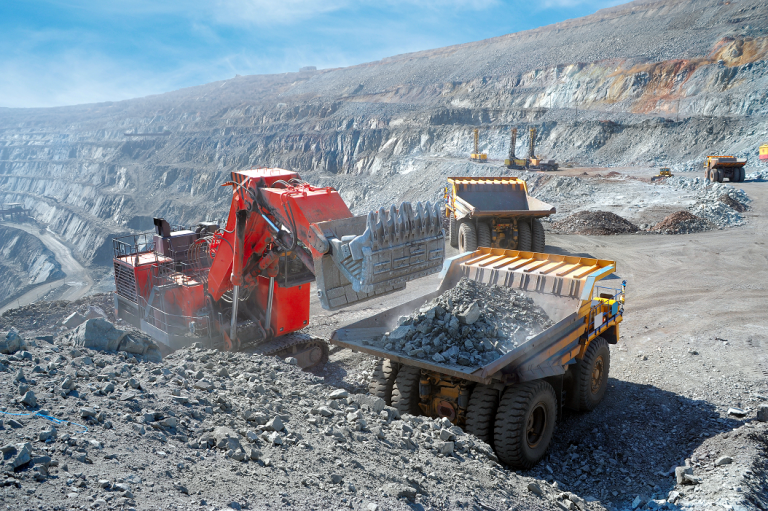
Mining is the same. Copper, surface mining, drilling, hauling, processing, power, maintenance, rebuilds, and parts support all create equipment demand, but the demand moves through different machines and suppliers over time.
Large manufacturing and semiconductor projects work the same way. Site development, excavation, grading, utilities, drainage, hauling, concrete preparation, and foundations usually come first. Cranes, aerial equipment, forklifts, telehandlers, electrical support, mechanical work, and indoor material handling often follow later.
That timing matters. If aerial equipment is softer while earthmoving is firmer, it does not automatically mean construction is weak. It may mean projects are still in the sitework or structural phase before finishing trades and access-equipment demand rise.
HEPLANET’s Roadbuilding Equipment: The Machines Behind Modern Infrastructure explains how infrastructure work moves through machine categories, project stages, and support fleets.
Reader takeaway: infrastructure and mining demand should be read by project stage, region, machine type, and support requirement.
What HEPLANET is watching next
The most important follow-up topics are:
Auction interpretation: More auction activity does not necessarily mean cheaper equipment. Final results, seller type, machine category, repeated serial numbers, freight, fees, and clean-machine availability matter.
Financing and rebates: Buyers need a practical comparison of 0% financing, cash rebates, warranty, dealer support, freight, insurance, attachments, maintenance, and resale value.
Fuel and logistics: Fuel deserves attention when crude movement affects diesel, freight, asphalt, refinery supply, fuel surcharges, equipment transport, or contractor bids.
Maintenance economics: If buyers delay replacement, preventive maintenance becomes more valuable.
Latin America: Mining, copper, rebuilds, exports, parts, and Spanish-speaking buyer networks deserve a focused English-language foundation article.
Jobsite power: Generators, battery storage, charging, data centers, electric trucks, and grid reliability are becoming fleet-planning issues.
Backhoes: The next backhoe article should answer the real question: when does a backhoe still beat a mini excavator plus skid steer or compact track loader?
Weekly bottom line
The week of June 8–16 did not prove a new heavy equipment market trend.
It showed which signals deserve attention.
Fuel remains important if it reaches diesel, freight, asphalt, and bids. Auction activity is useful, but it does not define the whole used-equipment market. Financing offers show that payment structure matters. Parts and maintenance become more important when buyers delay replacement. Global signals matter when they affect fuel, freight, mining, parts, or equipment movement. Jobsite power is becoming part of fleet strategy.
For contractors and fleet owners, the question is not whether the market changed in one week.
The better question is:
Which signals could change machine cost, uptime, payment, fuel exposure, parts support, resale value, or project timing if they continue?