Telematics Promises Transparency. So Why Doesn’t the History Follow the Machine?
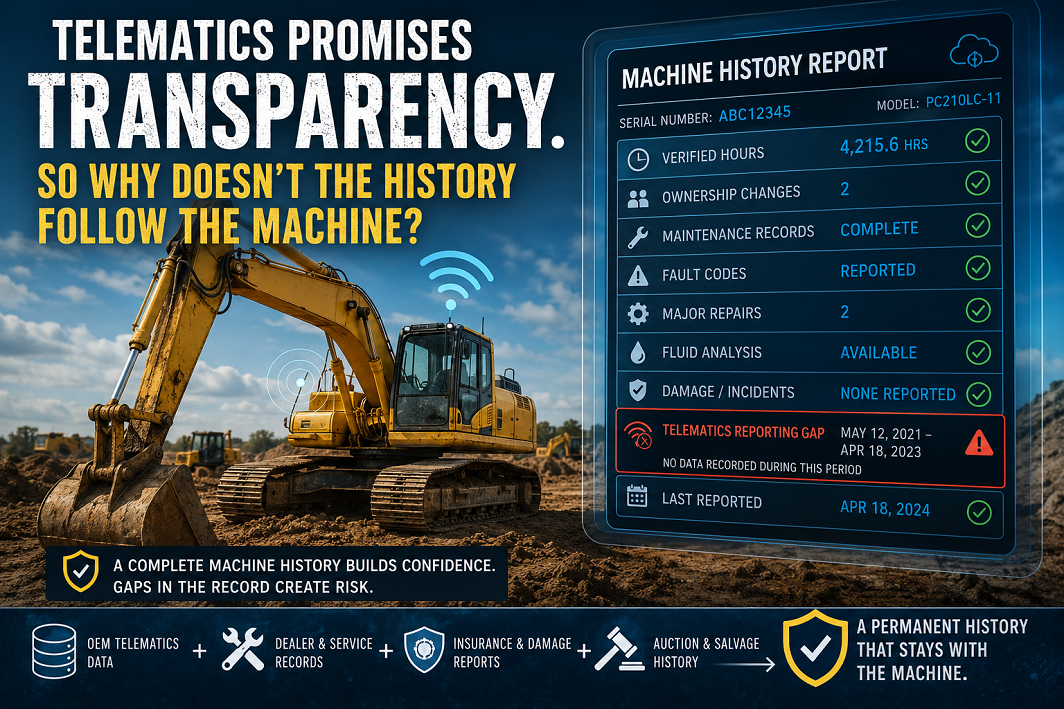
Telematics is increasingly included as part of a machine’s value. But when used equipment changes owners, the buyer may receive the connection without receiving the complete record.
When a used machine changes owners, what happens to its telematics history?
Does the buyer receive the machine’s complete operating record—verified hours, major fault codes, component failures, maintenance events, recurring problems, and documented repairs?
Or does the new owner activate a separate account and begin with what amounts to a clean screen?
That question has become more important as heavy equipment telematics has evolved.
When telematics first entered the construction equipment market, it was commonly promoted as an additional fleet-management service. The hardware was installed on the machine, owners often received an introductory period of access, and continued use could require a subscription.
The value proposition was straightforward: pay for the service and gain better control of the fleet.
Owners could monitor location, hours, fuel consumption, idle time, maintenance intervals, fault codes, and other operating information.
That model is changing.
Manufacturers and dealers increasingly promote connectivity as an included feature rather than a temporary service sold separately. Komatsu says its telematics system preserves historical equipment records and allows users to create equipment-history reports. John Deere’s JDLink provides access to machine information and wireless data transfer. Caterpillar’s Product Link collects hours, location, diagnostic codes, fuel use, idle time, and other performance data. Komatsu telematics, John Deere JDLink, and Caterpillar Product Link all demonstrate how deeply connected-machine data has become integrated into equipment ownership.
Dealers now use that connectivity as part of the machine’s value.
The buyer is told that the equipment is connected, its health can be monitored, and the system can improve maintenance, uptime, security, and fleet management.
But that creates a more difficult question:
If telematics is part of the machine’s value, why doesn’t the history follow the machine when it is sold?
The current owner benefits from access to the platform. That does not necessarily mean the owner possesses or controls the underlying historical record.
The information may be stored on an OEM server. Access may be provided through a manufacturer or dealer account. The dealer may be able to view reports the owner cannot. When ownership changes, the former account may be closed and a new one created.
The telematics hardware stays with the machine.
The history may not.
A buyer may receive access from the purchase date forward. The new owner may see tomorrow’s fuel consumption, the next maintenance interval, and the next fault code.
But can that buyer see what happened during the previous five years?
Can the buyer confirm that the hours are original?
Can the buyer see repeated overheating events, recurring electrical faults, hydraulic contamination, component failures, or maintenance that was repeatedly postponed?
Can the buyer see how a major repair was completed and how long the machine operated successfully afterward?
Or is the buyer receiving the connection while the most valuable part of the record remains somewhere else?
That is the conflict at the center of telematics transparency.
The seller benefits from presenting the machine in its strongest condition. The buyer needs its complete material history. The dealer may possess service records. The manufacturer may retain telematics data. An insurer may know the machine was declared a total loss. An auction company may know it was previously sold as salvage.
Each party may hold part of the truth.
No one is responsible for ensuring that the complete truth follows the serial number.
Free Telematics Access Is Not the Same as Owning the History
Calling telematics free does not resolve the conflict.
The owner receives genuine benefits:
- More accurate operating hours
- Better maintenance scheduling
- Earlier fault-code visibility
- Location and security information
- Reduced idle time
- Improved fleet utilization
- Better documentation of machine performance
Manufacturers and dealers benefit as well.
The manufacturer receives information about how machines perform in the field. Dealers gain earlier visibility into service requirements and developing component problems. Condition monitoring can create maintenance, repair, and parts opportunities while strengthening the relationship between the customer and dealer.
Komatsu says its system can track lifetime performance, graph condition trends, and create historical equipment reports. Its My Komatsu platform also provides reports covering equipment usage, idle time, fuel consumption, and other operating information.
The system can benefit everyone involved.
But the owner’s ability to view information during the ownership period should not be confused with ownership of the complete record.
The owner may have access.
The OEM may control the platform.
The dealer may control certain reports.
The next buyer may receive only what those parties decide to transfer.
That may have been understandable when telematics was treated mainly as an optional subscription attached to an individual customer account.
It is harder to justify when connectivity is promoted as a permanent, value-added feature of the machine.
If telematics adds value to the equipment, the material history it creates should add value too.
The Buyer Does Not Need the Previous Owner’s Identity
A permanent machine history does not need to expose the former owner’s private business information.
The buyer does not need customer names, operator identities, exact jobsites, production volumes, routes, or internal schedules.
The machine should stand on its own record.
What matters is what happened to the asset:
- Verified operating hours
- Number of ownership changes
- Major fault and warning history
- Engine, hydraulic, electrical, and emissions events
- Component failures and replacements
- Maintenance and repair records
- Fluid-analysis results
- Time operated after major repairs
- Fire, flood, rollover, or structural damage
- Insurance total-loss history
- Previous salvage disposition
- Unexplained gaps in telematics reporting
The industry can protect owner privacy without erasing machine-condition history.
Those are separate issues.
A buyer does not need to know who operated the excavator.
The buyer needs to know what happened to it.
Verified Hours Should Replace Assumptions
Telematics should help eliminate assumptions buyers make from age and utilization alone.
Consider two machines with 2,000 verified hours.
One accumulated those hours during its first year. The other accumulated them over three years.
The three-year-old machine may be priced differently because of calendar age, model year, warranty status, financing considerations, or changes in technology.
Mechanically, however, both machines have operated for 2,000 hours.
The younger machine is not automatically worse because it averaged more hours per month. The older machine is not automatically better because its hours accumulated more slowly.
What matters is what happened during those hours.
Was the machine maintained properly? Did it overheat? Did it operate with unresolved warnings? Were service intervals missed? Did it suffer hydraulic contamination? Were major repairs performed correctly?
Telematics promises transparency because it can replace assumptions with evidence.
Age still affects resale value.
But the machine’s operating history should explain what its hours actually mean.
A Documented Failure Can Increase Buyer Confidence
Complete telematics history does not mean every failure permanently destroys a machine’s value.
A properly documented failure and repair may give a buyer more confidence than a machine with no meaningful history.
Suppose a hydraulic pump failed at 4,000 hours.
A complete record might show that:
- The problem was identified promptly
- A new pump was installed
- The hydraulic tank and system were cleaned
- Contaminated oil was removed
- Filters were changed
- Oil sampling was completed
- Follow-up samples confirmed that contamination had been removed
- The machine operated another 1,500 hours without recurrence
The pump failed, but the owner responded correctly. The repair was documented, and the machine proved itself afterward.
That history can support the machine’s value.
Now consider another machine with the same failure.
A used pump was installed. The system received only a limited cleanup. The active codes were cleared, and the machine was immediately prepared for sale.
That seller benefits if the buyer sees only that the machine currently starts and operates.
The seller does not benefit from a record showing the original failure, the limited repair, and the lack of operating time afterward.
This is why seller-controlled disclosure undermines telematics transparency.
The information that rewards a proper repair is the same information that exposes an incomplete one.
The seller cannot be the only party deciding whether it remains visible.
Recurring Electrical Problems Need the Full Timeline
Electrical problems make the same point in a different way.
Intermittent faults can be difficult to diagnose. A sensor is replaced, the warning disappears, and the machine returns to work. Weeks later, another code appears. A harness is repaired. A controller loses communication. A voltage problem returns under a particular operating condition.
The owner may spend months chasing the underlying cause.
A buyer who sees only a list of repeated faults may become apprehensive even if the problem was eventually corrected. That gives the seller a reason to hide the earlier events.
But hiding the faults also removes the evidence that the final repair worked.
A useful machine history should show the complete sequence:
- The original fault
- Recurring events
- Diagnostic work
- Attempted repairs
- The final correction
- Operating time after the repair
- Whether the problem returned
A machine that experienced a persistent electrical problem and then operated successfully for another year may be a better purchase than one with an unexplained gap in its record.
Transparency should not stop at the failure.
It should show the resolution.
Missing Telematics History Is Part of the History
A permanent record should show not only what the telematics system reported, but also when it stopped reporting.
An owner may decide that the manufacturer or dealer has too much visibility into the machine’s activity. The antenna may be disconnected, the hardware disabled, or the system otherwise prevented from transmitting.
That decision may be legal, and it is not automatically proof of wrongdoing.
But the missing period cannot be treated as though it never existed.
Suppose a machine reports normally for its first year, disappears from the system for two years, and reconnects shortly before it is offered for sale.
The buyer should be able to see:
- The date reporting stopped
- The date reporting resumed
- The last verified hours before disconnection
- The first verified hours after reconnection
- Whether the increase in hours is plausible
- Whether service records cover the missing period
- Whether significant operating information is absent
The new owner should not receive a dashboard that creates the impression that the machine reported continuously throughout its life.
The reporting gap is itself a material fact.
During that period, the system may have missed:
- Operating hours
- Fault codes
- Overheating events
- Maintenance delays
- Engine or hydraulic warnings
- Component failures
- Recurring electrical problems
- Major repairs
There may be an innocent explanation for the gap.
But the buyer should not be required to assume one.
A machine with two years of unverified history carries more uncertainty than one with continuous, credible data. That uncertainty may justify additional inspection, oil sampling, service-record review, or a lower valuation.
The system should not automatically accuse the owner of misconduct.
It should make the interruption visible so the buyer can evaluate it.
A missing record should not be mistaken for a clean record.
Transparency Makes Manipulation Harder
If an owner can disable telematics, operate the machine off-record, reconnect it before sale, and present the current dashboard as though it represents the machine’s complete life, the technology can create false confidence.
A permanent record should prevent that.
It should show where the data is complete, where it is missing, and what documentation supports the machine during the unreported period.
This would not eliminate bad actors.
It would make their actions harder to conceal.
The owner who maintains continuous reporting, documents repairs, and preserves service records should be rewarded with greater buyer confidence.
The owner who presents a recently reconnected machine with a large unexplained gap should expect more questions and a possible value discount.
That is not punishment.
It is the market assigning a price to uncertainty.
Telematics Cannot Capture Every Material Event
Heavy equipment telematics can record a great deal, but it cannot document every event that affects condition or resale value.
A machine can be:
- Submerged in floodwater
- Damaged by fire
- Rolled over
- Structurally damaged
- Declared a total loss
- Sold through a salvage channel
- Rebuilt with used or nonstandard components
A burned machine may lose electrical power before the system transmits a meaningful event.
A submerged machine may simply stop communicating.
A rollover may generate fault codes without creating a permanent record explaining what physically occurred.
The telematics data may show when communication ended.
It may not show why.
That information may exist somewhere else. A dealer may have inspected the machine. An insurer may have paid a claim. A repair facility may have estimated or repaired the damage. An auction company may have sold it as salvage.
The problem is not always that the information does not exist.
The problem is that it does not remain attached to the machine.
When a Machine’s Damage History Disappears
Hurricane Katrina provides a useful example of what can happen without a permanent equipment history.
The storm produced catastrophic flooding and storm surge along the Gulf Coast. NOAA recorded extensive inundation in areas including Gulfport and other parts of coastal Mississippi.
In my experience in the equipment industry, a substantial number of nearly new machines exposed to the storm later moved through salvage and auction channels. Some had been submerged in saltwater.
At the original sale, everyone involved may have understood what happened.
The owner knew the machines were submerged.
The insurance company knew because claims were filed and paid.
The first salvage buyer may have purchased them in place or as part of a damaged package.
But that knowledge did not necessarily travel with the machines.
A broker or used-equipment buyer could purchase the equipment, clean it, replace enough electrical components to make it operational, and move it to another auction months later.
The next buyer might see a nearly new machine with low hours and little obvious rust.
If it did not start, the buyer might assume it needed a battery, fuse, starter, or another minor repair. Because the machine still looked new, the buyer could easily discount the possibility of deep saltwater exposure.
The most serious problems might not become evident until later.
Cleaning visible surfaces does not necessarily reveal or correct damage hidden in wiring, connectors, controllers, bearings, and other components.
The information existed.
It simply stopped following the serial number.
Voluntary Disclosure Creates an Incentive Conflict
It is easy to say that sellers should disclose major damage.
The problem is that nearly every party may have a financial reason not to become the one that permanently reduces the machine’s value.
The original owner may already have been paid by the insurer.
The insurer wants to recover as much salvage value as possible.
The salvage buyer wants to purchase at a discount and resell profitably.
The auction company benefits from bidder participation and stronger proceeds.
The manufacturer may not own the machine, control the sale, or know where it eventually appears. But the manufacturer can still be affected by the result.
Suppose several nearly new machines of the same model appear at auction after being submerged and sell for a fraction of normal value.
If the damage is not identified, those sales may be treated as ordinary market transactions.
They can then influence:
- Reported residual values
- Dealer trade allowances
- Fleet book values
- Lease-return assumptions
- Lender collateral estimates
- Automated appraisals
- Values assigned to clean machines of the same model
Publicly identifying the damaged machines protects buyers and improves future valuations.
It also causes those specific machines to sell for less.
That creates a divided incentive.
No conspiracy is required. Each party can act rationally within its own role while no one remains responsible for preserving the permanent truth about the asset.
Voluntary disclosure cannot fully solve a problem in which disclosure may work against the immediate financial interests of the parties controlling the information.
Telematics Transparency Benefits OEMs and Dealers
Transparency should not be viewed as something that benefits buyers at the expense of manufacturers and dealers.
Accurate machine histories would improve OEM and dealer resale data.
Instead of seeing only that a machine sold far below expectations, they could identify why:
- It suffered flood damage
- Its maintenance history was incomplete
- It had a recurring unresolved fault
- Its telematics had been disconnected
- It was declared a total loss
- It underwent a major repair immediately before sale
Those machines could be placed into the correct valuation categories rather than treated as evidence that every machine of that model was worth less.
OEMs could calculate more accurate residual values by separating normal transactions from exceptional assets.
Dealers could better understand why particular units failed to meet expected resale standards.
Lease-return estimates, trade allowances, fleet book values, and lender collateral calculations could be based on cleaner information.
Transparency might lower the value of an individual damaged machine.
It would protect the value of properly maintained machines by explaining the outliers.
This follows the same principle discussed in Used Equipment Market Reports Need Context: market figures become misleading when unusual assets and transactions are grouped with clean, representative equipment.
Used equipment is already divided by age, hours, condition, buyer type, sales channel, and intended application. As explained in Used Equipment Market: 7 Price Signals Buyers Miss, the market cannot be reduced to a single average.
Permanent machine histories would make those averages more accurate.
Transparency Protects Clean Machines
Suppose six flood-damaged excavators sell at auction for 40% below the normal value of clean machines.
Without damage flags, an appraiser or automated valuation system may include those sales in its comparable-sales analysis and conclude that the entire model has declined.
That conclusion would be wrong.
The machines did not sell cheaply because buyers suddenly rejected the model. They sold cheaply because they carried extraordinary damage and uncertainty.
A reliable machine-history system would allow them to be classified separately:
- Flood- or saltwater-damaged
- Insurance total loss
- Salvage
- Fire-damaged
- Rollover-damaged
- Structurally repaired
- Non-running
- Condition unknown
- Incomplete operating history
Their prices would remain useful when valuing similar distressed machines.
They would not be allowed to distort the resale value of clean equipment.
Transparency may lower the price of a damaged machine, but it protects the value of every undamaged machine by preventing abnormal sales from contaminating the market average.
That makes permanent machine history valuable to buyers, manufacturers, dealers, lenders, fleet owners, and responsible sellers.
Complete Machine Histories Should Earn More
A buyer will generally pay more when uncertainty is reduced.
A machine with verified hours, uninterrupted reporting, complete maintenance records, documented repairs, and proven operating time after those repairs presents less risk than a similar machine whose past cannot be confirmed.
A complete history does not guarantee that the machine will never fail.
It gives the buyer greater confidence that the purchase price reflects what the machine actually is.
Today, a clean-looking machine with an incomplete history can compete directly against one whose owner preserved telematics data, maintenance records, oil samples, and repair documentation.
That rewards presentation more than transparency.
A permanent machine-history system would reverse the incentive.
A valuation system could account for:
- Verified hours
- Continuity of telematics reporting
- Number and length of reporting gaps
- Ownership changes
- Maintenance-record completeness
- Major component history
- Documented failures
- Quality of corrective work
- Fluid-analysis trends
- Time operated after repairs
- Insurance and salvage history
- Structural or environmental damage
- Credibility of each data source
A machine with a documented failure and a properly documented repair may be worth more than one with a suspiciously perfect but incomplete history.
Likewise, a machine with continuous verified data may be worth more than an identical unit whose telematics disappeared for several years and returned immediately before the sale.
The absence of disclosed problems is not proof that no problems occurred.
Sometimes it proves only that the machine was not reporting.
The Machine Record Must Be Bigger Than Telematics
Telematics should be one of the most important inputs into a permanent machine history.
It cannot be the only input.
The broader record would need information from:
- OEM telematics platforms
- Dealers
- Independent repair facilities
- Oil-analysis laboratories
- Inspection companies
- Insurance carriers
- Finance companies
- Auction companies
- Salvage sellers
- Fleet owners
A dealer could document a major component replacement.
An insurer could record a total-loss determination without disclosing the owner’s identity or the amount paid.
An auction company could identify that a machine was previously sold as salvage, damaged, or non-running.
A repair facility could document a frame repair, fire recovery, wiring-harness replacement, or hydraulic-system cleanup.
Telematics could verify hours, fault activity, maintenance intervals, and the successful operating time that followed.
Together, those records would create something no single party can provide.
A Permanent History Must Also Be Fair
A permanent history should not become a collection of accusations or unverified comments.
Entries should identify their source and level of verification:
- Verified event: Supported by an OEM, dealer, insurer, auction company, laboratory, inspector, or repair facility
- Owner-reported event: Submitted with supporting records
- Inspection finding: Recorded by a qualified independent inspector
- Unverified report: Disclosed but not supported by sufficient documentation
- Resolved event: Followed by documented repair and successful operation
The system should also allow a machine to recover value after a problem is corrected.
A rollover followed by a documented structural inspection and proper repair should not be treated like an unrepaired rollover.
A hydraulic failure followed by a complete cleanup and years of successful operation should not carry the same risk as a failure repaired immediately before sale.
An electrical problem resolved 1,500 hours ago should not be treated as though the warning returned yesterday.
The history should be permanent.
Its interpretation should remain fair.
Heavy Equipment Needs a Center for Truth
The information required to create a permanent machine history already exists in pieces.
Telematics systems know the hours, fault codes, utilization, and operating trends.
Dealers know what they inspected and repaired.
Insurers know which machines suffered major losses.
Auction companies know how equipment was represented during prior sales.
Repair facilities know what work was performed.
The missing element is a neutral center that allows those facts to remain associated with the machine throughout its life.
The record should not disappear when a subscription ends.
It should not reset when the machine changes owners.
It should not vanish when the asset crosses a border or leaves the original dealer territory.
It should not hide a two-year reporting gap because the system was reconnected before the sale.
And it should not depend on whether the current seller believes disclosure will help complete the transaction.
Private ownership information can remain private.
The material history of the asset should remain with the asset.
Telematics Promises Transparency—But Only If the History Follows the Machine
Heavy equipment telematics has advanced from an optional fleet-management service into an increasingly standard feature promoted as part of the machine’s value.
The next step should be making the history as permanent as the hardware.
Telematics can document hours, operating trends, warnings, maintenance activity, and equipment health. Dealers, insurers, repair facilities, inspectors, and auction companies hold many of the remaining facts.
A credible machine-history system should combine them.
It should preserve failures, repairs, major damage, insurance events, reporting gaps, and successful operation afterward.
It should help buyers distinguish a properly repaired machine from one that was merely made presentable for sale.
It should reward owners who maintain continuous records and make selective reporting harder to conceal.
It should improve OEM and dealer resale analysis by separating damaged machines and other outliers from normal transactions.
And it should give buyers enough confidence to pay more for machines whose histories are complete and verifiable.
A damaged machine should sell for less.
A properly repaired machine should be allowed to recover value.
A machine with a complete history should command greater confidence and potentially a higher price.
A clean machine should not lose value because damaged machines were mixed into the same average.
Telematics promises transparency.
But that promise will remain incomplete until the next owner can see what happened before the machine became theirs.
The owner can change. The material history should not.