Electric Mining Trucks Still Have to Prove the Math
Electric mining trucks will not scale because they are electric. They will scale only when they prove the math.
The first question is not whether battery-electric mining trucks can move material.
The first question is how long it has to stop.
Mining trucks are not pickup trucks. In a high-production mine, a haul truck may run 20 hours a day. In some operations, it can run close to 24 hours a day with shift changes, fueling, service, inspections, and operator rotation built around production. If an electric mining truck has to stop for a long charging cycle, that lost time has to be recovered somewhere.
The mine either accepts less production, adds more trucks, changes the haul cycle, builds charging into the route, or redesigns part of the operation.
That is why the BHP, Rio Tinto, and Caterpillar trial of Cat 793 XE Early Learner battery-electric haul trucks in Western Australia’s Pilbara matters. The trucks are important, but the larger test is the operating model around them.
The question is not simply whether electric mining trucks can haul material.
The question is whether they can haul enough material, at the right cost, without disrupting production.
Electric Mining Trucks Start With the Charging Problem
Charging is not a side issue. It is the first production question.
A diesel truck can be fueled quickly and returned to work. A battery-electric haul truck has to fit a different rhythm. If charging is slow, the mine loses utilization. If charging happens during shift change, the mine has to prove the timing works every day. If charging is built into a planned service window, the service schedule has to cooperate.
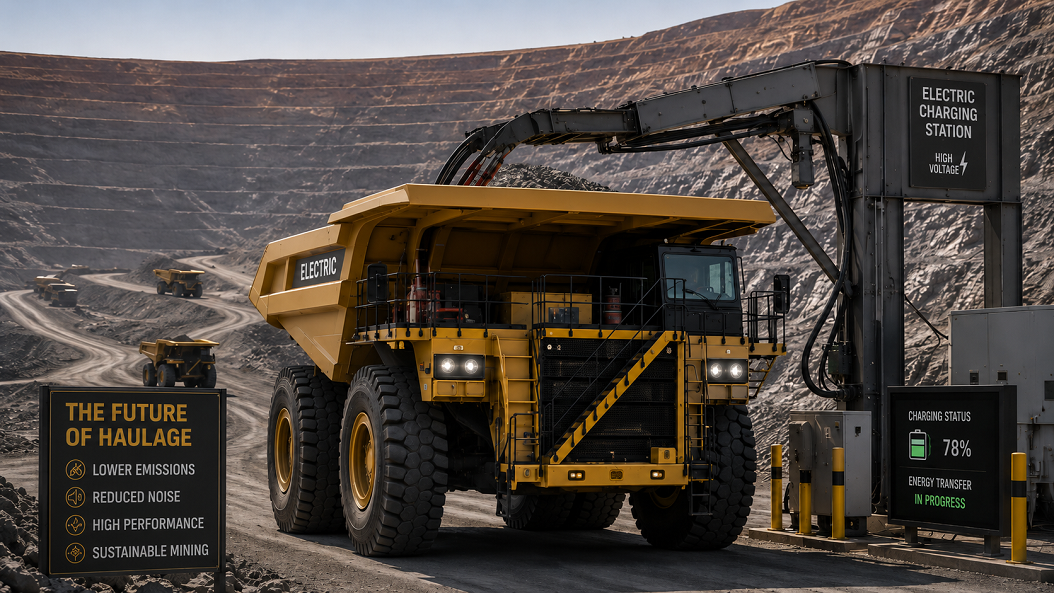
If dynamic charging is used, the haul road becomes part of the power system.
That is why BHP and Rio Tinto’s next phase with Caterpillar matters. The companies said the trial will evaluate dynamic charging through an energy transfer system designed to charge trucks while they are moving. That detail is important because it shows the industry already understands the central problem: stationary charging can become a production bottleneck.
A large mine can calculate payload, cycle time, grade, spotting time, truck count, loader match, and maintenance windows with discipline. Electric haulage has to fit inside that production model. It cannot sit outside the operation as a sustainability experiment if the truck is expected to replace diesel production.
The basic question is direct:
How many tons per hour does the truck move after charging time is included?
Until that answer is proven in real mine conditions, electric mining trucks remain trial technology, not a full diesel replacement.
For the source trial, see BHP’s announcement on the Cat 793 XE battery-electric haul truck trial in the Pilbara.
The Benefit Has to Survive the Full Cost Calculation
The benefit case is not as simple as diesel out, battery in.
Electric mining trucks may offer real advantages. They can reduce diesel consumption, reduce direct site emissions, lower heat and noise, cut some engine-related maintenance, and use regenerative braking in the right haul profiles. They may also fit long-term decarbonization plans and future autonomous haulage systems.
But those benefits have to survive the full cost calculation.
The mine has to account for the truck’s acquisition cost, charging infrastructure, power supply, site electrical work, technician training, safety procedures, battery condition, software support, spare parts, charging downtime, and the possibility that additional trucks are needed to cover lost utilization.
If the electric truck costs significantly more than the diesel version, the savings have to show up somewhere. Less diesel is one answer. Lower maintenance may be another. Emissions targets may have financial, regulatory, or investor value. But none of those benefits matter if the truck cannot match the production plan.
This is where press-release coverage usually stops too early.
The right question is not whether electric haul trucks are cleaner or more advanced.
The right question is whether they are cheaper, more reliable, more productive, or strategically necessary after the whole system is counted.
The Climate Case Is No Longer the Only Driver
The environmental case still matters, especially for large global miners with public decarbonization targets.
But the pressure around climate policy is not as simple as it was a few years ago.
Public and political attention has shifted in some markets toward energy cost, inflation, grid reliability, industrial competitiveness, and practical returns on capital. Bill Gates has also argued for a more practical climate strategy focused on human welfare and outcomes, not only emissions targets. In the U.S., federal climate policy has moved away from the prior administration’s regulatory posture.
That does not mean climate concerns disappear. It means electric mining trucks have to stand on more than emissions messaging.
A battery-electric truck can reduce operational diesel emissions at the mine. That matters. But the total environmental case depends on the power source, battery production, battery life, diesel displaced, truck utilization, and whether the mine has to add equipment to cover charging downtime.
A mine powered by cleaner electricity may show a stronger emissions case than one relying heavily on fossil-fuel power. A truck that runs high hours and displaces a large amount of diesel may justify its battery footprint more quickly than one used lightly. A truck that requires extra fleet capacity to protect production changes the math again.
Electric mining trucks may still make sense.
But the case has to be proven by application, not assumed by category.
The Transition May Require Two Support Systems
Diesel will not disappear quickly because the transition itself may be expensive.
During the changeover, mines may have to support both systems at the same time.
The diesel system does not go away just because two or four electric trucks enter the fleet. The mine still needs fuel infrastructure, lube trucks, diesel mechanics, engine support, component rebuild programs, filters, fluids, and existing maintenance routines.
At the same time, the mine now needs charging infrastructure, high-voltage technicians, electrical contractors, battery support, charging hardware, software diagnostics, new safety procedures, power-management systems, and OEM support for a developing platform.
That dual system can raise costs unless the electric truck savings are large enough to offset them.
This is a major reason diesel haul trucks will remain part of mining for years. The issue is not only whether electric technology works. It is whether the mine can afford the overlap between the old support system and the new one.
For large miners, that cost may fit into a long-term capital plan. For mining contractors or smaller operators, the duplicate support burden may be harder to absorb.
Power Infrastructure Becomes Mining Infrastructure
Electric haulage turns power into production infrastructure.
A mine running battery-electric haul trucks has to secure power at scale, move it where the trucks need it, protect the electrical system, manage peak demand, and build redundancy into the operation.
Transformers, switchgear, substations, charging stations, cabling, cooling systems, controls, and maintenance access become part of the haulage system.
That is not just an energy issue. It is a mining equipment issue.
If the charging system is down, the truck is down. If the mine cannot deliver enough power at the right time, production is exposed. If the electrical infrastructure is not built around the haul profile, the truck may be technically capable but operationally limited.
Diesel already has infrastructure. Electric does not remove infrastructure. It changes the infrastructure.
That is where the cost and complexity move.
For related market context, see our analysis of heavy equipment demand and support infrastructure.
Haul Roads and Grades Decide the Application
Electric mining trucks will not perform the same way in every mine.
The haul profile matters. Grade matters. Distance matters. Payload matters. Temperature matters. Road condition matters. Stop-and-go patterns matter. Regenerative braking opportunities matter.
A truck working downhill loaded and uphill empty may have a different energy profile than a truck hauling uphill under load. A short, predictable cycle may be easier to electrify than a long, variable route. A mine with consistent dispatch may be easier to model than one with constantly changing conditions.
This is why real mine trials matter.
The industry does not need a showroom answer. It needs production data from heat, dust, grade, payload, shift work, tire events, charging interruptions, and changing mine plans.
The Pilbara is a useful test because it is not an easy environment. If battery-electric haul trucks can prove themselves there, the results will carry weight.
Cybersecurity Becomes a Production Risk
Electric mining trucks are not automatically more vulnerable because they use batteries.
The risk comes from the connected system around them.
Battery-electric haulage may depend heavily on charging controls, battery-management systems, software updates, dispatch integration, remote diagnostics, sensors, autonomous systems, power infrastructure, and mine-network connectivity.
That expands the operational-technology risk.
A ransomware attack on a mine office is one kind of problem. A compromised charging system, dispatch system, truck-control system, or battery-management platform is a production problem. If trucks cannot charge, cannot dispatch, cannot validate safe operating status, or cannot communicate properly, the mine may not move material.
That is the concern.
As mining becomes more electrified, automated, and connected, cybersecurity becomes part of uptime planning. It is not just an IT issue. It is a production issue, a safety issue, and potentially a ransom target.
Mines will need to ask the same practical questions they ask about mechanical support: who responds, how fast, what fails safe, what can be isolated, and how quickly production can resume.
Maintenance Does Not Disappear
Electric machines reduce some maintenance items, but they do not eliminate maintenance.
A battery-electric haul truck still has tires, suspension, brakes, steering, frames, hydraulics, cooling systems, electronics, sensors, software, payload systems, cab systems, and structural wear. It may reduce some diesel-engine maintenance, but it adds other requirements.
Technicians now need high-voltage training. Mines need lockout/tagout procedures for electric systems. Dealers and OEMs need diagnostic support. Parts departments need new stocking strategies. Maintenance planners need to understand battery health, software updates, charging hardware, thermal management, and fault codes.
The risk does not disappear.
It changes form.
The mine may reduce some engine-related work, but it gains battery, power electronics, charging, software, and high-voltage support issues. If the support network is not ready, the truck may be advanced on paper and frustrating in the field.
The Technician Problem May Be Bigger Than the Battery Problem
Mining already competes for skilled mechanics, electricians, welders, tire technicians, operators, supervisors, and planners.
Battery-electric haulage adds another layer.
The truck needs people who understand heavy mechanical systems and high-voltage systems. The charging infrastructure needs support. The software needs support. The safety procedures need training. The mine has to know what happens when the truck faults during a production shift.
That is where early adoption gets tested.
OEMs can build the truck. Mines have to build the support capability.
A truck that requires specialist support every time it has a fault will struggle to scale. A truck that can be diagnosed, supported, and returned to production by a trained mine/dealer support system has a much better chance.
The difference will not be marketing.
It will be uptime.
The Used-Equipment Market Is the Real Test
For electric mining trucks, the used market may become the real proof point. The first buyers of electric mining trucks will likely be large miners and large mining contractors. They have the scale to trial new technology, build infrastructure, work directly with OEMs, and absorb early risk.
The second buyer is a different story.
Used equipment buyers are rarely early adopters. They are risk managers. A five-year-old electric mining truck could still be one of the largest purchases that buyer has ever made. That buyer is not going to accept a truck simply because it represents the future.
He will ask direct questions.
What is the battery condition? What is the remaining battery life? What does replacement cost? Who can service it? Is software support still available? Can the truck charge at my site? What charging infrastructure do I need? Will a lender finance it? Is there a known resale market? Can I sell it again if the application changes?
Those questions will decide the secondary market.
Diesel trucks have known rebuild paths, parts markets, component histories, and buyer expectations. Electric mining trucks will need their own valuation logic.
Battery health, charging history, software support, thermal-management condition, high-voltage component history, service records, and OEM support may become major value factors.
The used market will not trust these trucks because they are innovative. It will trust them after enough hours, failures, repairs, battery histories, resale transactions, and lender decisions prove what the asset is worth.
That may take years.
For related valuation logic, see our coverage of used construction equipment values and equipment downtime costs.
Diesel Will Not Disappear Quickly
Battery-electric haul trucks are important, but diesel mining trucks are not going away quickly.
Large mines have long asset lives, high production requirements, existing fleets, mature maintenance systems, and capital plans already built around diesel haulage. A mine cannot replace a haulage system overnight without affecting production, staffing, infrastructure, and risk.
Even if electric trucks prove themselves, replacement will likely happen by site, route, fleet cycle, and application.
Some mines may electrify specific haul routes first. Some may test mixed fleets. Some may use dynamic charging in selected corridors. Some may keep buying diesel trucks while battery-electric models mature.
That does not mean electric mining trucks fail.
It means the transition has to survive production math.
The future may include electric haulage, but the adoption curve will be written by uptime, charging, infrastructure cost, resale confidence, technician support, and mine economics.
FAQ: Electric Mining Trucks
How long do electric mining trucks take to charge?
A reliable published charge time for the Cat 793 XE Early Learner trial has not been released. That is why charging remains one of the biggest production questions. BHP and Rio Tinto have said the next phase will evaluate dynamic charging, which would charge trucks while they are moving.
Why does charging time matter in mining?
Charging time matters because mining trucks often work 20 to 24 hours per day. If charging reduces truck availability, the mine may need more trucks, different haul routes, new charging infrastructure, or changes to shift planning.
Are electric mining trucks cheaper to operate than diesel trucks?
They may be cheaper in some applications, but the answer depends on acquisition cost, charging infrastructure, power cost, diesel savings, maintenance savings, battery life, downtime, technician training, and resale value.
Are electric mining trucks better for the environment?
Electric mining trucks can reduce direct diesel emissions at the mine, but the full environmental case depends on the power source, battery production, truck utilization, diesel displaced, battery life, and end-of-life battery handling.
Will diesel mining trucks disappear soon?
No. Diesel mining trucks will likely remain in service for years because mines have existing fleets, fuel systems, maintenance programs, and production models built around diesel haulage. Electric adoption will likely happen by site, route, and fleet cycle.
The Bottom Line
Electric mining trucks still have to prove the math.
They may reduce diesel use. They may reduce direct site emissions. They may support long-term decarbonization goals. They may eventually fit well with autonomous haulage and optimized mine planning.
But they also bring hard questions: charging time, production loss, power infrastructure, acquisition cost, dual support systems, emissions accounting, cybersecurity, technician readiness, dealer support, battery life, and used-equipment value.
The BHP, Rio Tinto, and Caterpillar trial in the Pilbara is important because it is not only testing whether a battery-electric haul truck can run.
It is testing whether the mine system can support the truck.
The battery gets the headline.
The operating model decides whether electric haulage scales.