Equipment Uptime Is the New Buying Equation
Equipment uptime is becoming one of the most important buying questions in heavy equipment.
Contractors still compare horsepower, bucket size, payload, reach, lift capacity, breakout force, cycle time, and price. Those numbers still matter. A wheel loader still has to load trucks. An excavator still has to move dirt. An articulated dump truck still has to haul material. A paver still has to place asphalt. A crusher still has to keep rock moving.
But the market is shifting.
The better question is no longer only:
How much machine can I buy?
The better question is:
How do I keep the job moving without tying up too much cash, losing production to downtime, or buying a machine I cannot support?
That is why equipment uptime, cash flow, telematics, service support, rental flexibility, parts availability, and resale value are becoming part of the same buying decision.
Equipment uptime starts before the machine breaks
A machine is only valuable when it is working.
That sounds simple, but it changes how contractors, rental companies, dealers, lenders, and fleet owners should read the equipment market.
A machine with strong specs can still be a poor fleet asset if it is hard to diagnose, slow to get parts for, expensive to repair, poorly supported locally, or tied to the wrong payment structure. A machine with average specs can be the better business decision if it is easy to support, easy to maintain, properly financed, and productive enough for the work.
Downtime is not only a repair problem.
It is a margin problem.
When an excavator goes down, the pipe crew may stop. When a wheel loader is down, trucks may sit. When a paver loses setup time, asphalt delivery, crew productivity, and mat quality can suffer. When a crusher, screen, mill, pump, or conveyor goes down, production can stop across the whole operation.
That is why regional service support, trained technicians, parts availability, diagnostics, reman components, and planned maintenance matter.
The cheapest machine is not always the lowest-cost machine.
The better machine is often the one that can keep working, be repaired quickly, and protect job margin over time.
Service support is becoming part of the product
The strongest equipment companies are not only selling machines. They are selling support around the machine.
That is why service-center expansion matters.
Metso’s Prince George Service Centre is a good example of the broader shift. The larger signal is not simply that another facility exists. The signal is that mining and aggregates customers need component repair, diagnostics, inspections, field service, shutdown support, technical training, and faster turnaround closer to where the equipment is working.
That matters in mining, aggregates, roadbuilding, sitework, utilities, rental, and heavy construction.
For production equipment, distance from support can become a real cost. A part that exists somewhere in the system may still be expensive if it takes too long to identify, ship, install, or troubleshoot.
A contractor can recover from a planned repair.
An unplanned failure in the middle of a job is different.
That is where equipment uptime becomes a buying factor, not just a service-department issue.
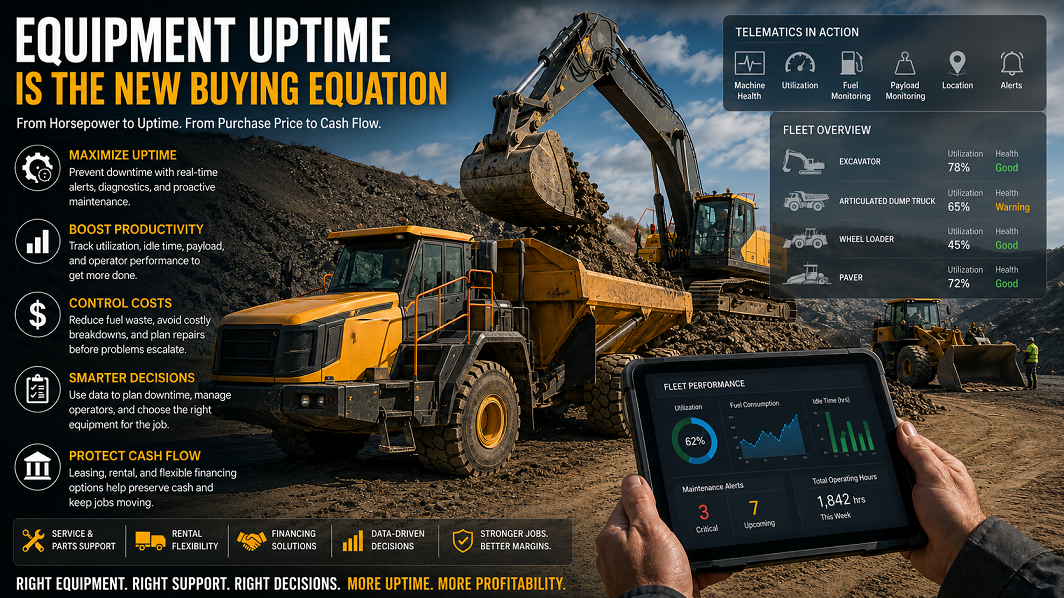
Telematics is not just machine data. It is downtime planning.
Telematics is often described as machine monitoring, but that undersells its value.
The real value is not simply seeing where a machine is or how many hours are on it. The value is seeing what is happening early enough to make a better decision.
A telematics system can show fault codes, idle time, fuel burn, operating hours, utilization, engine load, location, service intervals, machine health, payload information, and operator behavior. That gives the contractor a clearer picture of how the machine is actually being used.
That matters because downtime is not always sudden.
Sometimes downtime gives warnings.
A machine may show a fault code before the failure becomes serious. A truck may show signs of overloading before tires, brakes, axles, frames, or driveline components suffer. A loader may spend too much time idling. An excavator may run all day but produce fewer cycles than expected. A dozer may show high idle time because the operator is waiting on layout, trucks, pipe, material, or another crew.
The data does not fix the problem by itself.
It helps the owner ask better questions:
Is the operator wasting fuel?
Is the machine waiting on trucks?
Is the crew setup wrong?
Is the job understaffed?
Is the machine oversized or undersized?
Is the operator productive?
Is the machine being abused?
Is a repair coming that should be planned before the next major job?
That is where telematics connects directly to equipment uptime and cash flow.
If a contractor knows a repair is coming, parts can be ordered, shop time can be scheduled, a rental replacement can be arranged, and the machine can be pulled down between jobs instead of failing during production.
That is very different from waiting until the machine stops.
Telematics also helps separate machine problems from management problems. If a truck idles three hours a day, the problem may be the operator. But it may also be the job setup. Maybe the truck is waiting too long between loads. Maybe haul distance is too long. Maybe the loader is undersized. Maybe there are too few trucks or too many trucks in the cycle. Maybe the operator is being blamed for a production problem that actually started with planning.
That is why telematics should not be viewed only as a monitoring tool.
It is a management tool.
Develon’s Dash 7 articulated dump trucks, covered by Equipment Journal, are a useful example of where this is going. Payload monitoring, machine-health data, fuel tracking, operator information, and fleet-management tools are not just brochure features. They help the owner understand whether the truck is being loaded correctly, operated correctly, maintained correctly, and used efficiently enough to justify its cost.
For articulated dump trucks, that matters. These machines live in difficult conditions. Overloading, poor haul roads, long cycle times, operator habits, tire damage, braking, frame stress, and service delays all affect ownership cost.
The best question is not only:
Which truck moves the most material when it is working?
The better question is:
Does it move enough material, often enough, with enough uptime, to justify the ownership cost?
That is the kind of question telematics should help answer.
Productivity is not the same as uptime
A machine can be productive when it is working and still be a poor ownership decision if it does not stay available long enough.
That is one of the hardest lessons in equipment buying.
Some machines are impressive in production. They may have strong power, fast cycle times, good traction, good operator comfort, and excellent output when everything is working. But if they spend too much time waiting on parts, repairs, diagnostics, software support, tires, driveline components, electrical troubleshooting, or specialized service, the production advantage can disappear.
That is why uptime must be measured against productivity.
A truck that outworks the competition for six hours but sits down too often may not beat a truck that works steadily with fewer failures. A loader that moves more tons per hour may not be the better machine if it creates higher tire cost, fuel burn, brake wear, or hydraulic repairs. An excavator that is fast in the cut may still be a poor fleet fit if it is difficult to support locally.
The best fleet decision is rarely based on peak performance alone.
It is based on production over time.
Contractors should think in terms of real working availability:
How many hours did the machine work?
How many hours did it idle?
How many hours was it down?
How many tons, yards, loads, or cycles did it produce?
How much fuel did it burn?
How many repair events did it create?
How long did parts take?
How much did the repair cost?
How much money did the machine make after downtime and support costs were included?
Those questions are harder than comparing horsepower or payload, but they are closer to the truth.
Practical technology is winning because it reduces waste
The most useful jobsite technology is not always the most dramatic.
Autonomy, robotics, and artificial intelligence get attention, but contractors often benefit first from technology that reduces mistakes, waiting time, troubleshooting, fuel waste, rework, and operator guesswork.
That is why payload monitoring, machine-health alerts, paver control systems, fault-code visibility, material-management sensors, faster screed heating, and jobsite workflow tools matter.
BOMAG’s updated CR Series 2 paver controls, covered by Equipment Journal, are a practical example. Better operator controls, clearer fault-code visibility, material-management sensors, and screed improvements may not sound as exciting as full autonomy, but they can affect paving productivity directly.
Roadbuilding crews lose money through setup delays, inconsistent material flow, operator confusion, segregation, poor mat quality, heating delays, troubleshooting time, and rework.
A better control system can reduce operator confusion.
A clearer fault display can reduce troubleshooting time.
A payload system can reduce overloading.
A telematics alert can help plan service before failure.
A material-management system can improve consistency.
A scheduling or procurement tool can keep machines from sitting idle because another part of the job is not ready.
That is the practical technology story.
Technology is valuable when it improves uptime, utilization, quality, safety, or cash flow.
Cash flow is now part of the equipment decision
Contractors still need equipment, but many are more careful about how they take on cost.
Interest rates, backlog uncertainty, material costs, labor costs, fuel, insurance, repair exposure, and used-equipment values all affect buying decisions.
That is why the equipment finance conversation is changing.
The question is not always:
What is the lowest price?
The better question may be:
How do I preserve cash and still get the work done?
Equipment Finance News recently reported that dealers are leaning into leasing, rental, bundled service, and lifecycle support as customers look for ways to preserve liquidity.
That fits what many contractors already understand in the field. A contractor may need a machine but not want to commit to a large purchase if backlog is uncertain. A rental company may want to add fleet but protect utilization. A dealer may want to move equipment but protect margin and floorplan exposure. A lender may be watching collateral value and buyer cash flow more closely.
The machine matters.
The payment structure matters too.
A contractor who buys the wrong machine with the wrong payment can create pressure even if the machine performs well. A contractor who rents or leases correctly may protect cash and still complete the job. A buyer who delays replacement may save on payments but spend more on repairs, downtime, and emergency rentals.
There is no one answer.
The right decision depends on backlog, utilization, support, repair risk, resale value, and cash position.
Rental is a pressure valve when buyers hesitate
Rental becomes more important when buyers need production but do not want ownership risk.
If a contractor has work but does not want to buy, rental fills the gap. If a project is temporary, rental may be smarter than ownership. If backlog is uncertain, rental protects flexibility. If a machine is down and parts are delayed, rental keeps the job moving.
That does not mean rental is always better.
Rental can be expensive if the machine is used constantly. Ownership can be better if utilization is high and the machine fits long-term work. But rental gives contractors another way to manage uncertainty.
A buyer may not be saying no to equipment.
The buyer may be saying no to permanent ownership risk.
That distinction matters.
AI may first improve utilization, not machine operation
AI in construction is often framed as if machines will suddenly run themselves.
That may happen in some applications, but the more immediate impact may be less dramatic and more useful.
Suffolk’s move to embed AI engineers in construction projects, reported by Construction Dive, points toward that practical near-term opportunity. The first major use may not be autonomous equipment. It may be better design review, procurement tracking, delivery coordination, scheduling, documentation, payment applications, and process management.
That matters to equipment owners because equipment utilization depends on project flow.
A machine can be available and still be wasted if materials are late, drawings are unclear, approvals are delayed, subcontractors are out of sequence, payment paperwork is stuck, or the job is poorly coordinated.
Idle equipment is expensive.
A rental machine sitting because the site is not ready still costs money.
A crew waiting because the next phase was not coordinated still burns margin.
If AI helps contractors reduce coordination delays, avoid procurement surprises, improve documentation, and tighten schedules, it can indirectly improve equipment utilization.
That is the practical AI story to watch.
Not hype.
Utilization.
Parts, service, and support affect resale value
Equipment uptime also connects directly to used equipment value.
A machine with strong support is easier to own, easier to repair, easier to finance, easier to rent, and easier to resell. Buyers are more confident when parts are available, technicians understand the machine, diagnostic support exists, and common repairs are manageable.
A machine that is difficult to support carries more risk.
That risk shows up in resale value.
This is why parts availability, dealer support, aftermarket depth, reman options, and regional market fit matter. A machine that looks like a bargain can become expensive if it sits waiting for parts, needs special diagnostics, or cannot be supported in the market where it works.
For a deeper look at this issue, see HEPLANET’s How Parts Availability Affects Heavy Equipment Resale Value. Buyers comparing used-machine prices should also read Used Equipment Market Reports Are Easy to Misread before relying too heavily on broad market averages.
The used-equipment buyer is not only buying iron.
The buyer is buying future uptime.
Used equipment buyers should price uptime risk into the deal
Used equipment often looks attractive when new-equipment pricing, interest rates, or market uncertainty make buyers cautious.
That does not mean every used machine is a good buy.
A used excavator, wheel loader, dozer, articulated dump truck, backhoe, compact track loader, paver, crane, forklift, or crusher should be evaluated by more than year, hours, price, and paint.
Buyers should ask:
Can local technicians support it?
Are parts available?
Is the machine common in the region?
Are diagnostics available?
Does the serial number match the local parts system?
Are reman or aftermarket options available?
Is there a known history of downtime?
Is the machine productive enough after repairs, fuel, and downtime are included?
Can it be resold later?
That is why inspection still matters. HEPLANET’s Used Excavator Inspection Guide explains how buyers should look past appearance and evaluate real repair exposure before bidding or buying.
Auction buyers should be especially careful. Upcoming sales can be useful starting points, and HEPLANET’s Heavy Equipment Auction Calendar can help buyers track activity. But auction value still needs context: condition, supportability, region, freight, fees, buyer depth, seller type, and parts risk all matter.
The market is not one market
Broad equipment headlines can be misleading.
One dealer may show softer machine sales. Another OEM may report strong construction demand. Agriculture may be weak while infrastructure is strong. Aerial equipment may behave differently than earthmoving. Mining support may be strong while some regional rental customers remain cautious. Compact equipment may follow different patterns than roadbuilding or quarry machines.
That does not make the data useless.
It means the data has to be segmented.
The important questions are:
Which machine category?
Which region?
Which customer type?
Which brand?
Which revenue stream?
New, used, rental, parts, service, or finance?
Dealer inventory or end-user demand?
Construction, mining, agriculture, roadbuilding, utility, industrial, or material handling?
Without those questions, the market can look simpler than it really is.
The same applies to technology and repair trends. HEPLANET’s Heavy Equipment Repair in the Age of AI and Robotics explains why diagnostics, software, labor, robotics, and technician availability are becoming part of the repair conversation, not separate from it.
What contractors should watch
Contractors and fleet owners should watch the market through an ownership lens, not just a sales headline.
The most important signals are:
Are dealers adding service capacity?
Are parts delays improving or getting worse?
Are rental rates and availability changing?
Are lenders tightening or offering flexible terms?
Are OEMs adding technology that reduces real downtime?
Are machines being sold with better diagnostics, payload monitoring, or utilization data?
Are contractors delaying replacement and spending more on repairs?
Are dealers moving aged inventory or protecting price?
Are used machines holding value because buyers still need production?
Are machine owners choosing rental because they need flexibility?
The market does not have to crash for buyers to change behavior.
Sometimes the shift is more subtle.
They keep older machines longer. They rent instead of buying. They repair instead of replacing. They choose a stronger support network over a lower price. They pay attention to equipment uptime instead of spec sheets alone.
Bottom line
The new equipment market is not just about horsepower.
It is about keeping machines working, preserving cash, supporting the fleet, and protecting job margin.
Contractors still need production. But production now depends on more than machine size, engine power, bucket capacity, or payload rating. It depends on parts availability, service response, diagnostics, telematics, rental flexibility, financing structure, operator productivity, project coordination, and resale value.
The best machine is not always the biggest machine.
It is not always the cheapest machine.
It is the machine that can stay productive, be supported quickly, fit the payment plan, protect cash flow, and still make sense when it is time to repair, trade, rent, or resell.
That is where the equipment market is moving.
From horsepower to uptime.
From purchase price to cash flow.
From machine ownership to fleet strategy.