Rent vs Buy Construction Equipment: Should You Rent, Lease, Use an RPO, or Buy Heavy Equipment in 2026?
The rent vs buy construction equipment decision is not just about comparing a rental rate against a monthly payment.
The better question is:
Are you trying to finish one job, or are you trying to build a construction company?
That is where many rent-vs-buy equipment articles fall short. They list the pros and cons of renting, leasing, and buying. They may point out that renting avoids maintenance, ownership avoids rental availability problems, and leasing gives flexibility. Those points are not wrong, but they do not go deep enough.
For a contractor, equipment is not just a cost. Equipment is capacity. Equipment is control. Equipment is infrastructure. In many cases, equipment is part of what makes the company valuable.
A contractor who rents every machine may still make money. Plenty of contractors do. But if the company owns no equipment, what exactly is being built beyond contracts, relationships, labor, and execution? What happens if the owner dies, leadership changes, a key estimator leaves, or the company needs to be sold?
A construction company with no equipment may still be a business. But it is a different kind of business. It may be profitable, but it has less hard infrastructure behind it.
That does not mean every contractor should buy every machine. Renting can be the right move. Leasing can be the right move. A rental purchase option can be the right move. Buying can be the right move.
The mistake is letting a rental company, dealer, finance company, marketplace, or generic blog tell you there is one universal answer.
There is not.
The right answer depends on utilization, cash flow, job pipeline, personnel, transportation, repair exposure, rental availability, dealer support, resale value, and the long-term business plan.
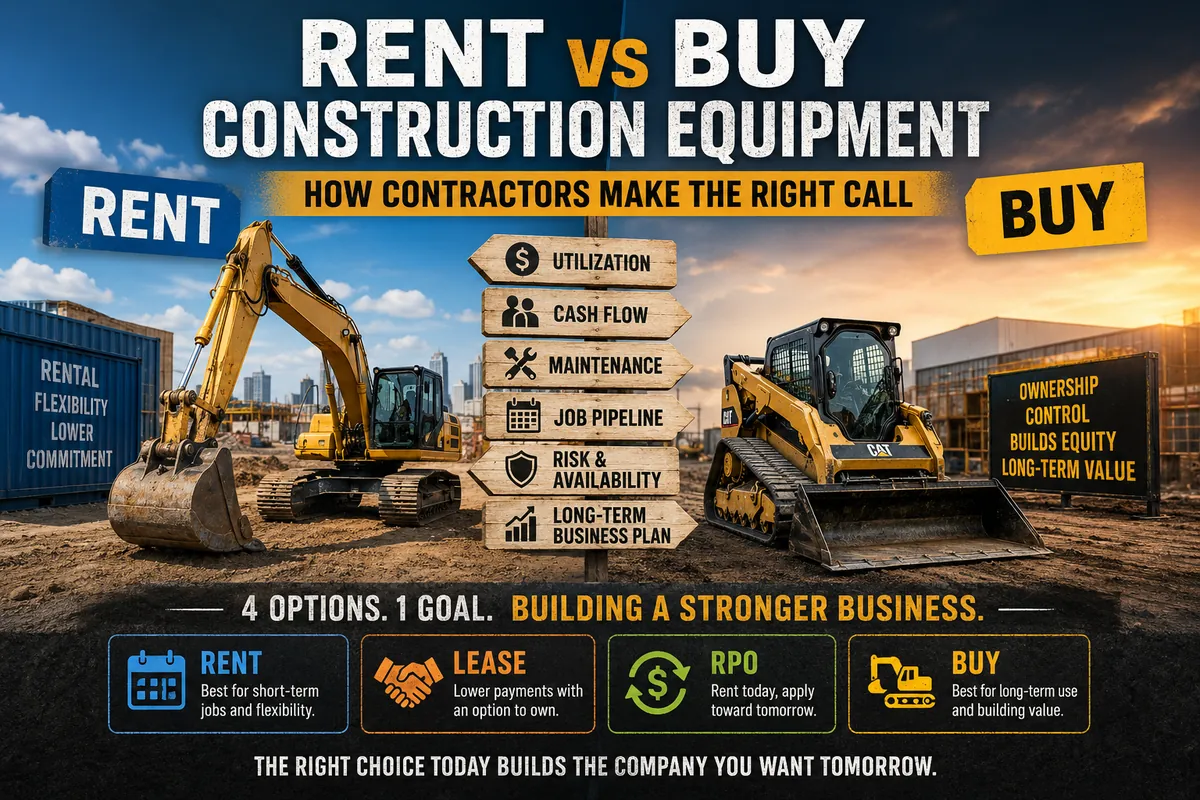
Quick Answer: When to Rent, Lease, Use an RPO, or Buy Heavy Equipment
Rent heavy equipment when the job is short-term, the machine is specialized for that specific project, future work is uncertain, cash is tight, or you need flexibility more than ownership.
Lease heavy equipment when you need the machine for a longer period, want lower payments, want an option to own later, or are not fully ready to commit to ownership.
Use a rental purchase option, or RPO, when you want to start using the machine now, avoid or reduce the down payment, and apply part of the rental toward a future purchase.
Buy heavy equipment when the machine is central to your work, you can keep it busy, you have the people to operate and manage it, and ownership helps build company value.
The rental decision is about flexibility.
The lease decision is about hesitation, cash flow, and option value.
The RPO decision is about working your way into ownership.
The buying decision is about commitment, utilization, and building a company around productive assets.
Rent vs Buy Construction Equipment: The Real Decision Is Commitment
Renting, leasing, and buying are often treated as purely financial decisions. They are financial decisions, but they are also commitment decisions.
Buying says:
I believe I can keep this machine working.
Leasing says:
I believe I need this machine, but I am not fully ready to own it outright.
Renting says:
I need this machine for now, but I want the ability to walk away.
That is why the decision has to start with the business plan.
Before comparing rental rates and monthly payments, ask:
- Do we have enough work to keep this machine busy?
- Do we have the personnel to run it?
- Do we have the management structure to schedule it?
- Do we have the transport capacity to move it?
- Do we have service support if it breaks?
- Will this machine help us win more work?
- Does owning it build our company, or is this only a one-time need?
If the machine fits the future business, buying or leasing may make sense. If the machine only fits one job, renting may be smarter.
The rent-vs-buy decision also changes by machine type. Excavators, skid steers, compact track loaders, dozers, backhoes, wheel loaders, and specialty attachments all carry different ownership risk, rental availability, resale strength, transport cost, and maintenance exposure.
Renting Can Help You Win a Job. Owning Equipment Can Help You Build a Company.
Renting is a valuable tool. It lets a contractor take on a job without committing to a machine for four or five years. It helps new contractors survive when they do not have the capital, credit history, or down payment to buy equipment. It helps established contractors handle temporary workload spikes, specialty applications, or unusual jobs.
But renting everything has a trade-off.
If every excavator, loader, dozer, skid steer, and attachment is rented, the contractor may be creating income but not building much equipment equity. The business may be generating cash flow, but the operating infrastructure belongs to someone else.
That matters.
Equipment ownership can increase the value of the company because the company owns productive assets. Those assets can support work, create borrowing power, provide resale value, and make the business less dependent on whatever the rental market has available next week.
A contractor with owned equipment has capacity. A contractor who rents everything has access, but that access depends on availability, pricing, terms, and timing.
That does not make renting wrong. It means renting should be part of a strategy, not the whole strategy by default.
The Missing Fourth Option: Rental Purchase Option
Many rent-vs-buy articles compare only three choices: rent, lease, or buy.
In the heavy equipment world, there is often a fourth option:
the rental purchase option, commonly called an RPO.
An RPO lets a contractor rent a machine with the option to convert the rental into a purchase. The monthly rate is often higher than a straight rental, but part of the rental payment may be applied toward the purchase price if the contractor buys the machine.
The credit varies by dealer, machine, market, and agreement, but a common structure may apply a portion of the rent toward the purchase.
This can be useful for contractors who:
- need the machine immediately
- do not have a full down payment
- have been awarded a job but have not built enough equipment equity yet
- want to test whether the machine fits their work
- want to turn rental expense into a path toward ownership
- need time to arrange financing
- want to prove utilization before committing
An RPO is not free money. The dealer is pricing risk into the deal. But it can be a practical bridge for a contractor who wants to move from renting toward ownership.
For many growing contractors, this is how ownership starts.
Dealer Rental and Rental-Company Rental Are Not the Same Product
A one-day rental from a rental company and a monthly rental from a dealer are not the same thing.
Rental companies are built around flexibility. They commonly offer daily, weekly, and monthly rentals. That flexibility has value, especially for short jobs. But the shorter the rental term, the more expensive the rate usually becomes when measured on a monthly or annual basis.
A daily rental rate multiplied by 30 days is usually much higher than the monthly rate. A weekly rental rate multiplied across a year is usually far higher than a long-term rental or ownership payment.
That is not an accident. That is how rental companies make the math work.
Dealers usually play a different role. Many dealers are stronger in monthly rentals, long-term rentals, leases, and rental purchase options. They may not offer the same daily or weekly flexibility, but they often bring stronger product knowledge, more technicians, parts access, warranty familiarity, and the ability to support or replace the machine if something goes wrong.
A rental company may win when you need a machine for a day or a week.
A dealer may win when you need a machine for months, want a path to purchase, or need deeper product support.
The right comparison is not “rental company vs dealer.”
The right comparison is:
What rental structure fits the job, the machine, and the contractor’s long-term plan?
The Weekly Rental Trap
Short-term rental can look cheaper than monthly rental until you add the whole cost.
Imagine a contractor needs an excavator to dig a trench. The plan is to rent it for one week, send it back while pipe is laid, then bring it back two weeks later for backfill, cleanup, or another phase.
On paper, that sounds efficient.
But now add the real costs:
- first delivery to the job
- first pickup from the job
- second delivery to the job
- second pickup from the job
- higher weekly rental rate
- lost time coordinating transportation
- possible machine availability risk the second time
- crew downtime if the machine is not available
- insurance or damage waiver
- attachment delivery
- fuel and cleanup
- internal trucking cost if self-hauling
By the end, the contractor may have paid close to a monthly rental rate anyway. In some cases, the contractor may have paid more.
Even if the contractor moves the machine with its own truck and trailer, the move is not free. There is driver time, truck mileage, trailer wear, fuel, insurance exposure, liability, and scheduling. Self-hauling may be cheaper than paying delivery, but it still has a cost.
This is where many contractors miscalculate rental savings.
They compare one week to one month, but they forget mobilization, timing, and availability.
Renting Does Not Eliminate Ownership Costs. It Packages Them.
A common argument for renting is that it avoids maintenance, depreciation, insurance, storage, and repair risk.
That is only partly true.
Renting may shift those responsibilities away from the contractor, but it does not make them disappear. The rental company bought the machine. The rental company has maintenance exposure. The rental company carries insurance exposure. The rental company has depreciation risk. The rental company has transport, service, downtime, and resale assumptions.
Those costs are built into the rental rate.
The rental company is not renting the machine at cost. It has to recover its ownership cost and make a margin.
That means the contractor renting the machine is still paying for depreciation, maintenance, insurance, and risk. The difference is that those costs are bundled into the rental price rather than shown separately on the contractor’s balance sheet.
That can still be a good deal. It just should not be confused with avoiding the cost entirely.
Rental-focused guides from companies such as BigRentz and DOZR are useful starting points because they explain common rent, lease, and buy considerations. But contractors should remember that these companies operate rental or rental-marketplace businesses. Their advice should be read with that business model in mind.
Monthly Purchase Payments Are Often Lower Than Rental Payments
In many cases, the monthly payment to finance a machine can be lower than the monthly rental payment for a similar machine.
That makes sense. If rental payments were consistently lower than ownership payments, rental companies would not have a business. The rental company has to cover its own equipment payment, maintenance, depreciation, insurance, overhead, and profit.
The difference is commitment.
When a contractor buys the machine, the contractor may be committing to 48 months, 60 months, or another financing term. When a contractor rents, the contractor may only be committed for a day, a week, a month, or the agreed rental period.
That flexibility has value.
But if the contractor is going to use the machine regularly anyway, the flexibility may be expensive.
The important question is not:
Is the rental payment lower this week?
The important question is:
If we are going to keep needing this machine, why are we paying someone else to own it?
Depreciation Is Not Automatically a Reason to Avoid Ownership
Depreciation is often presented as a reason to rent instead of buy.
Depreciation matters. Contractors should understand it. The IRS explains depreciation as the recovery of the cost of business or income-producing property over time, and contractors should review depreciation treatment with their accountant or tax adviser before making major equipment decisions. The IRS also publishes Publication 946, How to Depreciate Property, as an official reference for depreciation rules.
But depreciation alone is not a reason to avoid owning productive equipment.
A pickup truck depreciates too. Most contractors still own trucks because the truck helps the business function. Heavy equipment is different from a personal vehicle because it is supposed to produce revenue.
A machine that depreciates but produces profitable work may still be a very good asset.
The better question is not:
Will the machine depreciate?
The better question is:
Will the machine generate enough profit, tax benefit, residual value, and company capacity to justify that depreciation?
If the machine sits idle, depreciation is a problem. If the machine works, earns, and supports the business, depreciation is part of the ownership calculation.
Insurance Does Not Disappear When You Rent
Insurance is another area where the simple rent-vs-buy argument can be misleading.
A contractor may need insurance whether the machine is rented, leased, financed, or owned. Rental companies may require proof of coverage. They may offer or require damage waivers. They may build insurance exposure into the rental rate. In some short-term rentals, contractors may even feel like they are paying twice: once through their own coverage and again through rental protection or required rental terms.
Ownership has insurance cost. Rental has insurance cost too.
The question is not whether insurance exists.
The question is whether the contractor understands where the insurance cost sits and what risk remains after the paperwork is signed.
Storage Is Often Overstated
Storage is often listed as a major downside of owning equipment.
It can be. If a contractor owns machines that sit idle for long periods, secure storage becomes a real cost. But if a machine is working consistently, storage may not be the central issue.
Most contractors buy equipment because they intend to put it to work. If the machine is producing, it is usually on a jobsite, moving between jobs, or being serviced for the next job.
Storage becomes a bigger concern when the machine is underutilized, seasonal, specialized, or not aligned with the contractor’s work.
So storage should not be treated as an automatic reason to rent. It should be treated as a warning sign:
If you are worried about where to store the machine because you do not have enough work for it, you may not be ready to buy it.
Maintenance Is Not Avoided. It Is Assigned.
Renting can remove maintenance decisions from the contractor’s hands. That is one of its real advantages.
If a rental machine breaks, the contractor can call the rental company. If the rental company cannot fix it quickly, the contractor may be able to switch machines or find another rental source. That can be easier than owning a broken machine and deciding whether to repair it, rebuild it, or park it.
But maintenance is still part of the rental cost.
Rental companies plan to dispose of machines before heavy repair exposure becomes too high. They build maintenance, repair risk, utilization, and resale into their fleet strategy. They know the machine may break. They price that risk into the rate.
For the contractor, the benefit of renting is not that maintenance is free.
The benefit is that maintenance responsibility is shifted.
That can be valuable when the contractor lacks technicians, parts support, shop process, or management bandwidth.
For contractors, that repair decision is part of the larger ownership question: if the machine goes down, does the company have the support structure to get it back to work quickly?
Leasing Is Not Just a Middle Ground
Leasing is often described as a middle ground between renting and buying. That is partly true, but it is too simple.
A lease is closer to a step toward ownership with an exit clause.
A contractor may lease because they need the machine, want lower payments, want newer equipment, or are not ready to commit fully. Maybe the machine is new to the market. Maybe the contractor wants to run it for a couple of years before deciding. Maybe the job supports a lease payment but not a purchase decision. Maybe the company wants the option to buy at the end.
Those can all be valid reasons.
But a lease does not always provide as much flexibility as people think.
Lease returns can become expensive if the machine comes back over hours, damaged, worn beyond expected condition, or with excessive undercarriage wear. If a leased excavator comes back with an undercarriage beyond the allowed wear percentage, the contractor may face a large charge. If the engine has problems, the machine has damage, or the hours are far above the contract, the return cost can push the contractor toward buying the machine anyway.
In practice, many contractors who significantly exceed lease hours end up buying the machine because the return penalties make walking away expensive.
So leasing should not be treated as a risk-free test drive.
It is a commitment with terms.
Sometimes You Pay for Availability, Not Hours
There are situations where the machine may not run many hours but still needs to be available.
Snow removal is a good example.
A contractor with a snow contract may need a wheel loader, backhoe, skid steer, or compact loader parked and ready during the winter. The machine may sit for long stretches. But when the storm hits, everyone else needs the same type of machine at the same time.
Calling the rental company after the snow starts is not a strategy. The machines may already be gone.
In that case, the contractor is not paying only for utilization. The contractor is paying for availability.
A seasonal lease, short-term lease, RPO, or ownership structure may make sense even if the machine does not run high hours, because the value is in being ready when the work comes.
That is why utilization matters, but it is not the only factor.
Availability can be profitable too.
Specialized Equipment: Specialized for Whom?
Rental articles often say renting is best for specialized equipment.
That can be true, but the word “specialized” needs to be defined.
Specialized for whom?
A mulcher may be specialized for a site contractor who only occasionally clears vegetation. But for a land-clearing contractor, it may be a core attachment. A hydraulic hammer may be specialized for one contractor and normal work for another. A crusher bucket, trencher, compactor, screening bucket, or brush cutter may be unusual for one business and essential for another.
The decision should separate three things:
- the carrier
- the attachment
- the application
A contractor may own the excavator and rent the mulcher. Or own the compact track loader and rent a specialty attachment. Or rent both the carrier and the attachment for a one-time project. Or buy both if that work becomes a core part of the business.
The carrier and the attachment are not always the same decision.
A contractor should be careful leasing or buying a machine package with a specialty attachment if the attachment will not be used regularly. In some lease structures, the attachment may be effectively paid for during the lease term, especially if the finance company or dealer does not expect strong residual value at return.
The better question is:
Is this specialized equipment, or is this a specialized opportunity that may become part of the business?
Rental Is Often Most Useful in Survival Mode
For new contractors, renting may be necessary.
A newer contractor may not have the financial history, down payment, borrowing strength, or credit profile to buy multiple machines. A contractor may need an excavator, loader, and dozer for a job but not have the balance sheet to own all three.
Rental lets that contractor bid work, perform work, and build cash flow.
That matters.
Renting can be the bridge from no equipment to equipment ownership.
Used equipment, certified used programs, RPOs, and leases can also help contractors move from survival mode toward building a fleet.
The danger is staying in survival mode after the company has enough work to move forward.
If a contractor rents the same machine class repeatedly, has steady work, and has crews waiting on rental availability, it may be time to stop thinking like a renter and start thinking like a fleet owner.
Rental Companies and Dealers Both Want the Growing Contractor
Both rental companies and dealers want the entry-level contractor.
Rental companies want the contractor who needs equipment but cannot finance it yet. That contractor can rent now and may rent repeatedly as the business grows.
Dealers want the contractor too, but often through used equipment, certified used equipment, financing, RPOs, or eventually new machine sales. A contractor who starts with a brand, gets good support, and becomes comfortable with that dealer may stay with that brand as the company grows.
That is not bad. It is business.
But the contractor needs to understand that every source has an incentive.
Rental companies benefit when you rent.
Dealers benefit when you rent, lease, finance, buy, service, and trade.
Marketplaces benefit when you transact.
Finance companies benefit when you borrow or lease.
HE Planet’s position is simple: the contractor should understand the incentives, then make the decision that best protects the company.
Down Payments Are Not Always as Fixed as They Sound
Rental articles often say renting avoids the down payment required to buy equipment.
That can be true for contractors with weak credit, limited history, no contract backlog, or poor financials. But in actual equipment deals, down payments are often negotiable depending on credit, collateral, contract status, lender appetite, dealer support, OEM programs, and the machine being financed.
An established contractor may avoid or reduce a down payment. A contractor with an awarded contract may use that work to support financing. A strong dealer may help structure the deal. An OEM finance program may subsidize terms. A rental purchase option may let the contractor apply rent toward purchase later.
So “renting avoids down payment” is not the whole story.
A more accurate statement is:
Renting avoids long-term financing commitment. Buying may require a down payment, but the down payment is often part of a negotiable deal structure.
OEM Subsidies and Resale Value Can Change Lease Math
Leases are not priced in a vacuum.
OEMs and captive finance arms may support lease programs because they want machines placed in the market. Resale value matters. Brand strength matters. Expected residual value matters.
A machine with stronger expected resale value can often support more competitive lease terms. A brand or model with weaker residual value may require more support, higher payments, stronger subsidies, or different assumptions to compete.
This matters because contractors should not compare lease payments without understanding what sits behind them.
A lower lease payment may reflect strong residual value, OEM support, a favorable program, or a structure that pushes risk into return conditions, hour limits, or buyout terms.
The payment is not the whole deal.
The terms are the deal.
Financing, resale value, used-equipment demand, dealer inventory, and rental availability can all change the rent-vs-buy calculation from one year to the next.
Technology Access Is Not Guaranteed by Renting
Some rental-focused articles argue that renting gives contractors access to newer technology.
Sometimes it does. Rental fleets may have newer equipment, updated models, and a wide range of attachments. Rental companies also like machines that can serve many customers, so they may stock units with hydraulic options, couplers, buckets, forks, hammers, or other attachments.
But renting does not guarantee the latest technology.
You usually get what is available. If the rental fleet is tight, you may not get the exact spec you want. You may pay more for a machine with additional features. You may receive a machine with features you do not need. Rental fleets buy in packages, and not every unit is spec’d the same way.
Dealers may also have the latest equipment, especially if the goal is to demonstrate, rent, lease, or sell a current model.
Technology access should not be treated as a blanket reason to rent.
The better question is:
Do you need a specific technology feature to do the work, and can the rental or dealer actually provide that exact machine when you need it?
Rent vs Buy Construction Equipment: Decision Table
| Contractor situation | Best option to consider first | Why |
|---|---|---|
| One short job | Rent | Flexibility matters more than ownership |
| Repeated short jobs using the same machine | RPO or buy | Repeated rental may signal ownership demand |
| New contractor with limited credit | Rent, used purchase, or RPO | Rental may help survive; RPO may build toward ownership |
| Contractor awarded a long project | Lease, RPO, or buy | Contract visibility may support financing or ownership |
| Seasonal availability need | Lease or own | Availability may matter more than hours |
| Specialized attachment needed once | Rent attachment or rent package | Avoid owning low-use specialty equipment |
| Core machine used weekly | Buy | Ownership builds control and company value |
| Machine needed for uncertain future work | Rent or lease | Avoid overcommitting before pipeline is clear |
| Strong dealer support and resale value | Buy or lease | Support and resale reduce ownership risk |
| Weak maintenance structure | Rent or dealer-supported lease | Maintenance responsibility may need to be shifted |
When Renting Is the Right Move
Renting is usually the right move when:
- the job is short
- the work is uncertain
- the machine is outside your normal fleet
- the machine is needed for one specialized application
- you lack the down payment or credit to buy
- you lack personnel to manage another asset
- you lack transport capacity
- you lack maintenance support
- you are testing a machine class
- you need flexibility more than equity
Renting is also useful when the contractor is in a growth stage but not ready to commit. It lets the company take work, build history, and learn what machines it actually needs.
But renting should be measured honestly. Include delivery, pickup, insurance, damage waiver, fuel, cleaning, overtime, attachment cost, standby time, and the higher cost of daily or weekly rates.
When Leasing Is the Right Move
Leasing is usually the right move when:
- the machine is needed for a defined period
- the contractor wants lower payments
- the contractor wants the option to own later
- the machine is needed for seasonal readiness
- the company is unsure about long-term utilization
- the machine is newer technology and the contractor wants to test it
- ownership is likely but not fully decided
- cash flow matters more than immediate equity
Leasing can be a smart tool, but only if the contractor understands the return terms.
Before signing a lease, review:
- hour limits
- overage charges
- damage responsibility
- undercarriage return standards
- tire or track condition requirements
- maintenance responsibility
- insurance requirements
- buyout terms
- early termination terms
- end-of-lease inspection process
A lease is flexible only if the exit is affordable.
When an RPO Is the Right Move
A rental purchase option usually makes sense when:
- the contractor wants to own but is not ready today
- the machine can start earning immediately
- the job can help fund the purchase
- the contractor wants rent credit toward ownership
- the dealer is willing to support the structure
- financing needs time
- the contractor wants to prove utilization before buying
An RPO can be especially useful for contractors moving from renting to owning.
But the RPO should be reviewed carefully. Understand the monthly rate, rent credit, purchase price, credit period, maintenance responsibility, insurance, and what happens if you do not buy.
The key question is:
Is this rental truly helping you get into ownership, or is it just a more expensive rental with a purchase conversation attached?
When Buying Is the Right Move
Buying is usually the right move when:
- the machine is central to your business
- you can keep it working
- you have enough operators
- you have management capacity
- you have future work
- the machine supports multiple job types
- rental availability is unreliable
- the machine has strong resale demand
- parts and service support are available
- ownership builds company value
Buying is not only about having the lowest monthly cost.
Buying gives the contractor control. The machine is available when needed. Crews are not waiting on rental supply. The company can standardize operators, attachments, service routines, and job planning around its own fleet.
Ownership also forces discipline. If you own the excavator, you are more likely to find work for it before the current job ends. If you rent it, you may simply send it back.
That pressure is not always bad. For growing contractors, owned equipment can push the business to build the pipeline needed to support the fleet.
When Buying Is the Wrong Move
Buying is not always smart.
Do not buy just because the payment looks lower than rental.
Buying may be wrong when:
- the machine is only needed for one job
- future work is uncertain
- the contractor lacks operators
- the contractor lacks maintenance support
- the machine is too specialized
- the machine will sit most of the time
- cash flow is weak
- the company is already overextended
- transport is a problem
- the machine does not fit the long-term business
The worst purchase is not the expensive machine.
The worst purchase is the machine that does not belong in the business.
A Practical Rent-vs-Buy Decision Framework
Before deciding whether to rent, lease, use an RPO, or buy, work through these questions.
1. Is this a core machine or a job-specific machine?
If it is core to your work, ownership deserves serious consideration.
If it is job-specific, rental may be smarter.
2. How many months per year will it work?
Do not estimate based on optimism. Estimate based on signed work, recurring work, and realistic pipeline.
3. Do you have the people to run it?
A machine without an operator is not an asset. It is a parked cost.
4. Can you move it?
Transportation can change the math. Delivery, pickup, permits, trailers, trucks, drivers, and insurance all matter.
5. Can you support it?
If the machine breaks, who handles the repair? Do you have dealer support, technicians, parts availability, or rental backup?
6. What happens if the job is delayed?
Rental protects flexibility. Ownership protects availability. The right answer depends on which risk is bigger.
7. What happens when the job ends?
If the machine can go to the next job, buying may make sense. If not, renting may protect the business.
8. What is the resale value?
Strong resale can make ownership easier to justify. Weak resale increases risk.
9. What does the financing really cost?
Look beyond payment. Include down payment, term, interest, fees, insurance, and opportunity cost.
10. Does this decision build the company?
This may be the most important question.
If the equipment helps the contractor build capacity, win work, train operators, create equity, and increase company value, ownership may be part of the growth plan.
If the equipment only solves a temporary problem, renting may be the better business decision.
Final Verdict: Rent for Flexibility, Lease for Hesitation, RPO for Transition, Buy for Commitment
There is no universal answer to whether a contractor should rent, lease, or buy heavy equipment.
Renting is valuable when flexibility matters, work is uncertain, capital is tight, or the machine is needed for a short-term task.
Leasing is useful when the contractor wants use, lower payments, and the option to own later, but does not want to make the full ownership commitment immediately.
An RPO can bridge the gap when a contractor wants to work into ownership while the machine is already earning.
Buying is usually the stronger long-term move when the contractor has the utilization, personnel, work pipeline, support structure, and business plan to keep the machine productive.
The contractor who wins is not the one who always rents or always buys.
The contractor who wins is the one who understands what each option is really designed to do.
Renting can help you finish the job in front of you.
Owning equipment can help you build the company behind it.
About the Author
Frank Eusebio is a heavy equipment industry professional with more than 30 years of experience in construction equipment sales, equipment and fleet management, used equipment valuation, remarketing, dealer operations, and international equipment markets and auction consulting. His background includes Komatsu dealer operations, export markets, lease returns, dealer inventory strategy, and heavy equipment ownership economics. He also wrote, created, and implemented Develon’s remarketing program across its dealer network. At HEPLANET, he writes about equipment markets, fleet decisions, resale value, auction trends, parts availability, and the real-world costs that affect contractors, dealers, rental companies, and equipment owners.