HEPLANET Daily Heavy Equipment Industry Briefing — May 27, 2026
The May 27, 2026 HEPLANET Daily Heavy Equipment Industry Briefing looks at the strongest signals coming out of the Memorial Day weekend, including construction equipment demand, AI infrastructure, grid modernization, electric articulated haulers, mining equipment logistics, autonomous construction equipment, quarry technology, and fleet ownership trends.
Because Monday was Memorial Day in the United States, the industry news cycle was quieter than a normal business day. But the reports from Saturday, Sunday, and Monday still showed several important patterns for contractors, heavy equipment dealers, equipment rental companies, quarry operators, mining companies, roadbuilding contractors, and fleet managers.
The biggest theme was not one single announcement. It was the way several markets continue to connect: AI infrastructure, power demand, grid modernization, mining investment, aggregate production, utility construction, and heavy civil construction are increasingly feeding into one another.
For the heavy equipment industry, that matters. The next construction equipment cycle may be shaped as much by power infrastructure, data-center construction, electric heavy equipment, autonomous equipment, remote mining logistics, and machine support as by traditional highway and roadbuilding spending.
Power Infrastructure Is Becoming a Major Heavy Equipment Demand Driver
Grid modernization and utility construction continue to stand out as long-cycle demand drivers for heavy equipment and construction equipment.
Transmission expansion, substation construction, renewable energy integration, industrial electrification, and AI-data-center support infrastructure all require substantial civil construction and utility work. That creates demand for excavators, trenching equipment, cranes, compact construction equipment, utility fleets, aggregate production, paving crews, and roadbuilding support contractors.
The important point for the construction equipment market is that power infrastructure is no longer only a utility-sector story. It is becoming a heavy equipment industry story.
As AI data centers, industrial facilities, and electrified infrastructure place more demand on the grid, contractors will be needed to build access roads, prepare sites, move material, install underground utilities, support transmission projects, and restore roads and surfaces after utility work is complete.
For equipment owners, this could support demand across multiple machine categories, including excavators, wheel loaders, articulated haulers, bulldozers, cranes, compact track loaders, trenchers, utility equipment, paving equipment, and material-processing equipment.
The weekend intelligence reports repeatedly pointed to grid modernization, transmission expansion, AI-data-center infrastructure, utility upgrades, and civil construction demand as important long-cycle drivers for the heavy equipment market.
AI Infrastructure Is Quietly Reshaping Mining and Construction Equipment Demand
AI infrastructure is often discussed as a technology story, but its physical impact may become just as important for the heavy equipment industry.
Data centers require power. Power expansion requires transmission lines, substations, copper, steel, concrete, aggregates, transformers, access roads, site preparation, and civil construction. Those needs eventually flow back into mining, quarrying, hauling, roadbuilding, utility work, and construction equipment demand.
That means the AI boom is not only affecting software companies and chipmakers. It is also creating secondary demand for the industries that build, power, and supply the physical infrastructure behind the digital economy.
This is especially important for mining equipment, quarry equipment, and aggregate equipment. Copper demand, electrical infrastructure, grid expansion, and industrial construction all support long-cycle machine demand. Haul trucks, hydraulic excavators, wheel loaders, crushers, drills, quarry fleets, utility equipment, and field-maintenance operations could all be affected by this broader infrastructure buildout.
For HEPLANET readers, the key takeaway is simple: AI growth may become one of the indirect drivers behind future mining, construction, utility, aggregate, and heavy equipment demand. The weekend reports framed this clearly: AI infrastructure is becoming an industrial equipment story, not only a technology story.
Volvo Electric Articulated Haulers Show Electric Heavy Equipment Moving Into Real Production
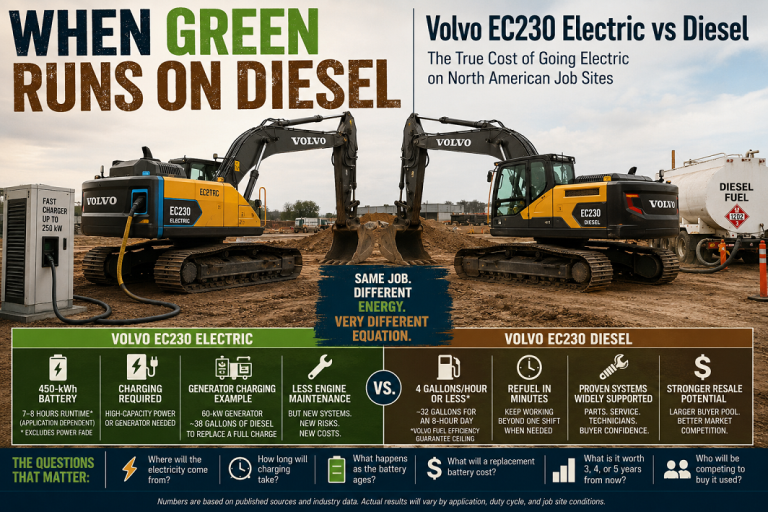
Volvo Construction Equipment’s A30 Electric and A40 Electric articulated haulers remain one of the most credible electric heavy equipment signals because they are moving beyond concept-stage discussion.
Volvo CE says it has begun serial production of the A30 Electric and A40 Electric articulated haulers, calling them the first electric articulated haulers of this size to enter serial production. The company says the machines are being produced at its Braås site in Sweden and are aimed at quarrying and mining applications.
That matters because articulated haulers are not small demonstration machines. They are production assets commonly used in quarry operations, mining, infrastructure work, earthmoving, site development, and heavy construction.
Volvo says the A30 Electric and A40 Electric have payloads of 29 tonnes and 39 tonnes, respectively, and can provide up to roughly six hours of operation on a single charge depending on application.
The likely transition will not be simple or universal. Electric construction equipment and electric mining equipment will probably be most practical where duty cycles, charging infrastructure, site layout, and operating schedules make sense. Quarries and controlled production sites may become early proving grounds because routes are repetitive, operating zones are defined, and charging infrastructure can be planned around the job.
For contractors, quarry operators, and fleet owners, the question is not whether every excavator, wheel loader, bulldozer, or haul truck becomes electric immediately. The better question is where electric heavy equipment can deliver a practical operating advantage without creating new uptime risks, charging delays, or fleet management complications.
The weekend reports treated Volvo’s electric articulated haulers as one of the strongest real-world electrification signals because the machines are aimed at quarry and mining fleets rather than light-duty demonstration use.
Remote Mining Logistics Are Becoming a Bigger Heavy Equipment Issue
Agnico Eagle’s Hope Bay redevelopment plans in Nunavut, Arctic Canada, highlight another important issue for the heavy equipment industry: remote mining economics increasingly depend on logistics as much as geology.
Reuters reported that Agnico Eagle plans to revive the Hope Bay gold mine with a $2.4 billion investment and use seasonal barge shipping through the Northwest Passage to move heavy equipment and supplies during a short summer window.
For mining contractors and equipment support companies, this is bigger than one gold mine.
Remote mining projects require mining equipment, earthmoving machines, support trucks, fuel supply, parts inventory, field service, hydraulic repair capability, and maintenance planning that can withstand harsh operating conditions and limited access windows. When an excavator, haul truck, wheel loader, bulldozer, drill, generator, or support machine goes down in a remote region, the repair problem is not only mechanical. It becomes a transportation, scheduling, inventory, parts availability, and heavy equipment uptime problem.
This is why Arctic mining, remote infrastructure, and extreme-environment equipment support deserve close attention. As mineral demand increases and projects move into more difficult regions, the ability to move machines, replacement parts, technicians, and maintenance resources may become a major competitive factor.
The Saturday intelligence report identified the Hope Bay development as one of the strongest operational signals of the weekend because it connects mining equipment demand, Arctic logistics, remote maintenance, and long-cycle infrastructure development.
Autonomous Construction Equipment Is Becoming a Real Fleet Management Issue
Caterpillar’s ongoing AI and autonomy push continues to show where large equipment manufacturers believe the industry is heading.
Caterpillar announced in January that it was introducing intelligent machines designed to advance autonomous technology in construction operations, describing the effort as the result of more than three decades of research, development, and real-world deployment in automation and machine intelligence.
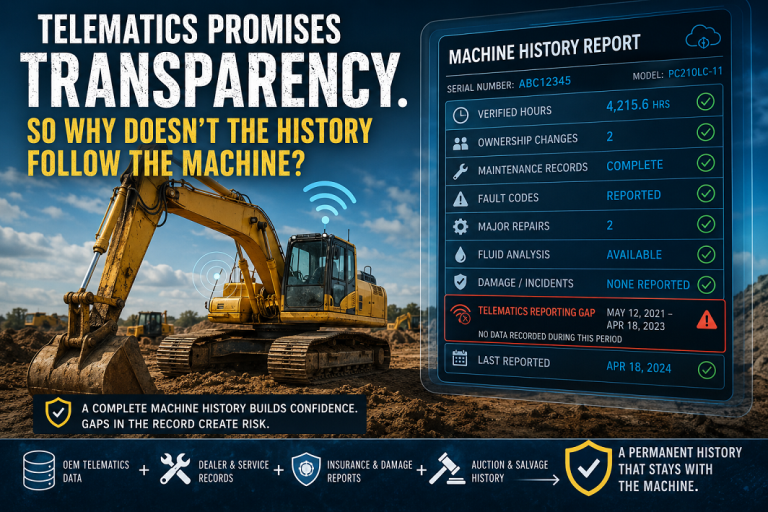
This points to a larger shift in the construction equipment business. Competition is no longer only about horsepower, bucket size, breakout force, payload, fuel burn, operating weight, or machine price. Increasingly, it is also about data, telematics, predictive diagnostics, software integration, autonomous workflows, machine health monitoring, and construction equipment fleet management.
That shift is especially important for quarry equipment, mining equipment, aggregate operations, and production-material sites. These operations often have repeatable routes, measurable production targets, and high equipment utilization, making them practical environments for autonomous hauling, dispatch optimization, predictive maintenance, and connected fleet systems.
For contractors and fleet owners, the long-term implication is that equipment decisions may increasingly involve both machine capability and information capability. Excavators, bulldozers, wheel loaders, articulated haulers, compact loaders, crushers, and haul trucks still have to move dirt, rock, and material. But the systems around those machines may determine how efficiently they do it.
The weekend reports described this shift as the heavy equipment industry moving from simple “iron competition” toward software, telematics, diagnostics, predictive maintenance, autonomy, and fleet-data competition.
India’s Construction Equipment Market Shows the Global Picture Is Uneven
Global construction equipment demand remains uneven.
The Times of India reported that India’s construction equipment industry saw a 2% year-over-year decline in FY26 equipment sales, falling to 136,995 units from 140,191 units. The report said slower infrastructure execution and project delays weighed on domestic demand, while exports rose nearly 32% to 17,394 units.
That combination is important. A weaker domestic construction equipment market does not necessarily mean weaker global competitiveness. In India’s case, export growth suggests that manufacturers may be gaining traction outside the domestic market even while local infrastructure execution slows.
The report also said road construction equipment and material-processing equipment showed growth despite the broader softness, which is useful context for contractors, dealers, rental companies, and OEMs watching roadbuilding equipment demand and global equipment supply trends.
For the global heavy equipment industry, this reinforces a broader trend: emerging-market manufacturers are becoming more export-oriented, and construction equipment competition is increasingly global.
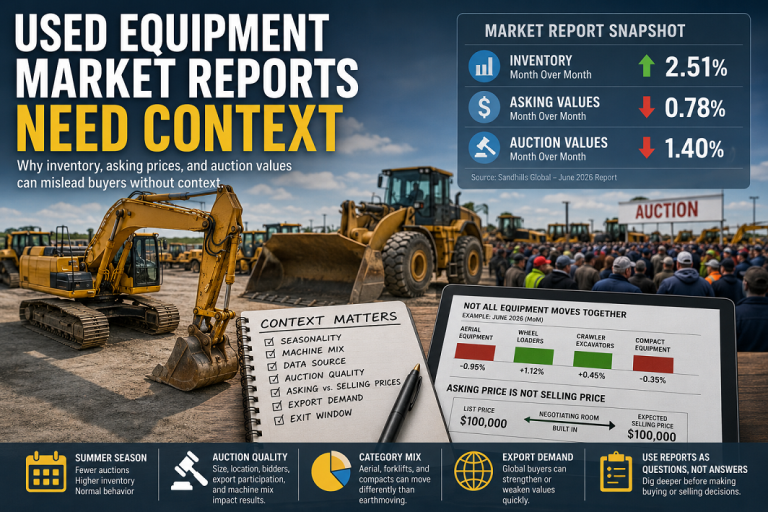
Contractors, dealers, and rental companies should pay attention to these shifts because global equipment supply affects machine availability, pricing pressure, replacement cycles, heavy equipment parts availability, and long-term competition across excavators, loaders, bulldozers, compact equipment, roadbuilding machines, and material-handling equipment.
Equipment Rental vs Ownership Is Getting More Strategic for Contractors
The weekend signals also point toward a changing ownership calculation for contractors and fleet managers.
As heavy equipment becomes more expensive, more software-driven, more electric, and more connected, owners have to think beyond purchase price. They must consider utilization, financing costs, technology obsolescence, construction equipment maintenance costs, technician skills, heavy equipment parts availability, charging or fuel infrastructure, and resale value.
That may push more companies toward mixed fleet strategies. Some excavators, bulldozers, wheel loaders, compact machines, and trucks may remain core owned assets. Others may be rented for specialized work, short-term production needs, or technology-heavy applications where ownership risk is harder to justify.
This does not mean construction equipment ownership is going away. It means ownership decisions are becoming more strategic.
The fleets that perform best may be the ones that know which machines should be owned, which should be rented, which should be rebuilt, and which should be replaced before equipment downtime costs overwhelm the savings of extended ownership.
The weekend reports identified equipment rental vs ownership, mixed-fleet planning, maintenance exposure, financing costs, rebuild economics, machine uptime planning, and lifecycle ownership as increasingly important issues for contractors and fleet owners.
Heavy Equipment Parts Availability and Maintenance Support Are Becoming More Important
As construction equipment and mining equipment become more advanced, the value of maintenance quality and parts support continues to increase.
Modern heavy equipment increasingly depends on diagnostics, telematics, emissions systems, hydraulic performance, electronic controls, sensors, software, and preventive maintenance. That means heavy equipment uptime is no longer only about having a mechanic available. It is also about having the right parts, the right diagnostic tools, the right technical support, and the right maintenance process.
For contractors, this affects the real cost of owning excavators, wheel loaders, bulldozers, articulated haulers, compact equipment, and roadbuilding machines. A low purchase price can quickly lose its advantage if the machine is difficult to support, construction equipment parts are hard to source, or downtime interrupts production.
For dealers, rental companies, aftermarket suppliers, and service providers, the opportunity is also clear. The companies that can keep machines working through heavy equipment parts availability, field service, hydraulic repair, component rebuilds, preventive maintenance, and technical support will become increasingly important as fleets get more complex.
The weekend reports specifically identified diagnostics, rebuilds, reman, hydraulic repair, undercarriage management, component support, lifecycle economics, installation discipline, and fleet maintenance strategy as important themes for the heavy equipment aftermarket and construction equipment service market.
Key Takeaway
The Memorial Day weekend did not produce a normal flow of daily industry news, but it did reinforce several major heavy equipment industry themes.
Power infrastructure is becoming a larger equipment demand driver. AI infrastructure is creating secondary demand across mining, utilities, aggregates, roadbuilding, and civil construction. Electric articulated haulers are moving into real production. Remote mining logistics are becoming more important. Autonomous construction equipment, telematics, and predictive maintenance are pushing the construction equipment industry toward data-driven fleet management.
For contractors, equipment owners, dealers, rental companies, mining operators, quarry owners, and fleet managers, the direction is clear: the future heavy equipment market will be shaped by infrastructure demand, energy transition, machine intelligence, logistics, construction equipment maintenance strategy, heavy equipment parts availability, and uptime economics — not by machine sales alone.
Memorial Day Reflection
Because Monday was Memorial Day in the United States, it is also worth closing this briefing with respect and gratitude.
Memorial Day is not simply a long weekend or the unofficial start of summer. It is a national day of remembrance for the men and women of the United States Armed Forces who gave their lives in service to the country.
Their sacrifice helped preserve the freedoms, institutions, industries, and opportunities that many Americans continue to build upon today. From the earliest generations of soldiers to those who served in more recent conflicts, Memorial Day asks the country to pause, remember, and recognize that freedom has often carried a very real cost.
HEPLANET thanks and honors those who served, those who sacrificed, and the families who carry their memory forward.