Why Aftermarket Parts Are Becoming More Important in Heavy Equipment Ownership
Buying a machine is only the beginning of the ownership decision.
For contractors, miners, rental fleets, and equipment owners, the real test comes after the machine goes to work. Can it stay productive? Can it be repaired quickly? Are critical parts available? Does the dealer have the inventory, technicians, and urgency to support the machine when it is down? And if the OEM channel becomes slow, expensive, or limited, are there other realistic support options?
That is where aftermarket parts are becoming more important.
This does not mean aftermarket parts are always the right answer. It also does not mean OEM parts no longer matter. The real issue is more complicated, and the heavy equipment industry often talks around it instead of explaining it clearly.
The truth is that most modern heavy equipment manufacturers do not personally manufacture every component inside their machines. They engineer the machine. They design the specifications. They approve suppliers. They test, assemble, support, warrant, and distribute the finished product through their dealer networks. But many pumps, undercarriage components, cab parts, air conditioning systems, electronics, seals, bearings, hydraulic parts, and other components come from specialized manufacturing suppliers.
That matters because the aftermarket is not simply a world of cheap copy parts. It includes different layers of suppliers, from high-quality manufacturers capable of producing OEM-grade components to low-cost trading channels selling parts with little accountability behind them.
For equipment owners, the key question is not whether a part is called OEM or aftermarket. The better question is: who made it, what standard was it built to, who stands behind it, and what happens if it fails?
Heavy Equipment Ownership Is About More Than the Purchase Price
Many equipment-buying decisions still begin with brand preference, purchase price, financing, dealer relationship, and resale value. Those factors matter. But they do not tell the whole story.
A machine that looks attractive on the front end can become expensive if parts are hard to find, major components are locked into limited supply channels, or repairs take too long to complete. The true cost of ownership is not just what the machine costs to buy. It is what the machine costs to keep working.
For a contractor, downtime can be more expensive than the part itself. A delayed hydraulic pump, cylinder seal kit, final drive component, cooling part, undercarriage item, or electrical component can stop production, delay a job, force a rental replacement, or create pressure to make rushed repair decisions.
That is why parts availability has become an ownership-risk issue.
OEM Parts Carry More Than the Cost of the Part
It is easy to look at an OEM part price and assume the difference is only markup. That is too simple.
OEM pricing supports a larger system. It helps pay for engineering, testing, warranty exposure, dealer infrastructure, parts distribution, technical support, training, documentation, service tooling, inventory carrying cost, and the accountability that comes with a factory-backed channel.
That support has real value.
When a machine is under warranty, when the repair is highly technical, when software or diagnostics are involved, when the component is safety-critical, or when the owner needs dealer-backed accountability, OEM parts and dealer support may be the best choice.
But that does not mean every repair should be forced through the OEM channel forever. As machines age, warranties expire, budgets tighten, and downtime pressure increases, owners often need other support paths.
That is where the aftermarket becomes part of a serious ownership strategy.
The Aftermarket Is Not One Market
The term “aftermarket” is often used as if it describes one type of part. It does not.
There are high-quality aftermarket parts made by capable manufacturers with strong engineering, materials, machining, heat treatment, testing, and quality-control systems. Some manufacturers are part of the same supplier ecosystem that builds components for major OEMs. In some cases, a part sold outside the OEM channel may come from the same manufacturing source, the same warehouse, or the same production capability as the part sold through the dealer channel.
But there are also lower-quality parts built mainly to hit a price point. Some are designed for short-term use, resale appearance, or auction preparation rather than long service life. Others pass through layers of trading companies where the buyer may have little visibility into the real manufacturer, the material quality, the warranty process, or the supplier’s willingness to stand behind the product.
That is the problem with judging aftermarket parts by the word “aftermarket.”
A quality aftermarket part can be a strong ownership tool. A poor aftermarket part can create downtime, repeat labor cost, warranty frustration, and more expensive failure than the original repair.
The difference is not the label. The difference is the supplier and the support behind the part.
Supplier Quality Matters More Than the Word Aftermarket
A contractor buying aftermarket parts should not only ask, “How much does it cost?”
The better questions are:
- Who is the actual manufacturer?
- Is this a direct supplier relationship or a trading company chain?
- What warranty is offered?
- How does the supplier handle warranty claims?
- Is the part built for long service life or short-term resale appearance?
- Are there quality-control standards behind the product?
- Can the supplier provide consistent availability over time?
- Does the seller understand the machine and the application?
This is especially important with components such as hydraulic pumps, travel motors, cylinders, final drives, undercarriage, engine parts, sealing products, and electrical components. A low-cost part can become expensive if it fails early, damages related components, or forces the owner to pay labor twice.
Warranty also needs to be understood clearly. Many aftermarket suppliers may replace a failed part, but they typically do not cover technician labor, lost production, travel time, rental replacement, fluid loss, contamination cleanup, or secondary damage. Those costs remain with the machine owner.
That does not make aftermarket parts bad. It means the buyer needs to understand the real risk profile.
Process Matters as Much as the Part
Some aftermarket parts get blamed for failures that are really process failures.
A dealer repair usually comes with more than the part. It comes with trained technicians, service procedures, diagnostic tools, contamination-control practices, documentation, warranty discipline, and accountability. That process costs more, but it also reduces risk.
Outside the dealer channel, the part distributor usually does not control the installation. A customer may buy a good aftermarket hydraulic pump, hire an independent mechanic, and still suffer a repeat failure if the hydraulic system is not properly cleaned, the oil is contaminated, the filters are not replaced, the root cause is not corrected, or the installation is rushed.
When that happens, the failure may be described as a “cheap aftermarket pump” problem. In reality, the issue may have been the repair process.
This same risk exists with OEM parts. A factory pump can also fail if the system is contaminated or the original failure cause is not corrected. The difference is that dealers usually have procedures designed to protect both the machine and the repair.
That is one reason dealer support matters. The owner is not just paying for a part. The owner is paying for process, training, accountability, and reduced risk.
A responsible aftermarket supplier may stand behind the part itself, but that usually does not include labor, downtime, travel, mileage, fluid cleanup, or the cost of doing the job twice. For machine owners, that distinction is critical.
Even OEMs Recognize the Economy Parts Market
Another point is often overlooked: lower-cost replacement parts are not always outside the OEM world.
Some manufacturers and dealers offer economy or classic parts lines for older machines, price-sensitive repairs, or customers who need a lower-cost option. These programs vary by brand and market, but they show that the industry itself recognizes different repair economics for different machines and ownership situations.
That does not make every economy part equal to a premium OEM part. It also does not make every aftermarket part inferior. It simply proves that the market needs more than one parts tier.
A new production machine under warranty, an older machine working part-time, a machine being prepared for resale, and a high-hour export machine do not all justify the same repair decision. The right part depends on the machine’s role, value, expected life, application, and risk tolerance.
Aftermarket Parts Can Save Money, But Price Alone Is the Wrong Test
The savings can be significant.
In some repairs, aftermarket components may reduce the part cost by 30%, 50%, or more compared with the dealer channel. In certain categories, such as undercarriage, hydraulic components, seals, pins and bushings, cooling parts, and older-machine repairs, the difference can be large enough to change the repair decision entirely.
But savings should not be judged only on the purchase price.
A full aftermarket undercarriage may cost far less than an OEM undercarriage. That may be the right decision for some owners, especially if the machine is older, lightly used, headed for resale, or working in an application where the economics do not justify the OEM option. But it may not deliver the same service life as a premium OEM undercarriage in a high-production application.
That distinction matters.
There is a difference between buying a part to keep a production machine running for years and buying a part to make a machine presentable for resale. Both markets exist. Both have a purpose. But they should not be confused.
The right aftermarket decision depends on application, expected machine life, operating hours, repair budget, job urgency, resale plans, and supplier quality.
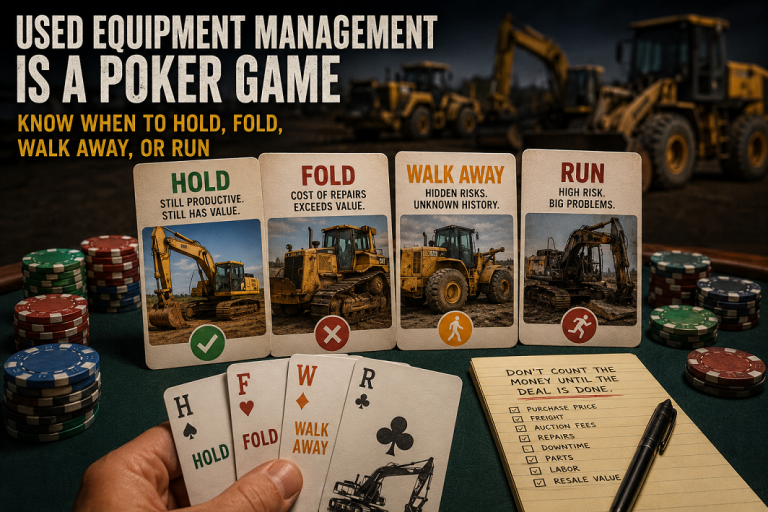
Used Equipment Buyers Should Pay Close Attention
Aftermarket support is especially important in the used equipment market.
A used machine may look like a bargain at auction or through a private sale, but if the support structure is weak, the machine can become difficult and expensive to keep running. Parts availability, dealer coverage, and aftermarket support should be part of the buying decision before the machine is purchased.
This is where many buyers make a mistake. They inspect the visible machine, review the hours, listen to the engine, check the hydraulics, look at the undercarriage, and compare the price. Those steps matter. But the buyer should also ask whether the machine can be supported after the sale.
Before buying used equipment, buyers should consider:
- Is there a strong local dealer for this brand and model?
- Are common wear parts readily available?
- Are hydraulic, engine, undercarriage, and sealing components supported by the aftermarket?
- Are rebuilt or remanufactured options available?
- Is there an active used-parts or salvage-parts market for this machine?
- Can independent repair shops work on the machine?
- Are diagnostics, manuals, and technical support realistic to obtain?
- Does the buyer have a relationship with a reliable non-OEM parts supplier?
- Will parts availability protect resale value later?
The used-parts market should not be overlooked. Used components usually come with limited warranty protection, if any. In many cases, the practical guarantee is that the part has been tested and should work when installed. After that, the risk often belongs to the buyer.
But in the real world of uptime, used parts can still be a viable support option. If a machine is down and the new OEM or aftermarket part is not available quickly enough, a tested used component may help the owner get the machine back to work.
That is one reason machine population matters. For common brands and models, there are often more aftermarket suppliers, more used-parts sources, more technicians, and more repair knowledge in the market. For rare machines with limited local population, the owner may have fewer choices. When that machine breaks, the owner may be forced to wait for a single supply channel instead of choosing between OEM, aftermarket, rebuilt, used, or local repair options.
A used machine with strong dealer support, strong aftermarket coverage, and an active used-parts market is usually a lower-risk ownership decision than a machine that depends on one narrow parts channel.
Dealer Support and Aftermarket Support Should Work Together
This should not be framed as dealer support versus aftermarket support.
The strongest ownership position usually includes both.
A good dealer provides expertise, factory connection, warranty handling, technical knowledge, major repair capability, diagnostics, field service, rental backup, and local accountability. A good aftermarket supplier provides additional sourcing options, price flexibility, availability, and support for older or high-hour machines.
Together, they create support depth.
Support depth matters because downtime rarely happens at a convenient time. A contractor may not have the luxury of waiting weeks for a backordered part. A mine may not be able to let a production machine sit. A rental company may need to turn a machine quickly. A small contractor may need to choose between repairing now, renting temporarily, or replacing the machine entirely.
The more options the owner has, the better the decision-making becomes.
The Aftermarket Is Becoming Part of Fleet Risk Management
In the past, aftermarket parts were often viewed mainly as a lower-cost alternative.
That view is too narrow.
Today, aftermarket support is increasingly part of fleet risk management. It affects repair planning, machine selection, used-equipment valuation, rebuild decisions, rental backup, and replacement timing.
When evaluating a machine, owners should ask:
- How expensive will this machine be to keep running?
- How quickly can I get parts?
- Am I dependent on one support channel?
- What happens when the machine is out of warranty?
- Will aftermarket support exist five or ten years from now?
- Do I have suppliers I trust before the emergency happens?
- Will parts availability help or hurt resale value?
Those questions matter as much as horsepower, bucket size, operating weight, or purchase price.
The Best Strategy Is Not OEM or Aftermarket. It Is Support Depth.
The future of heavy equipment ownership is not about choosing one side permanently.
It is about understanding the support structure behind the machine.
OEM parts, dealer service, aftermarket replacement parts, rebuilt components, independent repair networks, and rental backup all play a role. The right choice depends on the machine, the repair, the urgency, the cost, the risk, and the owner’s business model.
A newer machine under warranty may lean heavily toward OEM support. A mid-life machine may benefit from a mix of dealer service and aftermarket components. An older machine may only remain economical because aftermarket support keeps repairs realistic.
For equipment owners, the lesson is simple: do not evaluate a machine only by what it costs to buy. Evaluate it by how well it can be supported over its working life.
Aftermarket parts are becoming more important because uptime is becoming more important. Repair cost is becoming more important. Parts availability is becoming more important. And machine owners need flexibility when the first support channel is not enough.
In heavy equipment, the machine that keeps working is the machine that earns.