Buying Used Heavy Equipment at Auction: Inspection and Buyer Beware Guide
Buying used heavy equipment at auction can be one of the best ways to make money in this industry.
It can also be one of the fastest ways to lose it.
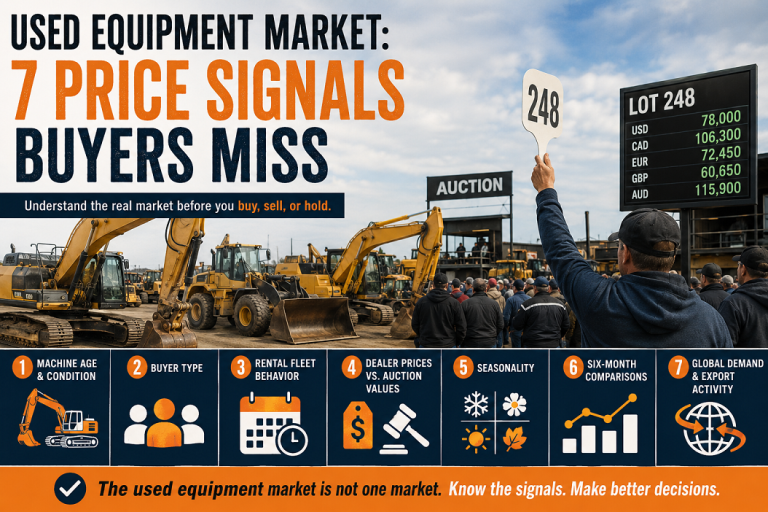
Auctions create opportunity because they bring machines, buyers, sellers, dealers, exporters, rental fleets, contractors, and speculators into the same place at the same time. A prepared buyer can find value, move quickly, and buy machines that may not be available through normal dealer channels.
But auctions are not designed to slow you down.
They are timed. They move fast. They create pressure. They make bidding feel like a competition against other buyers and against the clock. That energy is part of what makes auctions work, but it is also what causes buyers to make bad decisions.
A good auction buyer does not get caught up in the show.
A good auction buyer comes prepared, knows the machine, knows the cost, knows the freight, knows the risk, and knows the walk-away number before the bidding starts.
The goal is not just to win the bid.
The goal is to buy the right machine at a number that still makes sense after fees, transportation, repairs, downtime, and parts availability are considered.
Auction Buying Is a Discipline, Not a Guess
The best auction buyers usually know what they are looking for before they arrive.
They know the brand they are targeting. They know the model range. They know the application. They know common problems. They know what the machine is worth in their market. They know what it will cost to haul it home. They know whether they can fix it themselves or will need dealer support.
That preparation matters because auction decisions often happen quickly.
A buyer who shows up casually can be pulled into the excitement. Another bidder pushes the price. The auction clock is running. The machine looks clean. The photos looked good. It feels like the opportunity may disappear.
That is when mistakes happen.
Before bidding, a buyer should already know:
What machine they want
What comparable machines are selling for
What transportation will cost
What buyer fees apply
What immediate service may be needed
What major repairs could cost
Whether parts are available
Whether dealer or aftermarket support exists
How much risk they are willing to accept
The absolute number where they stop bidding
If the machine passes that number, let it go.
There will be another machine.
Read the Terms Before You Bid
Auction terms matter.
Before signing up or bidding, buyers should understand the fees and conditions of sale.
Many auctions charge buyer fees. Those may be flat fees, percentage-based fees, internet bidding fees, documentation fees, or other charges. A $500 or $1,000 fee may not sound large compared with the cost of a machine, but it matters when a buyer is already bidding up to the maximum number.
A percentage-based buyer premium can be even more important on larger machines.
Buyers should also understand:
Payment deadline
Removal deadline
Storage charges
Taxes
Loading rules
Transport responsibility
Title or documentation requirements
Export paperwork
Currency
Inspection limits
“As-is, where-is” terms
Dispute limits
Most auction purchases are sold as-is, where-is. That means the risk transfers to the buyer once the sale is complete.
Some platforms offer inspection reports or assurance-style programs, and those can be helpful. But buyers should read the details carefully. An assurance program is not the same thing as a dealer warranty. It may be limited by time, scope, inspection method, exclusions, and what was actually checked.
If a machine has to be hauled hundreds or thousands of miles before it is put to work, the timing of any assurance program matters. The buyer may not discover a problem until the machine arrives, is unloaded, serviced, and put under real working conditions.
That is why the terms must be understood before bidding, not after the invoice arrives.
The Hour Meter Is Only One Clue
Hour meters are useful, but they are not the whole story.
A low-hour machine may have been abused. A high-hour machine may have been well maintained. A meter may have been replaced. Electronics may have been changed. Some machines idle heavily. Some machines work hard every hour they run. Some applications are simply more severe than others.
A 5,000-hour excavator used in light site work is not the same as a 5,000-hour excavator used in rock, demolition, land clearing, quarry work, or severe underfoot conditions.
The better question is not only:
How many hours are showing?
The better question is:
Does the machine’s condition match the hours?
That means looking at wear patterns, undercarriage, pins and bushings, hydraulics, structural areas, filters, service records, leaks, repairs, paint, and overall presentation.
A machine may show low hours and still tell a different story if the wear does not match.
Check the Filters and Fluids
Filters can tell a story if the buyer takes time to look.
Many owners and mechanics write the service date or machine hours directly on filters. That can help confirm whether the visible maintenance history makes sense with the hour meter.
If a machine shows 3,000 hours, but the filter markings tell a different story, slow down.
Also pay attention when the oil looks brand new but the filters look old.
Fresh oil can be a good sign if the machine was properly serviced. But it can also hide problems. Changing oil right before auction may reduce visible contamination, metal, fuel dilution, or other signs of wear. If the dipstick looks fresh but the filters appear neglected, that inconsistency deserves attention.
Look for:
Dates written on filters
Hours written on filters
Old filters with fresh oil
Milky oil
Burnt smell
Metallic residue
Low fluids
Leaks around recently cleaned areas
Fresh paint around repair zones
Oil that looks too clean compared with the rest of the machine
No single clue proves a machine is bad.
But inconsistencies matter.
At auction, the buyer is piecing together a story. Filters and fluids are part of that story.
Appearance Matters, But It Can Mislead
Auction machines are often cleaned, painted, repaired cosmetically, or dressed up before sale.
That does not automatically mean something is wrong. Sellers want machines to present well. Buyers like clean machines. Appearance affects price.
But appearance can also hide history.
Fresh sheet metal can make a machine look better, but it can also remove evidence of damage. A dented panel may tell a story. A replaced panel may hide that story. Mismatched paint, fresh paint on one section, new doors, new side panels, or uneven paint texture can all indicate that something was changed.
Again, that does not always make the machine bad.
It means the buyer should ask why.
A machine with honest wear is sometimes easier to judge than a machine that has been made to look new.
Photos can also mislead. A machine can photograph well and still have weak hydraulics, cracked structures, worn undercarriage, bad swing components, leaks, or engine issues.
Photos are a starting point.
Inspection is where the real story begins.
Inspection Is Usually Available, But Still Limited
Most major auctions allow buyers to inspect machines before the sale. That is a major advantage, and buyers should use it.
But auction inspection is still limited.
Machines may be parked close together. There may not be room to swing an excavator safely. A dozer may not be allowed to push dirt. An excavator may not be allowed to dig. A loader may not be tested under real load. A truck may only move around the yard. Some machines may arrive late, giving buyers less time to inspect the most desirable lots.
That creates a problem.
A machine can start, move, and look good in a yard but still fail under real production conditions.
That is why auction inspection has to be intentional. Do not just walk around the machine and look at paint. Check the areas that cost money.
Undercarriage
Hydraulics
Engine
Swing system
Pumps
Final drives
Transmission
Cooling system
Structural cracks
Booms, arms, blades, buckets, frames
Filters and fluids
Service records
Leaks
Electrical systems
Attachment wear
Transportation requirements
The buyer may not be able to test everything, but they should test everything the auction allows.
Never Bid Blind on a Machine You Have Not Inspected
One of the most dangerous auction mistakes happens when a buyer sees a machine they did not plan to buy.
It looks good. The bidding is low. Nobody seems to be chasing it. The buyer takes a quick look from a distance and starts thinking they may have found a steal.
That is where auction discipline matters.
A machine that looks like a bargain may simply be priced correctly for the risk that other buyers already noticed.
Maybe it does not run. Maybe it has weak hydraulics. Maybe it needs an engine. Maybe the undercarriage is gone. Maybe the seller knows something the bidder does not. Maybe the buyers who inspected it closely already decided to stay away.
A buyer should never bid serious money on a machine they have not personally inspected or had inspected by someone they trust.
There are times when a machine sells low enough that the buyer may still recover the money later. But that does not make it a smart purchase. A cheap machine can still tie up capital, cost money to haul, require major troubleshooting, and sit for months before it is useful.
At auction, a surprise bargain is not always an opportunity.
Sometimes it is a warning.
Undercarriage Can Make or Break the Deal
Undercarriage is one of the biggest cost risks on any tracked machine.
That is true even on compact equipment. On larger dozers, excavators, crawler loaders, pipelayers, and mining machines, undercarriage can be the difference between putting the machine to work and spending tens of thousands of dollars before the machine earns a dollar.
A machine with a worn undercarriage can still be a good buy if the price reflects it.
The danger is paying good-machine money for a machine that needs major undercarriage work.
The first rule is simple: take your time.
Mud, paint, tight tracks, new sprockets, missing information, and poor access can all make an undercarriage look better than it is.
If the undercarriage is packed with mud, do not ignore it. Mud can hide roller wear, link wear, bushing condition, cracks, missing hardware, leaking rollers, idler wear, and sprocket condition. If possible, pull away enough mud to see what matters.
A tight-looking track is not always a good sign. Sometimes a track looks tight because it has been adjusted correctly. Other times, it looks tight because a worn chain has been shortened, over-adjusted, or dressed up for auction. If the undercarriage is loud, squealing, jumping, or unusually tight, slow down and look closer.
Undercarriage is too expensive to inspect casually.
Dozer Undercarriage and Excavator Undercarriage Are Different
One common mistake is checking an excavator undercarriage as if it were a dozer undercarriage.
They do not wear the same way.
Dozers travel, push, turn, and load the chain differently. Dozer bushing wear is often visible externally. Experienced buyers may feel the bushings to understand wear and whether the chain has been turned.
If the worn flat side of the bushing is facing down, the chain may not have been turned yet. But that does not automatically mean the undercarriage is good. The buyer still has to determine whether the chain has usable life left or whether it is ready for a pin-and-bushing turn.
That turn is not free. Depending on machine size, labor, and parts condition, turning pins and bushings can cost a significant portion of a new undercarriage — sometimes roughly 30% to 40% of new undercarriage cost. That is not a negligible repair, and it needs to be included in the buying number.
If the flat side is facing up, the chain may already have been turned. That usually means the undercarriage is well into its life cycle and may be at least roughly 60% worn. At that point, the buyer has to evaluate how much life remains before a full undercarriage replacement is needed.
The buyer should not just feel one bushing.
Feel several bushings across both sides. Look for uneven wear. Look for bushings that have broken through. A broken-through bushing is a serious warning sign. Once the bushing is broken through, the undercarriage may be beyond saving, regardless of whether the chain has been turned.
Also watch for individual bushings that look newer than the rest. One new bushing in an old chain may mean a repair was made, but it can also indicate that a broken bushing was replaced to improve appearance. A mismatched bushing may cause the track to jump slightly as it passes around the sprocket or idler because it no longer matches the wear level of the rest of the chain.
Excavator undercarriage is different.
Excavators often travel less than dozers, but they carry heavy shifting loads through the carbody and undercarriage as the machine digs, swings, lifts, and works over the side. Much of the wear may be internal. Feeling the outside of an excavator bushing may tell very little.
On an excavator, pay close attention to the idler position and the adjustment area. The front idler and track adjuster position can indicate internal chain wear. A new undercarriage has more adjustment room. As the chain wears internally, the idler moves forward and available adjustment decreases.
But there is a trick buyers need to understand.
A link can be removed from an excavator chain to make the track look tighter and pull the idler position back. That can make a worn chain look better than it really is. A new sprocket installed on an old chain can also improve the appearance to a lesser degree without solving the internal chain wear.
If you see a new sprocket with an old chain, be careful.
It may be an honest repair. But it may also make the undercarriage look better than it is.
Also listen to the undercarriage. On both dozers and excavators, a track that squeals badly, runs extremely tight, or sounds unusually loud may be telling you something. It could be packed with mud, over-tightened, poorly adjusted, or showing signs that a link was removed or the undercarriage was tightened to improve appearance for the sale.
Before the auction, learn how many links that machine’s track chain should have. If the machine is missing a link, that is important information.
Structural Cracks and Repairs Tell a Story
Cracks and weld repairs deserve serious attention.
On excavators, check the boom, arm, bucket, bucket linkage, stick nose, boom foot, and areas around attachment mounts. On dozers, check blade lift arms, push arms, C-frame, blade structure, trunnions, and frame areas. On loaders, check loader arms, center section, articulation area, bucket linkage, and frame.
Look for:
Cracks
Fresh welds
Plating
Short patch plates
Poor weld quality
Mismatched paint
Grinder marks
Reinforced areas
Cracks around pin bosses
Repairs near high-stress areas
Some reinforcement is normal in certain applications. Some machines may have factory reinforcement. Some attachments require additional plating. A properly repaired arm or boom may still be serviceable, and in some cases a good repair can make the structure stronger.
The issue is not simply whether there was a repair.
The issue is whether the repair was done correctly.
A full-length reinforcement plate that follows the structure and is professionally welded tells a different story than a small patch welded over a crack.
A small patch may suggest someone was trying to hide a problem cheaply.
If the crack is still visible and unrepaired, understand that structural repair can be expensive. The steel may not be the largest cost. The labor, welding skill, downtime, alignment, disassembly, and risk of future failure can be significant.
Poor structural repairs are a reason to walk away unless the price is low enough and the buyer understands the repair.
Starting Problems Are Not Always Simple
If a machine will not start, many buyers assume it has a bad battery, weak starter, bad alternator, or some minor electrical problem.
Sometimes that is true.
But a no-start machine can also hide much larger problems.
There are cases where a machine does not start because someone does not want it to run. A disconnected battery, missing fuse, unplugged relay, or simple electrical interruption can keep buyers from operating the machine and discovering weak pumps, engine blow-by, travel problems, swing issues, overheating, or other expensive problems.
That does not mean every no-start machine is suspicious.
But it does mean a buyer should not assume the problem is small.
One of the most dangerous auction mistakes happens when a buyer sees a good-looking machine they did not originally plan to buy. The machine looks clean. The bidding is low. It feels like a bargain. The buyer takes a quick walk around, assumes the problem cannot be too serious, and jumps in because they think they are stealing it.
That is not buying. That is gambling.
If the machine does not run and the buyer has not personally inspected it, tested what can be tested, reviewed the risk, and calculated the possible repair exposure, the bid should be extremely conservative or avoided altogether.
A non-running excavator may need something simple.
It may also need a pump, engine, controller, wiring repair, final drive, fuel system work, or major troubleshooting before it ever earns a dollar.
Even if the purchase price is low enough that the buyer may eventually recover the money, that does not make it a good decision. The buyer may tie up capital, spend money on transportation, lose time, and discover that the “steal” was cheap for a reason.
A machine that cannot be started should be priced as a machine with unknown engine, hydraulic, transmission, electrical, and travel condition.
If the buyer cannot test it, the bid has to reflect that risk.
Engine Blow-By Can Signal Expensive Problems
Every used diesel engine may show some signs of wear. The question is whether the wear is normal or excessive.
Blow-by happens when combustion gases pass the piston rings and enter the crankcase. Some light vapor may be normal on an older machine. Heavy blow-by can indicate worn rings, cylinder wear, poor sealing, or an engine that may eventually need major repair.
When checking the engine, look for:
Excessive crankcase pressure
Heavy vapor from the breather
Oil mist
Hard starting
Heavy smoke
Unusual engine noise
Coolant in oil
Oil in coolant
Overheating
Low power
Poor throttle response
Fresh oil hiding old problems
Black smoke can indicate fuel, air, turbo, injector, or service issues. White smoke, blue smoke, heavy blow-by, and abnormal crankcase pressure all deserve attention.
An engine overhaul can change the entire economics of an auction purchase.
If engine condition is uncertain, the bid needs to be conservative.
Hydraulics Reveal Expensive Weakness
Hydraulic problems can be some of the most expensive issues on used equipment.
At auction, a machine may perform basic functions but still have weak pumps, internal leakage, worn cylinders, valve issues, travel problems, swing weakness, or overheating under load.
Watch for:
Slow boom, arm, bucket, blade, or loader functions
Weak lifting
Cylinder drift
Noisy pumps
Hot hydraulic oil
Foam or aeration
Jerky movement
Weak travel
Weak swing
Functions slowing when used together
Leaking cylinders
Freshly cleaned hydraulic areas
Contaminated oil
Recently replaced hoses that do not match the rest of the machine
A leaking hose can be real, but it can also distract the buyer.
If a machine performs poorly and there is a visible hose leak, the buyer may assume the leak explains the weakness. Sometimes it does. But sometimes the leak becomes an excuse that hides a weak pump or larger hydraulic problem.
Do not let one visible repair item explain away poor performance too quickly.
Hydraulic pressure testing is ideal, but it is not always possible at auction. When pressure testing is not available, the buyer has to rely on operating feel, cycle speed, combined-function performance, leaks, noise, and experience.
Excavator Swing and Travel Need Special Attention
Excavators deserve specific checks because swing, travel, and carbody issues can be very expensive.
If space and auction rules allow, swing the machine carefully and safely. Do not hit nearby machines. Do not operate recklessly. But observe how the swing responds and stops.
An excavator swing brake should stop the upper structure reasonably quickly after the controls are released. If the machine keeps drifting or struggles to stop, it may indicate swing brake or swing motor issues.
The swing bearing should also be checked.
One practical field check is to position the excavator carefully, place the bucket flat on the ground, and gently lift the machine just a few inches while feeling for movement or a click between the upper structure and the carbody. The goal is not to abuse the machine. The goal is to feel whether there is excessive play.
A click or clunk does not automatically mean the swing bearing must be replaced immediately, but it is a warning sign. Swing bearing repairs can be major expenses.
Travel performance also matters.
If possible, lift one side of the machine slightly and run the track forward and backward while watching for smooth movement, jumping, hesitation, binding, weak travel, or abnormal noise. Then repeat on the other side if safe and allowed.
Excavators use significant hydraulic power to travel. Weak travel can point to travel motors, pumps, final drives, track issues, or internal hydraulic weakness.
Another useful check is to travel the machine while turning or zigzagging within safe limits. Changes in speed, weakness, hesitation, or stalling under combined movement can reveal hydraulic or powertrain issues that may not show up when the machine is sitting still.
Do Not Ignore Cooling and Electrical Systems
Cooling and electrical problems are often underestimated.
A machine can start, move, and operate for a short inspection but still overheat after working under load.
Check:
Radiator condition
Coolers
Fan
Belts
Hoses
Coolant leaks
Oil cooler leaks
Debris packed in cooling cores
Hydraulic oil temperature
Warning lights
Broken gauges
Codes
Wiring repairs
Missing panels
Loose harnesses
Battery condition
Alternator output signs
Sensor issues
Modern machines depend heavily on electronics. A sensor, controller, harness, display, or emissions-related issue can create downtime and cost that older buyers may underestimate.
Do not assume electrical problems are always minor.
Sometimes they are. Sometimes they are not.
Transportation Can Change the Deal
Transportation is part of the purchase price.
A compact machine may be simple to move. A large dozer, excavator, wheel loader, truck, drill, crane, or mining machine may require special permits, escorts, partial disassembly, multiple trucks, special trailers, or route planning.
Large machines may need the blade, bucket, counterweight, ripper, or other components hauled separately.
That matters before the bid.
A machine that looks like a good deal in the auction yard may not be a good deal after freight is added. Buyers close to the sale may be able to pay more because their transportation cost is lower. Buyers far away need to subtract transportation from the number they can pay.
Before bidding, estimate:
Hauling cost
Permits
Escorts
Oversize restrictions
Disassembly
Reassembly
Attachment transport
Loading rules
Border crossing, if applicable
Insurance
Time to move the machine
Do not figure this out after winning.
Know it before the auction starts.
Parts Availability Can Decide Whether the Deal Works
A machine may be cheap because the buyer pool is small.
Sometimes that is an opportunity. Sometimes it is a warning.
Before bidding, know whether parts are available.
Can the local dealer support the machine?
Are common parts stocked?
Are aftermarket parts available?
Are filters, seals, hoses, pins, bushings, sensors, pumps, cooling parts, final drives, and undercarriage available?
Can independent mechanics work on it?
Is the model common enough to have used parts support?
Are major components expensive or hard to find?
Is the machine locked into OEM-only repair channels?
The purchase price is only one part of the decision.
A machine that cannot be repaired quickly can cost far more than it saved at auction.
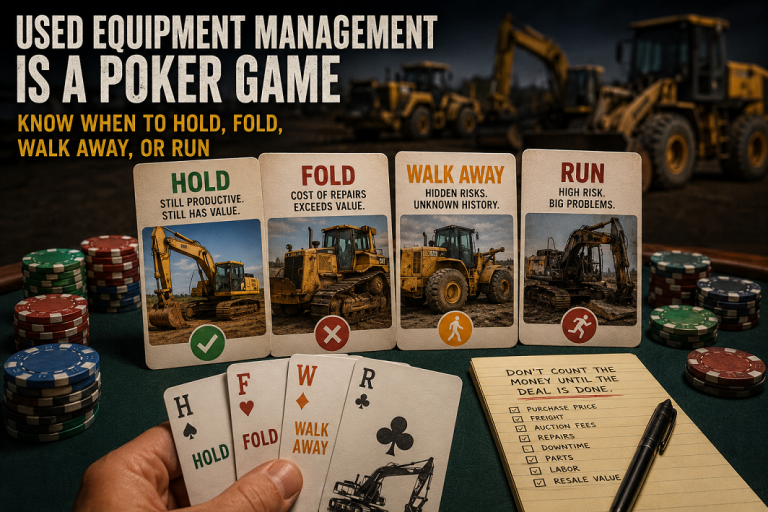
Set the Number and Walk Away
Auction discipline is simple to say and difficult to practice.
Set the number.
Stick to it.
That number should include:
Machine value
Buyer fees
Taxes
Transportation
Immediate service
Known repairs
Possible hidden repairs
Undercarriage risk
Hydraulic risk
Engine risk
Downtime
Parts availability
Resale value
Profit margin or job value
Risk tolerance
If the bidding passes your number, stop.
The auction environment is built to make buyers stretch. The machine is right there. The bidding is moving. Other buyers are competing. Nobody wants to lose.
But buying above your number does not make the machine better.
It only makes the deal riskier.
The best auction buyers are not the ones who win every machine.
They are the ones who know which machines to let go.
Auctions Are Not Bad, But They Are Different
Auctions are not the enemy.
Many excellent machines are bought at auction every year. Some come from rental fleets. Some come from contractors finishing projects. Some are late-model machines with strong history. Some are fleet reductions. Some are dealer trade packages. Some are machines that simply need the right buyer.
Auction buying can create opportunity.
But it shifts responsibility to the buyer.
A dealer-certified machine may cost more but come with inspection, documentation, support, warranty options, or dealer accountability.
An auction machine may cost less but often comes with less information and less recourse.
Both can make sense.
The key is knowing which situation you are in.
Final Takeaway
Buying used heavy equipment at auction can be one of the best opportunities in the industry, but it rewards discipline, preparation, and experience.
Do not buy only on price.
Do not trust the hour meter alone.
Do not assume fresh paint means good condition.
Do not ignore undercarriage, hydraulics, engine blow-by, swing components, structural repairs, filters, fluids, transportation, buyer fees, parts availability, or dealer support.
The auction yard can make everything feel urgent.
But the machine will still need to work after the auction is over.
The best buyers slow the process down in their own mind. They inspect carefully, calculate honestly, bid with discipline, and walk away when the number no longer makes sense.
And one final piece of auction advice rarely shows up on inspection checklists:
Do not party too hard the night before.
Used equipment auctions bring people together from across the industry, and it is easy to turn the night before into a reunion. But tired buyers and hungover buyers make expensive decisions.
Show up clear-headed.
At auction, the winning bidder is not always the buyer who got the best deal.
Sometimes the winning bidder is simply the person who accepted the most risk.
The goal is to know the difference.